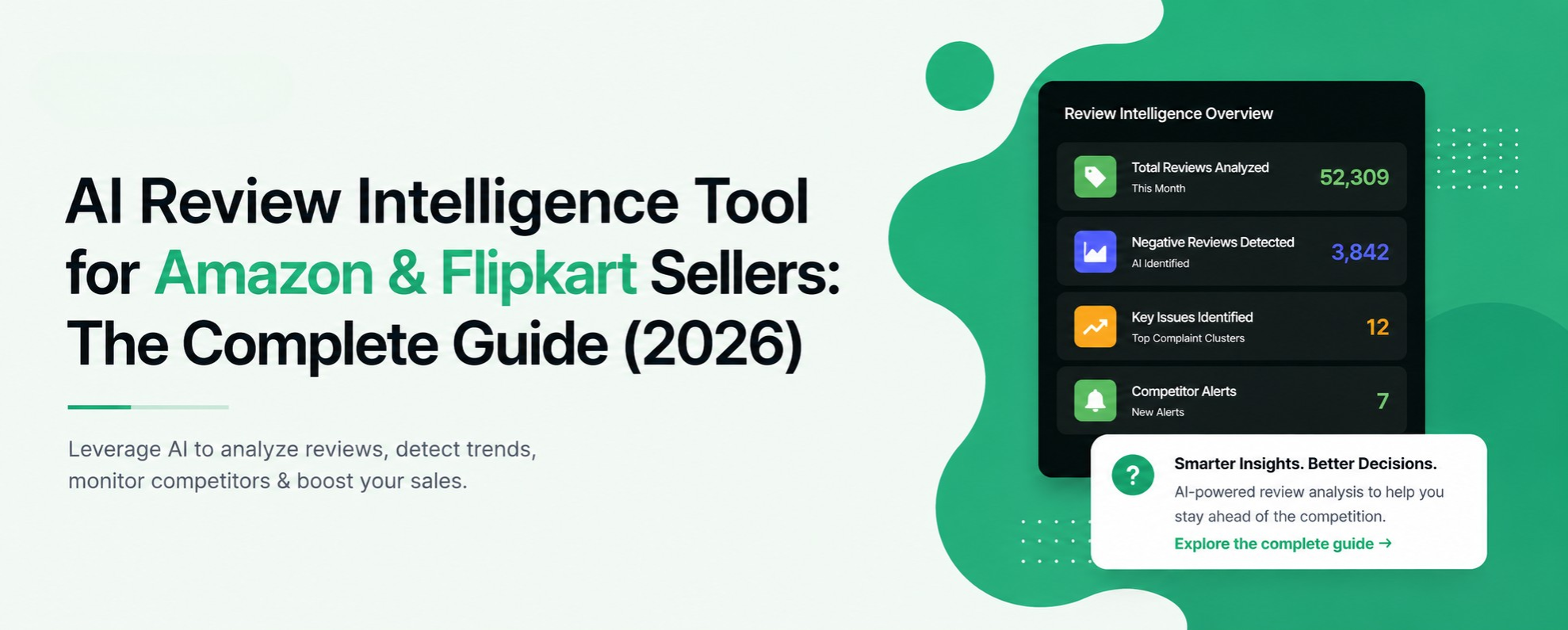
An Amazon review analysis tool reads every customer review on your listings and your competitors' listings — then tells you in plain language: what buyers consistently love, what they consistently complain about, which product features are causing returns, and what your rivals' customers wish was better. It turns 10,000 reviews you'd never have time to read into 5 specific actions you can take this week.
Why Review Intelligence Matters More Than Ever for Indian Sellers
Your Reviews Are Talking. Most Sellers Aren't Listening.
Amazon.in and Flipkart together process hundreds of millions of product reviews across categories from electronics to kirana goods. A mid-sized seller with 20 SKUs might accumulate 500 to 2,000 new reviews per month across all listings. Reading them manually takes 6 to 10 hours a week. Pattern-detecting across them takes skills most sellers don't have and time most sellers can't spare.
The result: most Indian sellers operate on a lagging, impressionistic understanding of what their customers think. They notice when a product drops to 3.8 stars. They don't notice that 34% of their 2-star reviews in the past 30 days mention 'packaging damaged' — a supply chain fix that would cost ₹12 per unit to solve and recover 0.4 rating points over 90 days.
Indian Buyers Review Differently — And That Requires India-Specific Analysis
Indian buyers write reviews in a mix of Hindi, English, and Hinglish — often in the same sentence. 'Product achha hai but quality thodi weak lagti hai' is a negative signal. A US-trained sentiment engine will either mistranslate it or simply not process it. An India-first review tool understands that 'bilkul bakwas' means the customer is furious and 'ekdum mast product hai' means they're delighted — and classifies accordingly.
Beyond language, Indian buyers review specific concerns that global databases don't capture well: courier partner complaints common on Flipkart, festive gifting suitability, size accuracy for Indian body types in apparel, and compatibility with Indian electrical standards in electronics. Review intelligence built for India flags these patterns — global tools built for Amazon.com do not.
Competitor Review Mining: The Biggest Untapped Advantage
Most sellers track their own reviews. Almost none systematically mine competitor reviews for product and positioning intelligence. This is a significant missed opportunity — because your competitors' reviews are telling you exactly what problems exist in your category that no current product is solving well.
A competitor with 800 reviews and a 3.9-star rating isn't your enemy. They're a free focus group that has already told 800 real buyers what's wrong with the current category standard. If 22% of those reviews mention 'cable too short' and your product has a longer cable, you have a positioning advantage sitting in plain sight — waiting for someone to put it in their listing title.
A Hyderabad-based seller of electric kettles was doing ₹3.8 lakh/month on Amazon.in with a 4.1-star average. After running an AI review analysis on her top-selling ASIN and 3 closest competitors, three patterns emerged: (1) Her own reviews flagged 'lid doesn't seal properly' in 19% of 1-star reviews. (2) Competitor A's reviews mentioned 'auto-shutoff doesn't work' in 28% of negative reviews — she added 'reliable auto-shutoff with safety certification' to her listing title. (3) Competitor B's buyers repeatedly mentioned 'wish it had a temperature display' — she sourced a temperature-display variant and launched it as a new SKU.
Within 12 weeks: her primary listing's rating recovered from 4.1 to 4.5 stars. The 'auto-shutoff' positioning upgrade lifted conversion rate by 11%. The temperature-display variant became her highest-margin SKU within 60 days. Total revenue moved from ₹3.8 lakh to ₹5.6 lakh/month.
AI review analysis tools for Amazon.in and Flipkart automatically process customer reviews to surface sentiment patterns, product defect signals, competitor weaknesses, and listing optimisation opportunities. For Indian D2C and growth sellers, tools built specifically for the Indian market process Hindi, Hinglish, and English reviews — delivering actionable intelligence in plain language via WhatsApp, not complex dashboards.
How an AI Review Analysis Tool Works
Modern review intelligence tools have replaced the 'read and hope you notice a pattern' workflow with a five-step automated intelligence loop:
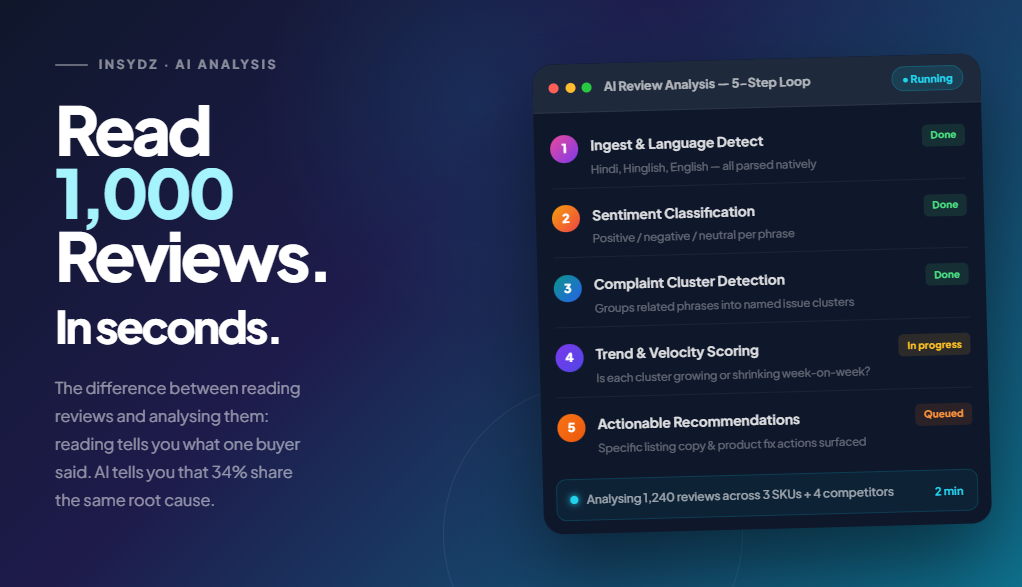
India-first review intelligence processes Hindi, Hinglish, and English reviews — not just English translations
Reviews are pulled from Amazon.in, Flipkart listings — yours and your competitors'. Each review is language-detected and processed natively in Hindi, Hinglish, or English. No forced translation that loses meaning before analysis begins.
Each review is scored positive, neutral, or negative — with sub-sentiment tags like 'delivery complaint', 'feature praise', 'value-for-money concern', and 'return intent'. The scoring model is calibrated for Indian marketplace language, not Western retail vocabulary.
Reviews are automatically sorted into issue clusters: Packaging, Durability, Value for Money, Size Accuracy, Delivery, Customer Service, Feature Request. You see exactly which cluster is driving your 1-star and 2-star reviews.
The tool runs the same process on your top 3 to 5 competitors. You see their recurring complaint patterns — the exact pain points their customers are experiencing. This is where product opportunity lives.
New negative reviews — yours or a competitor's — are flagged via WhatsApp within 60 minutes. Weekly digest: top 3 sentiment shifts across all tracked products, with specific action recommendations.
Reading reviews tells you what one buyer said. AI analysis tells you that 34% of your negative reviews share the same root cause — and that fixing it will measurably improve your rating within 8 weeks.
Core Review Signals Indian Sellers Should Be Tracking
Not all review data is equally actionable. Here are the seven signals that consistently drive the highest-impact decisions for Amazon.in and Flipkart sellers:
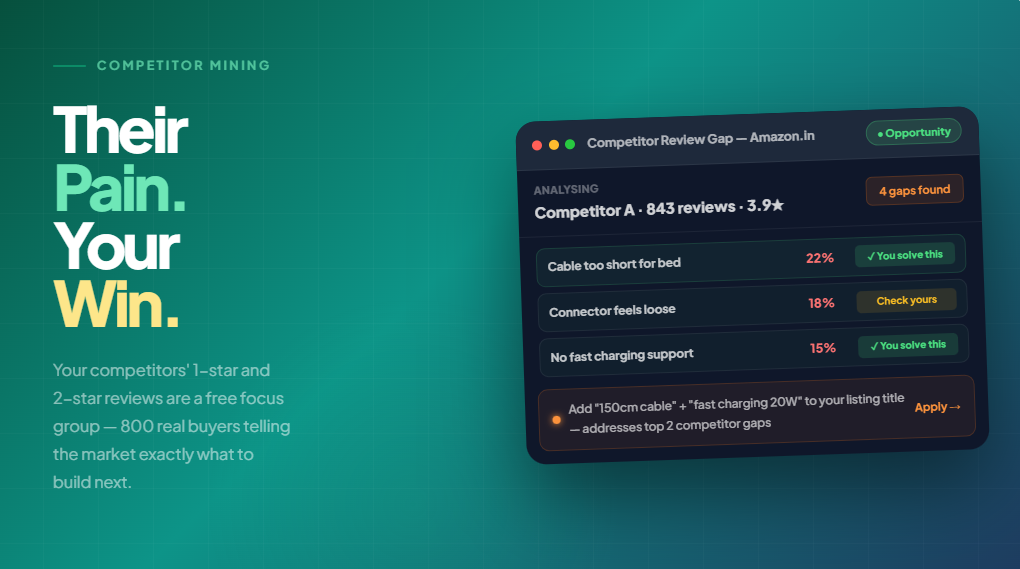
The 5-step automated review intelligence pipeline — from raw reviews to WhatsApp-delivered action recommendations
| Review Signal | What the AI Detects | What You Do With It | Revenue Impact |
|---|---|---|---|
| Durability Complaints | Products flagged as breaking, malfunctioning, or failing early | Source stronger materials; update listing to address objection proactively | Reduces return rate 8–15% |
| Size / Fit Inaccuracy | 'Smaller than expected', 'not as described', 'sizing wrong' | Update size chart; add dimensions callout image; revise bullet points | Cuts negative reviews 20–30% |
| Packaging Damage | Reviews mentioning damaged on arrival, poor packing, crushed box | Flag to logistics team; upgrade packaging materials | Protects 4-star average |
| Missing Feature Mentions | Buyers asking for a feature a competitor offers | Product roadmap input; or highlight existing feature they missed in listing copy | Conversion rate uplift 5–12% |
| Competitor Pain Points | Your rival's reviews: what their customers hate most | Your counter-messaging in listing; or source a better version of that product | Category market share gain |
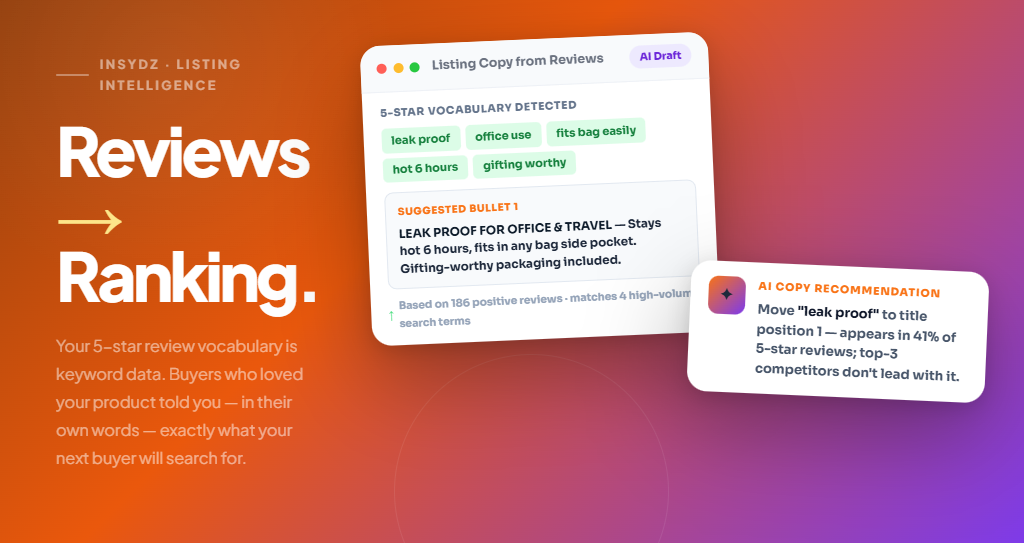
| Positive Theme Clusters | What buyers love most — in their exact words | Mirror that language in title, bullets, A+ content | CTR and CVR improvement |
| Review Velocity Drops | Sudden slowdown in new review rate | Trigger review request campaign; check if reviews are being suppressed | Maintains ranking momentum |
Manual vs. Tool vs. India-First AI: How the Options Compare
| Capability | Manual Review Reading | Global Tools (US) | Insydz AI Review Intelligence |
|---|---|---|---|
| Amazon.in Review Data | Manual only | Limited India data | Native Amazon.in |
| Flipkart Review Analysis | Manual only | Not supported | Full coverage |
| Sentiment Scoring | No — subjective | English only | Hindi + Hinglish + English |
| Competitor Review Mining | 1–2 hrs/product | Amazon.com focused | Automated, all 3 platforms |
| Feature Gap Detection | No systematic method | Basic topic clusters | AI-tagged issue categories |
| Negative Feedback Alerts | Not available | Email only | WhatsApp within 60 min |
| Recurring Complaint Trends | Manual reading only | Limited | Weekly digest, auto-flagged |
| Listing Copy Suggestions | Not available | Not available | Bullet rewrites from reviews |
| Review Velocity Tracking | Not available | Amazon.com only | Daily, WhatsApp alerts |
| Language of Insights | Your language only | English only | Hindi / English / Hinglish |
| Pricing | Your time (4–6 hrs/wk) | ₹3,300–8,300/month | ₹1,999–2,999/mo (free tier) |
5 Mistakes Indian Sellers Make With Customer Review Data
A 4.1-star average tells you nothing actionable. The number that matters isn't your average rating — it's the percentage of reviews in your worst issue category, and whether that percentage is growing. A product at 4.2 stars with 28% of negative reviews mentioning a single fixable defect is a product with a very clear, solvable problem. You can't tell the difference by looking at the number alone.
Indian sellers consistently overlook the richest source of free product intelligence: their competitors' negative reviews. Every 1-star and 2-star review on a competing product is a buyer telling the market what they wish was different. Sellers who read those reviews systematically can position against known pain points, source improved product variants, and write listing copy that directly addresses the category's most common complaints.
A single 1-star review saying 'stopped working after 3 days' is one data point — possibly an outlier. Thirty reviews in 90 days saying variants of 'stopped working early' is a product defect signal that requires supply chain intervention. Sellers who track patterns spend energy on the root causes that generate those responses in the first place.
The most direct application of review analysis is consistently under-used: mining your positive reviews for the exact language your buyers use to describe what they love, then putting that language back into your listing title, bullet points, and A+ content. Global tools built for Amazon.com miss this entirely for Indian sellers — because they don't process Hinglish review language.
Many sellers who engage with review data do a one-time audit — clean up their worst issues, update their listing, and move on. This misses the compounding value of continuous tracking. Competitor products change. New sellers enter with different defect patterns. Seasonal usage creates new complaint clusters: monsoon-related issues in apparel, AC compatibility in electronics, gifting suitability during Diwali season.
Seven review signal categories automatically detected and prioritised by Insydz AI — with action recommendations per cluster
Best Practices: Weekly Review Intelligence Execution Model
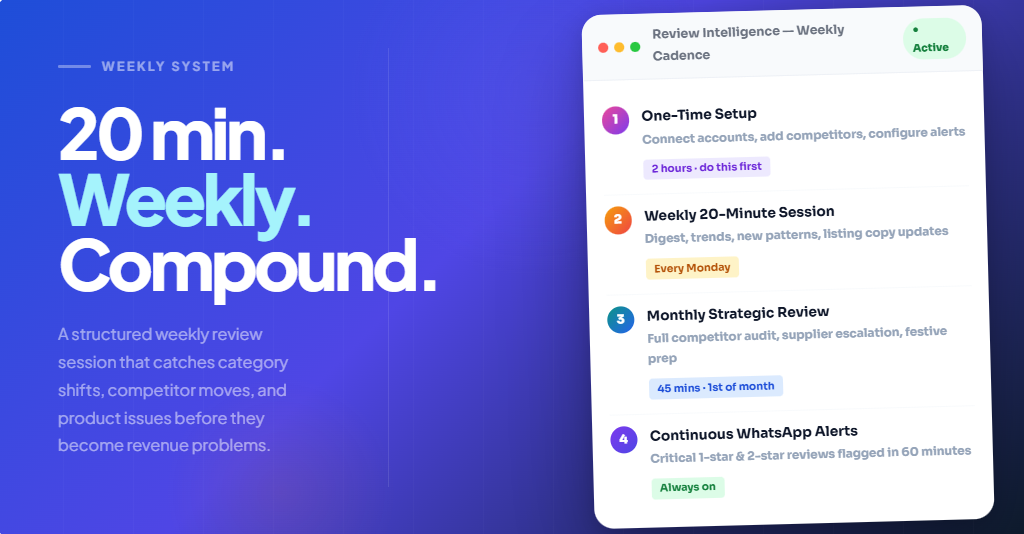
Three-phase review intelligence workflow — one-time setup, weekly monitoring, and monthly strategic review
- ✓Connect your Amazon.in and Flipkart seller accounts and add your top 10 SKUs for review monitoring
- ✓Add your top 3 to 5 direct competitors per product — their ASINs and Flipkart listing URLs
- ✓Configure WhatsApp alerts for: any new 1-star or 2-star review on your listings; new negative reviews mentioning keywords like 'broken', 'stopped working', 'wrong size'
- ✓Run an initial review audit on your top 3 SKUs — identify your top 2 complaint clusters per product
- ✓Run the same audit on your top competitors — identify their top 2 complaint clusters
- ✓Review your weekly sentiment digest — flag any complaint category that increased by more than 3 percentage points
- ✓Check competitor review velocity — is any rival accumulating reviews unusually fast? A new product launch or viral moment incoming
- ✓Review any 1-star and 2-star reviews on your listings that came in this week — is there a new pattern emerging?
- ✓Update your listing copy if a new positive theme cluster emerged — mirror the buyer vocabulary back into your bullets
- ✓Full competitor review analysis: have their complaint clusters shifted? Have they fixed the issues you were counter-positioning against?
- ✓Identify the single highest-impact product improvement from this month's review data — escalate to supplier or in-house team
- ✓Compare your listing copy against your current top positive review themes — are they aligned, or has buyer language drifted?
- ✓Plan listing updates for the upcoming festive season based on review language trends — what did buyers say after last Diwali, Big Billion Days, or Republic Day Sale?
Key Metrics to Track
Start Mining Reviews Like a Pro — Free
AI review intelligence for Amazon.in, Flipkart &. WhatsApp alerts. Hinglish-ready. Setup in under 30 minutes.
Best Review Analysis Tools for Indian Sellers in 2026
Global Tools: What They Offer and Where They Stop
Several established platforms offer review analysis as part of their broader Amazon intelligence suites — Helium 10's Review Insights, Jungle Scout's Review Automation, and dedicated sentiment platforms like Bazaarvoice and Trustpilot. For Indian sellers, an honest assessment:
| Tool | Review Analysis | India Platforms | Hinglish Support | WhatsApp Alerts | Price (INR/mo) |
|---|---|---|---|---|---|
| Manual Excel | None | Any (manual) | No | No | Free (your time) |
| Helium 10 (Review Insights) | Amazon.com only | Amazon only | No | No | ₹3,300–8,300 |
| Jungle Scout | Limited | Amazon only | No | No | ₹3,800–8,000 |
| Trustpilot / Bazaarvoice | Website reviews | Not marketplace-native | No | No | ₹8,000–25,000 |
| Insydz | AI-powered | Amazon.in + Flipkart | Yes | Yes | ₹1,999–2,999 |
Insydz: Review Intelligence Built for Amazon.in and Flipkart
Insydz approaches review analysis as a connected intelligence function — not an isolated feature. Review signals feed into the same platform as competitor pricing, keyword rankings, and market trends, so sellers see the full picture in one place rather than triangulating across tools.
Reviews are understood in the language they were written, not force-translated into English before analysis.
Platform-specific complaint patterns are tracked separately — what buyers complain about on Flipkart often differs from Amazon.in.
Automated analysis of your top competitors' reviews, with gap identification and counter-positioning recommendations.
Your own 1-star and 2-star reviews are flagged within 60 minutes — not buried in an email digest opened three days later.
Specific bullet point rewrites based on positive review language and competitor complaint counter-messaging.
Review sentiment analysis contextualised for Indian seasonal patterns: post-Diwali product reviews, Big Billion Days delivery feedback, Republic Day Sale return rates.
A review intelligence tool is only valuable if it processes the language your buyers actually write in and covers the platforms they actually buy from. For Indian sellers, that test eliminates most global options immediately.
Frequently Asked Questions
An Amazon review analysis tool automatically reads and classifies customer reviews on your Amazon.in and Flipkart listings — and your competitors' listings — to surface patterns, sentiment signals, and product intelligence you couldn't extract manually. Indian sellers need one because: (a) the volume of reviews across 10 to 20 SKUs makes manual reading impractical; (b) patterns only become visible at scale — you can't spot that 22% of your negative reviews share a root cause by reading 5 reviews a week; and (c) global tools don't process the Hindi and Hinglish reviews that make up a significant share of Indian marketplace feedback.