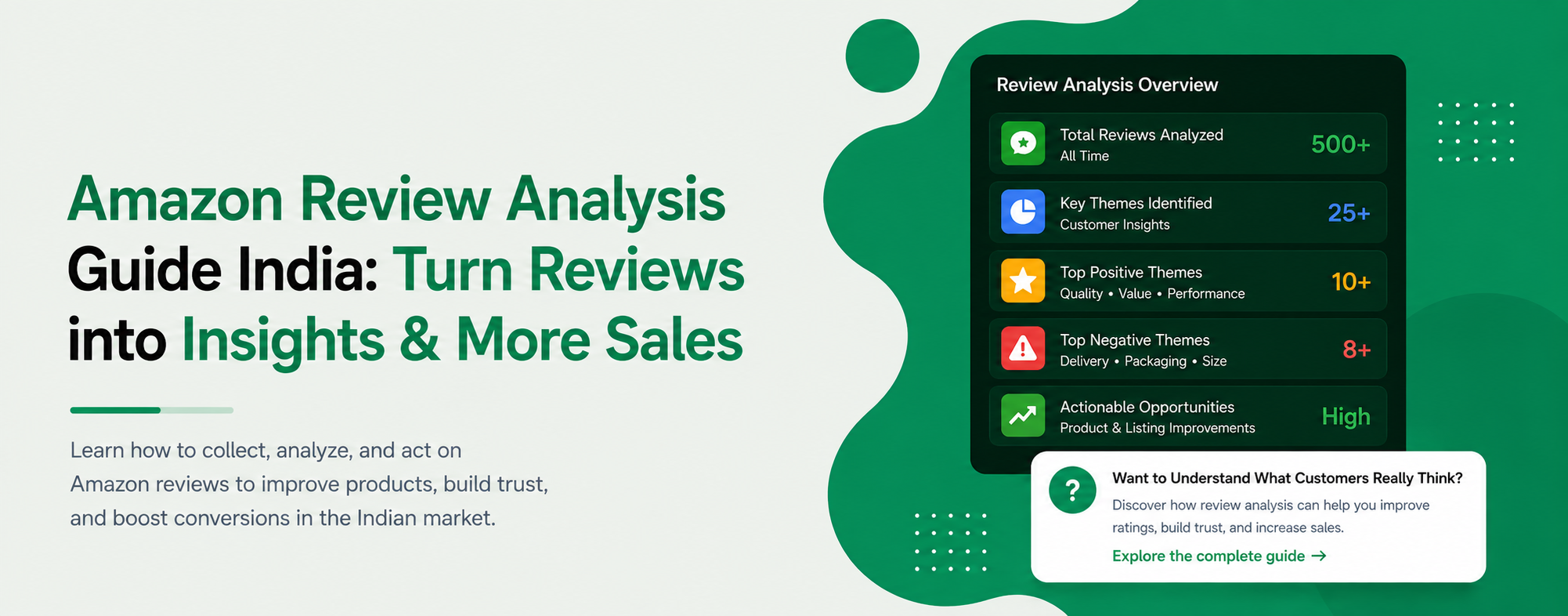
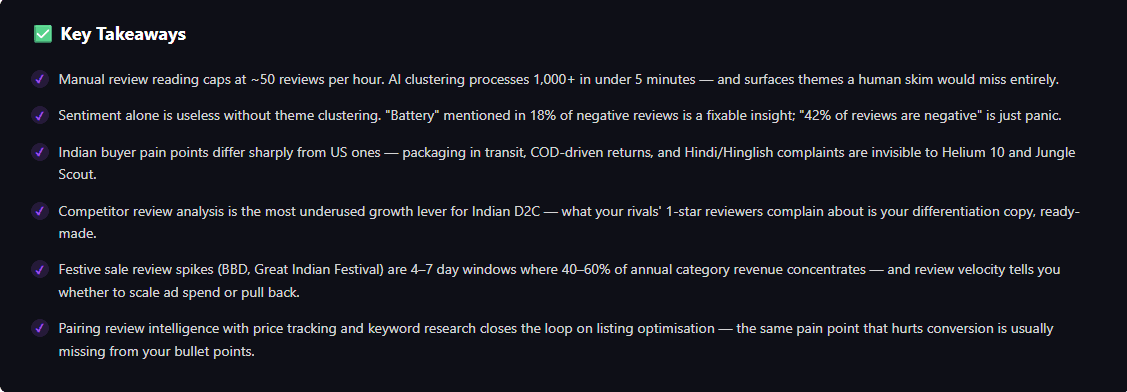
Instead of reading thousands of Amazon reviews to figure out why your conversions dropped or why returns are spiking, an Amazon review analysis tool reads them for you — clustering complaints by theme, ranking pain points by frequency and revenue impact, and flagging the exact phrases your buyers (and your competitors' buyers) keep repeating.
What is an Amazon Review Analysis Tool?
An analyze Amazon reviews tool is software that ingests every review on a product listing — yours and your competitors' — and uses NLP to extract structured intelligence: sentiment polarity, theme clusters, feature requests, recurring complaints, and language patterns. Instead of scrolling through 800 reviews and guessing, you get a ranked list of what buyers actually love, hate, and wish you'd build.
For Indian D2C sellers, the unlock is bigger than for US sellers. Indian reviewers post in English, Hindi, Hinglish, and transliterated Tamil and Telugu — and they complain about things US-trained models often miss: courier handling damage, COD-driven trial purchases that come back, GST receipt confusion, and packaging that survives a Mumbai monsoon but not a Lucknow one.
Modern tools go further than sentiment scoring. They cluster the 1,247 reviews on your wireless earbuds listing into 14 themes, rank them by how often they correlate with 1- and 2-star ratings, and tell you which three fixes would move your average rating from 4.1 to 4.4. That's review mining — and it's the fastest path from customer voice to listing copy that converts.
Why is Review Analysis Critical for Indian D2C Sellers?
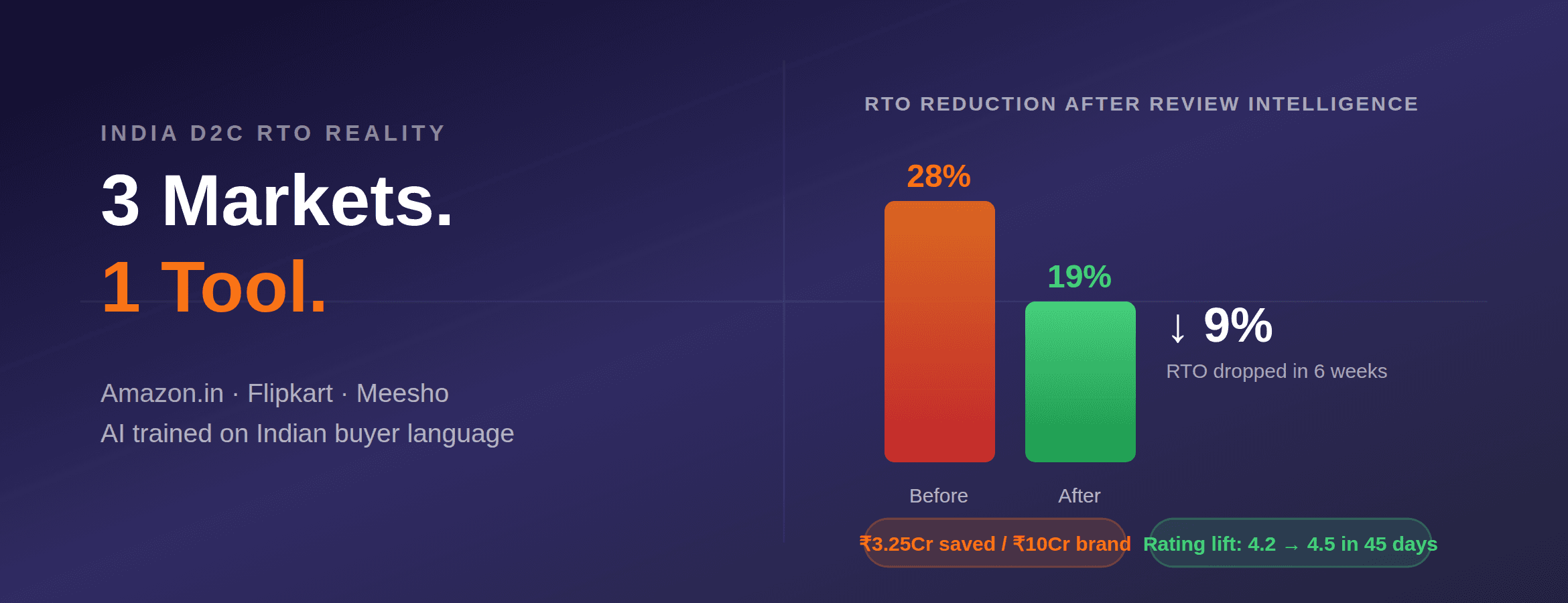
Real outcome from review intelligence: a Mumbai D2C brand cut RTO from 28% to 19% and rating climbed 0.3 points — all triggered by a single review cluster fix.
India's Returns Reality Hides in the Reviews
Indian e-commerce runs on a brutal RTO economics: return-to-origin rates of 25–35% are common for COD-heavy categories, and during festive quarters COD returns can hit 58%. A ₹10 crore D2C brand at 25% RTO loses roughly ₹3.25 crore a year to failed deliveries and returns — and a third of those returns are seeded by complaints already buried in your existing reviews.
Manual review reading misses the pattern. Your team sees individual 1-star reviews and replies one at a time. A review analysis tool sees that 22% of negative reviews from pin codes outside metros mention "package was damaged" — which means your bubble wrap spec is fine for Bangalore but not for Bareilly, and that's a packaging SKU change worth ₹40,000 per crore in retained revenue.
A Mumbai-based home appliances D2C brand was running ₹85L/month on Amazon.in with a 4.2 average. Returns hit 28%. Manual review reading turned up nothing actionable. AI clustering surfaced one theme: 31% of 1-star reviews mentioned "missing manual" — buyers in Tier 2 cities couldn't operate the product without printed instructions. They added a QR-code printed insert in eight languages. Within 6 weeks: returns dropped to 19%, rating climbed to 4.5, and conversion rate lifted 14%.
Competitor Reviews Are Your Free Differentiation Brief
Your competitors' 1-star reviews are the cheapest market research you'll ever do. When 47 buyers complain that the rival earbuds "disconnect during Wynk Music" or that a competing kurta "runs small for Indian sizing," that's not noise — that's your next ad headline, your next bullet point, your next product tweak. Most Indian sellers never read competitor reviews systematically because the volume is overwhelming. AI clustering changes the math entirely.
Festive Review Velocity Is a Real-Time Demand Signal
During Big Billion Days and Great Indian Festival, 40–60% of category-annual revenue concentrates into a 4–7 day window. Review velocity in that window — both yours and your top three competitors' — is the closest thing to a real-time demand signal you'll get on Amazon.in. A spike in negative reviews on day 2 of BBD usually predicts the exact moment a competitor will pull ad spend; that's your window to surge.
The A10 Algorithm Reads Reviews Too
Amazon's ranking algorithm factors review velocity, sentiment, and recency into rank position. Listings with declining sentiment slide silently in search results — and most sellers only notice when monthly revenue drops 15%. Continuous review monitoring catches sentiment drift on day 3, not week 8.
Amazon review analysis tools help Indian D2C sellers cluster customer sentiment by theme, identify RTO-driving complaints, mine competitor pain points, and surface festive-season demand signals across Amazon.in and Flipkart — replacing 8 hours of manual review reading with a 5-minute automated dashboard.
How Does AI Amazon Review Analysis Work?
Modern review analysis tools have replaced the manual spreadsheet workflow with an automated 5-step intelligence loop:
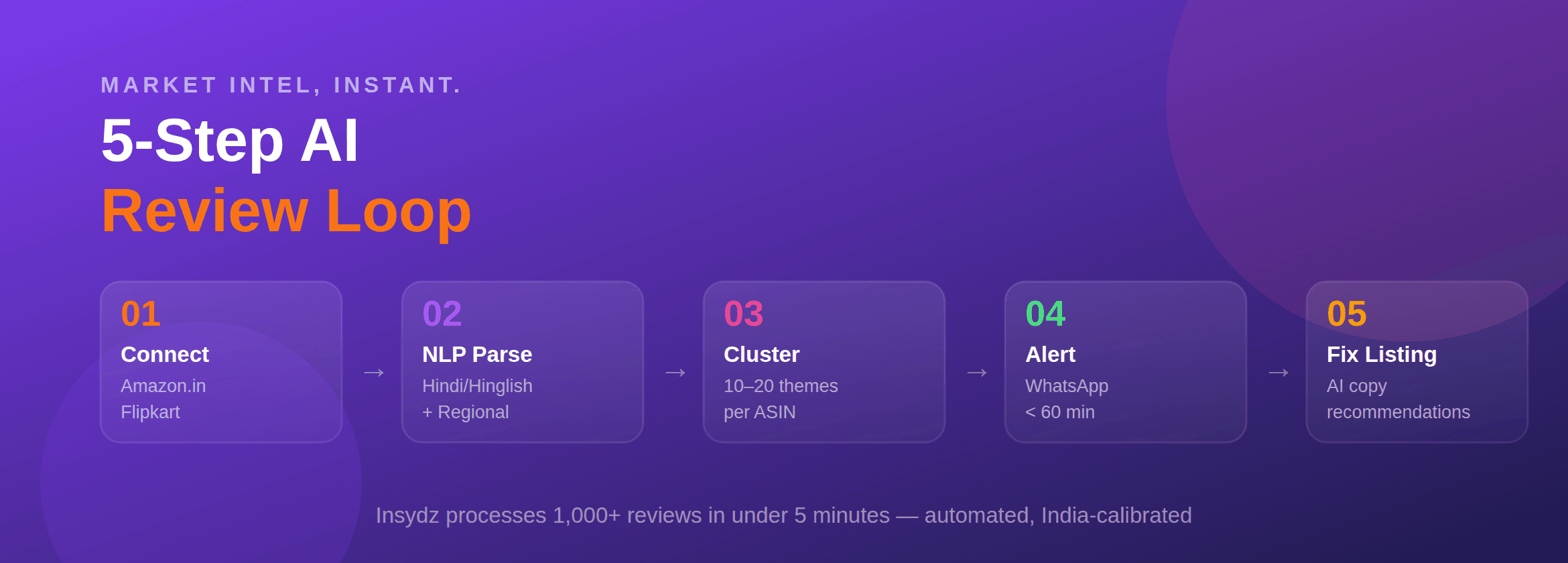
The 5-step automated review intelligence loop from ASIN connection to WhatsApp-delivered sentiment alerts and AI listing recommendations.
Connect Your Seller Account
Link your Amazon.in or Flipkart seller account and add the ASINs you want to track — yours and up to 10 competitors. The tool starts pulling all historical reviews immediately. No CSV exports, no manual data collection.
NLP Extraction & Language Handling
Each review is parsed for sentiment polarity, language (English / Hindi / Hinglish / regional transliteration), specific entities mentioned (battery, packaging, fit, delivery), and review-buyer signal (verified purchase, COD vs prepaid, location tier).
Sentiment Clustering & Theme Discovery
Reviews are grouped into 10–20 thematic clusters per ASIN — "sound quality," "packaging damage," "fit too small," "delivery delay," "COD experience." Each cluster is ranked by frequency, sentiment severity, and correlation with 1–2 star ratings.
Competitor Gap & WhatsApp Alerts
The tool benchmarks your theme clusters against the top 5–10 competitors in your category. Any new negative theme spike on a competitor — or on your own listing — triggers a WhatsApp alert within 60 minutes, with the affected ASIN, cluster name, and recommended fix.
AI Listing Recommendations
Based on the highest-impact clusters, the platform generates concrete listing edits: "Add 'water-resistant up to IPX5' to bullet 3" — addresses 14% of negative reviews. Estimated conversion lift: +9%. Estimated rating impact: +0.2." Not data — decisions.
Sentiment without clustering is theatre. Knowing "42% of reviews are negative" tells you nothing you can act on. Knowing "31% of negative reviews mention 'missing manual', concentrated in pin codes 226001–226021" tells you exactly what to fix and where.
Types of Review Insights Indian Sellers Must Track
Not all review data is equal. The clusters that move revenue are the ones tied to fixable listing or product changes — and Indian sellers using global tools usually miss the highest-conversion categories entirely.
| INSIGHT TYPE | EXAMPLE (INDIA) | VOLUME | REVENUE IMPACT | PRIORITY |
|---|---|---|---|---|
| RTO Trigger Themes | "Wrong size," "Different from photo" | High | Very High (returns) | Critical |
| Packaging & Transit | "Bottle leaked," "Box crushed" | Medium | High (Tier 2/3 specific) | Critical |
| Feature Requests | "Should have come with charger" | Medium | Medium (next SKU) | Important |
| Competitor Comparisons | "boAt is better at this price" | Low-Medium | High (positioning) | Important |
| Regional Language Pain Points | "Manual Hindi mein nahi hai" | Growing | High (Tier 2/3) | Opportunity |
| Festive-Specific Complaints | "Ordered for Diwali, came after" | Spike | Very High (BBD/GIF) | Critical |
Six review insight categories Indian sellers must track — ranked by RTO impact and competitive opportunity.
5 Common Mistakes Indian Sellers Make with Review Analysis
Each of these mistakes silently costs Indian sellers conversion, rank, and margin every week they go uncorrected.
Reading Only Your Own Reviews
Your reviews tell you what's wrong with your product. Your competitors' reviews tell you what's wrong with theirs — which is exactly what you should highlight in your listing copy. Indian D2C founders skip competitor review mining because the volume is intimidating; AI clustering makes it a 10-minute task.
Trusting US Sentiment Models on Hinglish Reviews
Tools trained on Amazon.com reviews routinely mis-classify Hinglish complaints. "Bahut bekaar product hai bhai" reads as neutral to a US-trained sentiment model. India-first NLP catches it as strongly negative — and clusters it correctly with similar regional-language complaints you'd otherwise miss entirely.
Ignoring Pin-Code-Level Patterns
Review complaints aren't evenly distributed. "Package damaged" concentrated in pin codes 700001–700099 (Kolkata) means your courier partner there is the problem, not your packaging. Sellers who don't segment review themes by location end up over-engineering products to fix a logistics issue.
Acting on Single Reviews, Not Clusters
One angry 1-star review with a long story will pull a founder into a week of product redesign. A cluster of 47 mild 3-star reviews mentioning the same minor complaint is the bigger conversion drag — and easier to fix. Volume-weighted clustering forces you to prioritise the right battles.
Not Closing the Loop With Listing Edits
Sellers analyse reviews, find insights, and never update their listings. Backend search terms, A+ content, bullet points, and the first three lines of the description should be re-written every quarter using the previous quarter's review intelligence. Sellers who don't do this leave 15–20% conversion lift on the table.
Review Analysis Methods Compared
| METHOD | SPEED | INDIA DATA | ACTIONABILITY | COST |
|---|---|---|---|---|
Manual Review Reading | 8–12 hrs | Partial (skim only) | Low — anecdotal | 3–4 hrs/week labour |
ChatGPT + CSV Export | 2–3 hrs | Limited (US bias) | Medium — one-shot | ₹0–₹1,500/mo |
Global SaaS (Helium 10) | 1 hr | No Flipkart, US sentiment | Medium | ₹4,000–8,000/mo |
India-First AI (Insydz)Recommended | < 5 min | Amazon.in + Flipkart + Hinglish | High — actionable AI | ₹1,999–2,999/mo |
Review analysis methods compared — sorted by speed, data fit for India, and actionability of output.
Every week without structured review analysis is a week of buyer complaints silently bleeding into rank position, ad spend, and RTO — while your competitor's analyst spots the same patterns and moves first.
Best Practices: Weekly Execution Model for Indian D2C Sellers
The Indian D2C founders who get the most out of review analysis don't run it as a quarterly project. They build a daily–weekly–monthly rhythm that compounds insights into listing edits without requiring a dedicated analyst.
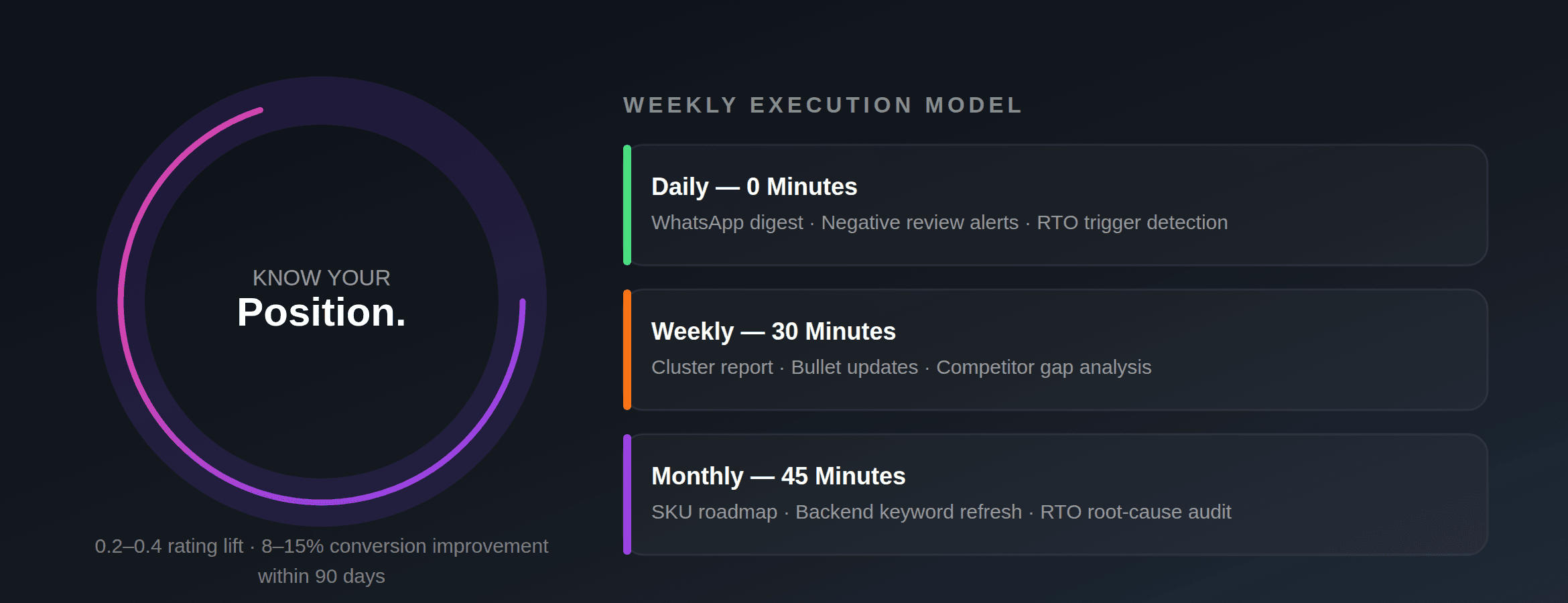
The Daily-Weekly-Monthly rhythm for high-growth Indian D2C brands: turning review signals into listing updates and SKU roadmaps.
Daily — Automated (0 minutes of your time)
WhatsApp digest: top 3 sentiment shifts across tracked ASINs
Negative review alerts — any 1-star with verified purchase + photo evidence
Competitor review velocity — sudden spikes signal pricing or stock issues
RTO-trigger theme detection — if "wrong size" mentions jump 20%, alert fires
Weekly — 30-Minute Review Session
Full sentiment cluster report — top 5 themes ranked by revenue impact
Update bullet points on 1–2 ASINs using AI-generated recommendations
Check competitor gap report — what their reviewers complain about that you can fix
Identify out-of-stock competitors — review velocity drops are a leading indicator
Adjust A+ content for next week using cluster-driven copy
Monthly — Strategic Audit (45 minutes)
Review-driven SKU roadmap — which clusters point to next product launch?
Backend keyword refresh — top reviewer phrases added to ASIN search terms
RTO root-cause review — pin-code-segmented complaint themes vs returns data
Competitor feature gap — what they ship that buyers ask you for in your reviews
Key Metrics to Track Monthly
Negative Theme Concentration
What % of negative reviews are driven by your top 3 clusters? Target: keep below 50%. Above that means one fix will move the needle.
Sentiment Drift (90-day)
Direction of average rating across rolling 90 days — leading indicator of rank changes 4–6 weeks later.
Competitor Pain-Gap Count
How many themes your competitor's buyers complain about that your product solves but your listing doesn't say. Target: under 3.
Listing Edit Velocity
Number of bullet/A+ updates per ASIN per quarter driven by review insights. Target: minimum 4.
RTO–Review Correlation
% of returned orders whose pain point was already mentioned in reviews 30+ days prior. Target: under 15%.
Hinglish Coverage Rate
% of reviews correctly classified by your tool when written in Hinglish or transliterated regional languages. Target: above 90%.
Mine 1,000+ Reviews in Under 30 Minutes — Free
Connect Amazon.in & Flipkart. Get your first sentiment-cluster report today. WhatsApp alerts on negative theme spikes included.
Best Tools for Amazon Review Analysis in India (2026)
Why Global Tools Underperform for Indian Sellers
Helium 10's Review Insights and Jungle Scout's review tools were built around Amazon.com sentiment patterns and English-only review text. Adapting them for India means your sentiment scores get distorted by Hinglish reviews flagged as neutral, your Flipkart reviews are simply absent, and your RTO-driving complaints — which look very different from the US returns profile — get clustered under the wrong themes.
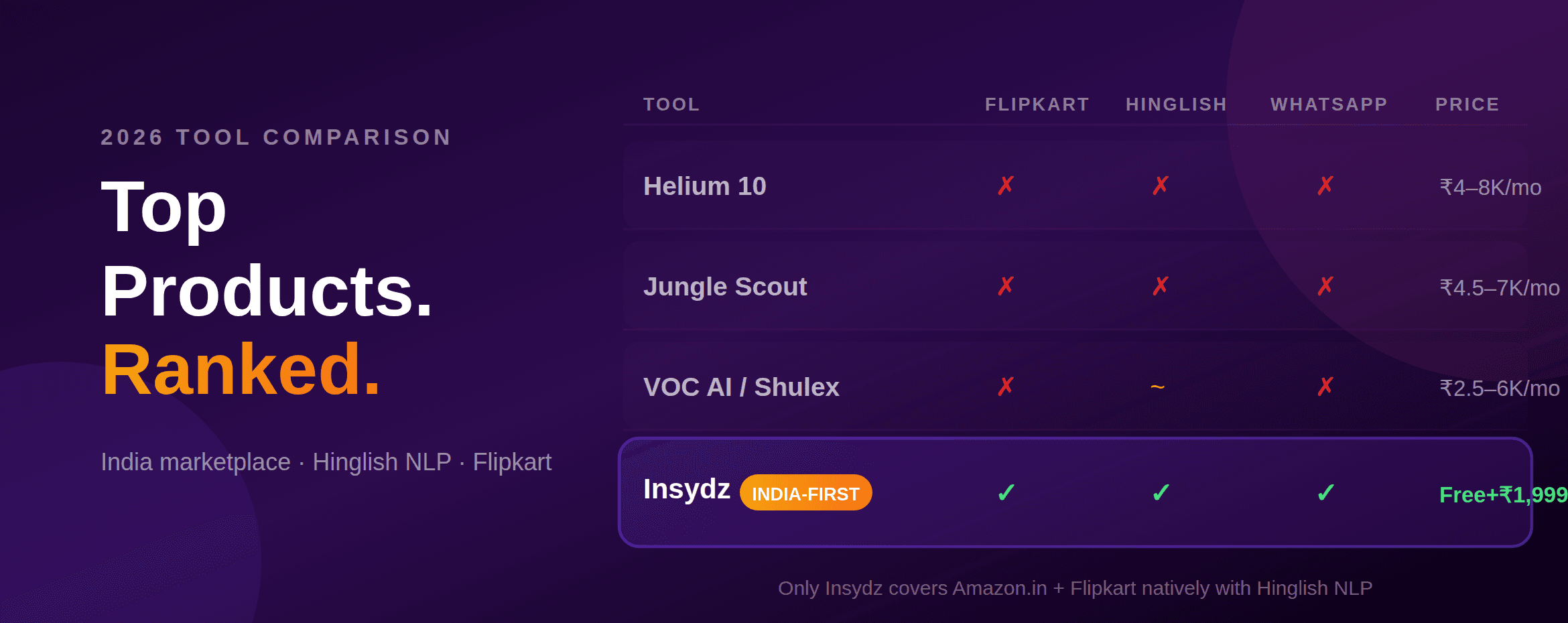
2026 tool comparison for Indian D2C sellers — only Insydz provides native Flipkart coverage, Hinglish NLP, and WhatsApp alerts in one platform.
| TOOL | AMAZON.IN | FLIPKART | HINGLISH NLP | WHATSAPP ALERTS | PRICE (INR/MO) |
|---|---|---|---|---|---|
| Helium 10 | Partial | No | No | No | ₹4,000–8,000 |
| Jungle Scout | Partial | No | No | No | ₹4,500–7,000 |
| VOC AI / Shulex | Yes | No | Limited | Email only | ₹2,500–6,000 |
| Insydz INDIA-FIRST | Yes | Yes | Native | < 60 min | ₹1,999/mo + Free |
Full Capability Comparison — India Market
| CAPABILITY | MANUAL + CHATGPT | GLOBAL TOOLS (US-FIRST) | INSYDZ (INDIA-FIRST) |
|---|---|---|---|
| Amazon.in Native Reviews | Manual export | Partial — US-primary | Native Amazon.in |
| Flipkart Review Tracking | Manual only | Not supported | Full coverage |
| Hindi / Hinglish NLP | Hit or miss | English only | Native + transliteration |
| Sentiment Clustering | Prompt-by-prompt | Template themes | Auto + custom themes |
| Competitor Review Mining | Manual collection | Limited ASINs | Up to 10 competitors |
| RTO Trigger Detection | Not possible | Not built for it | India-calibrated AI |
| WhatsApp Sentiment Alerts | None | Email only | Within 60 min |
| Festive Review Intelligence | Manual | Not available | BBD, GIF, Diwali tuned |
| AI Listing Recommendations | Manual rewrite | Generic copy | Per-ASIN, per-cluster |
| Pricing | Your time + ChatGPT | ₹4,000–8,000/mo | Free–₹1,999/mo |
Full Amazon.in + Flipkart review database
Reviews tracked natively on both platforms — not estimated from Amazon.com. Flipkart review coverage is unique to India-first tools.
Hindi & Hinglish sentiment classification
Regional language reviews, transliterated Hindi complaints, and Hinglish product feedback are clustered correctly — not filtered out as "low confidence" like US-trained models do.
RTO trigger theme detection
"Wrong size," "different from photo," "packaging damaged," "COD courier rude" — the four highest-converting RTO drivers are detected and scored automatically per ASIN.
WhatsApp sentiment alerts within 60 minutes
Any negative theme spike on a tracked ASIN — yours or a competitor's — triggers a WhatsApp alert with the cluster name, sample reviews, and a recommended listing fix.
AI listing recommendations
For each top sentiment cluster, the platform generates the exact bullet point or A+ copy edit to test — no guesswork, no duplication.
Festive-tuned review intelligence
Pre-festive review audits surface seasonal complaint themes specific to Big Billion Days, Great Indian Festival, Diwali, and Republic Day Sale — three weeks before the revenue window opens.
If you're an Indian D2C seller on Amazon.in or Flipkart and you're still reading reviews manually — or running them through ChatGPT one CSV at a time — you're optimising on guesswork. The question isn't whether you need a review analysis tool — it's which one is built for your market and your budget. For most Indian D2C sellers, the answer is clearly an India-first platform.