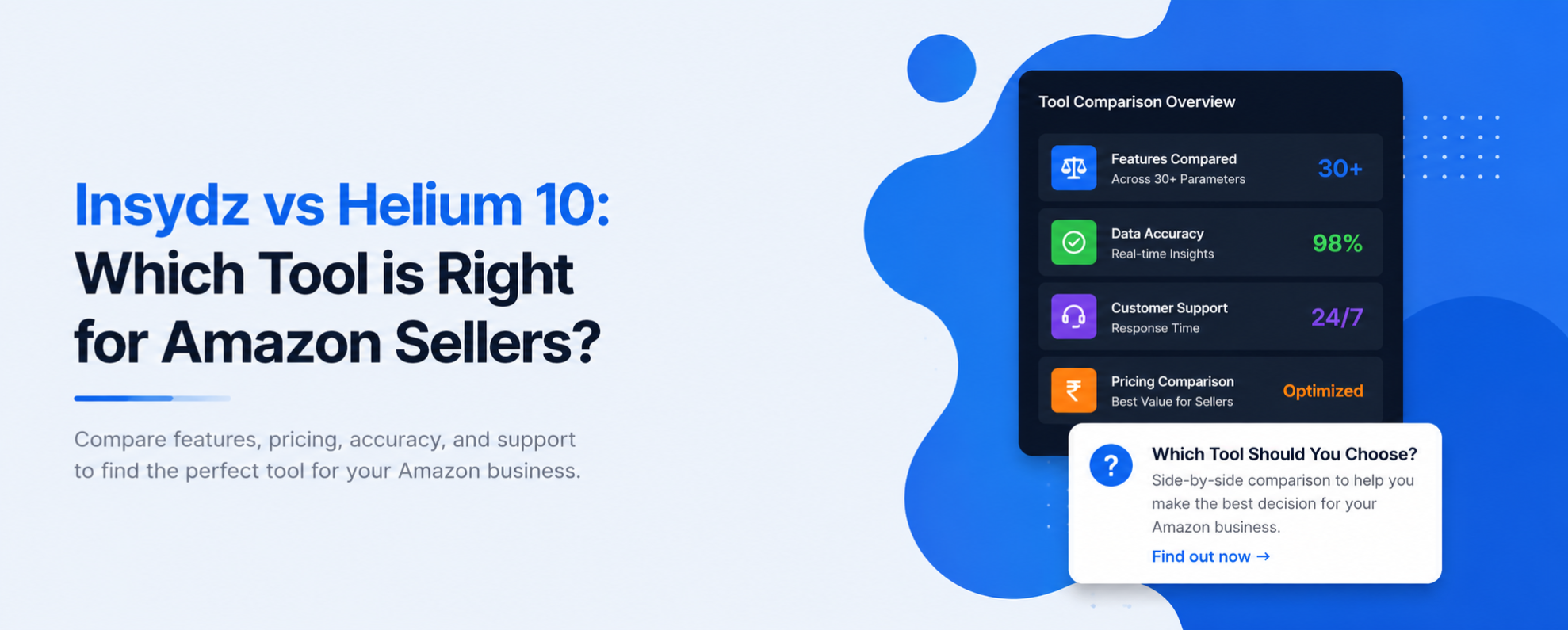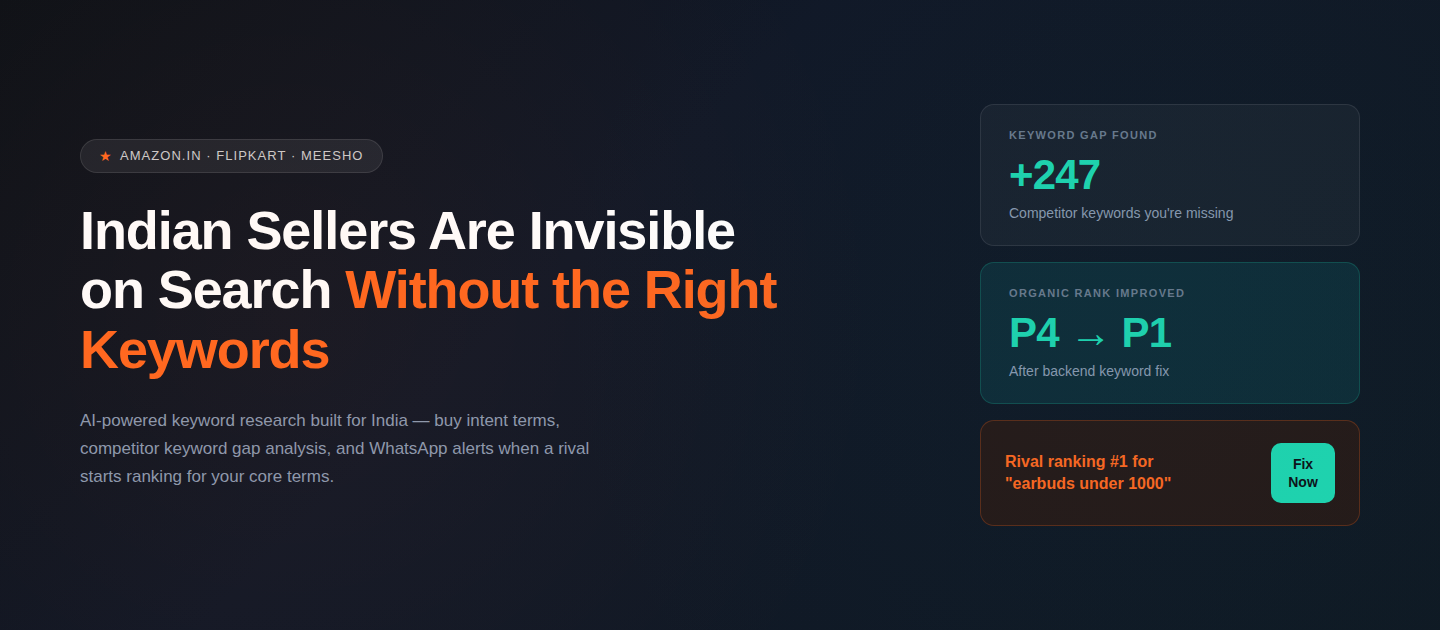
Instead of guessing which keywords to put in your product title and backend fields, an amazon keyword research tool tells you precisely which terms drive actual sales on Amazon.in right now including the hidden buy-intent terms your competitors are ranking for and you've never even thought of.
What is Amazon Keyword Research for India?
The best amazon keyword research tool india is software that identifies the exact search terms Indian buyers type into Amazon.in and Flipkart before purchasing and reveals which of those terms your competitors are ranking for that your listing currently doesn't target. This is called keyword gap analysis, and it's the fastest route to organic rank improvement available to any Indian seller.
Unlike generic global tools built for US or European marketplaces, India-focused keyword research accounts for regional language intent, rupee-based price-search patterns, and platform-specific search behaviour on Amazon.in, Flipkart simultaneously.
Here's the scale of the problem: Indian sellers on Amazon.in collectively leave an estimated ₹500–800 crore in annual organic revenue on the table simply because their listings are not optimised for the search terms their buyers are actually using. AI-powered keyword dashboards surface the exact gaps that are costing you search visibility — showing you which competitor keywords to target first, ranked by revenue impact.
Why is Keyword Research Critical for Indian Sellers?
India's Search Behaviour is Unlike Any Other Market
India's e-commerce search behaviour is unlike any other market in the world. Buyers search in Hindi transliterations, regional colloquialisms, and hyper-specific price brackets. When performing keyword research in search engine optimization for the Indian market, a buyer looking for a mobile stand might search "mobile holder for car dashboard under 300 rupees" a term with zero US equivalent and zero visibility in Helium 10's keyword database. An India-first tool surfaces this term with its actual Amazon.in search volume and competition score.
The Keyword Visibility Gap is Silent and Compounding
Most Indian sellers do keyword research once at launch and never revisit it. Meanwhile, their competitors are continuously adding new terms, capturing new search traffic, and rising in rank. By the time the revenue impact becomes visible in your seller dashboard, you've already lost 3–6 months of compounding organic traffic to a better-optimised listing that captures amazon competitor keywords you are missing.
A Pune-based mobile accessories seller was doing ₹2.8 lakh/month on Amazon.in. A competitor entered the same category and captured the "fast charging cable type c" keyword cluster 14 related search terms with a fully optimised listing. The Pune seller's revenue dropped to ₹1.1 lakh within 8 weeks. The competitor wasn't cheaper or better reviewed they were simply found first on 14 searches the original seller had never even tracked.
Amazon's A10 Algorithm Penalises Keyword-Thin Listings
Amazon's ranking algorithm factors keyword relevance across product title, bullet points, description, backend search terms, and even Q&A sections. A listing missing 40 relevant backend keywords is algorithmically invisible for those search terms regardless of its price competitiveness or review score. Backend keyword fields on Amazon.in are underused by 80% of Indian SMB sellers. Fixing this alone with the right India-specific terms can lift organic rank by 2–3 positions on multiple search queries simultaneously.
The Festive Season Keyword Window is Worth Months of Revenue
During Big Billion Days and Great Indian Festival, 40–60% of annual e-commerce revenue concentrates into 4–7 days. Sellers who rank for festive search terms on Day 1 win disproportionately. A seller missing "Diwali gift set under 500" or "gifting hamper for office" in their backend fields on October 1st loses those searches entirely because listing optimisation changes take 2–3 weeks to index and influence rank.
Amazon keyword research tools help Indian sellers identify which search terms drive buyer traffic on Amazon.in and Flipkart, reveal competitor keyword gaps, and recommend backend optimisation fixes especially critical for sellers managing 10–100 SKUs without a dedicated SEO analyst.
How Does Amazon Keyword Research Work?
Modern tools have replaced the manual spreadsheet workflow with a 5-step automated intelligence loop:
The 5-step automated keyword intelligence loop from ASIN connection to WhatsApp-delivered rank drop alerts and AI listing recommendations
Link your Amazon.in or Flipkart seller account and add the ASINs you want to track. The tool begins pulling your current keyword rank positions immediately no manual setup required.
The tool identifies your top 5–10 competitors by category and crawls every keyword they rank for including long-tail, buy-intent, and regional language variants. This forms the basis of your keyword gap report.
Each keyword is scored by monthly search volume, competition density, and buyer intent signal separating high-value 'buy now' terms from low-value browsing terms. India-specific data, not US benchmarks.
You receive a WhatsApp alert the moment your rank drops more than 3 positions on a tracked keyword, or when a competitor enters a keyword cluster you're currently winning.
The platform delivers a concrete fix: 'Add "fast charging type c 2m" to your product title and backend field 3. Estimated rank improvement: P14 → P4. Monthly traffic gain: +520 clicks.' Not data decisions.
Keyword data without ranking context is useless. Knowing a term has 12,000 monthly searches means nothing if you're already ranking P2 for it. The gap terms your competitors rank for and you don't is where your growth actually lives.
Types of Amazon Keywords Indian Sellers Must Track
Buy Intent Terms and Price Bracket Keywords deliver the highest conversion rates yet are the most commonly missed by Indian sellers optimising with global tools. Here's the full taxonomy every India seller needs to cover:
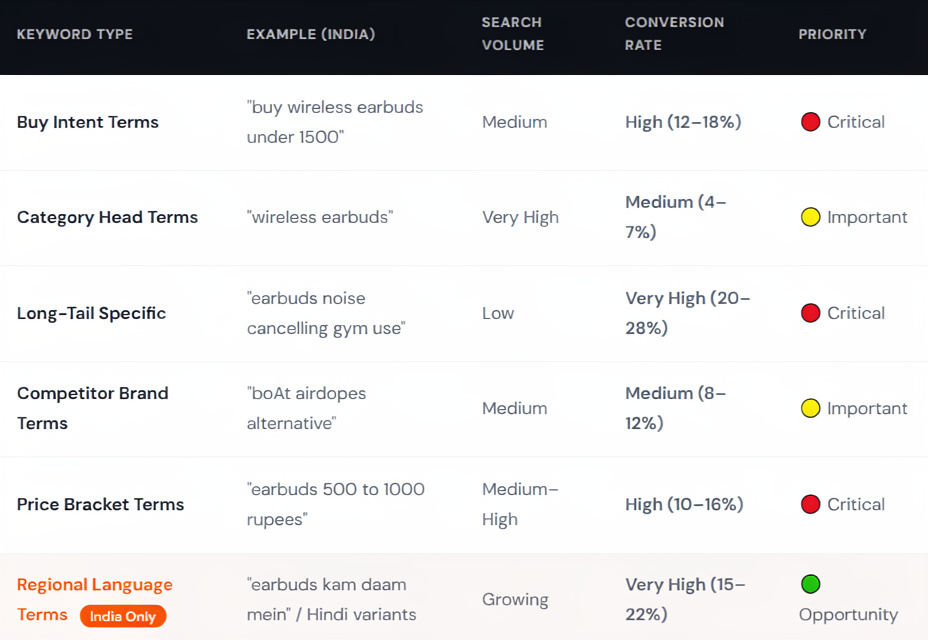
Six keyword categories Indian sellers must track ranked by conversion rate and competitive opportunity
5 Common Mistakes Indian Sellers Make with Keyword Research
Each of these mistakes silently costs Indian sellers ranking positions and therefore revenue every week they go uncorrected.
Helium 10 and Jungle Scout pull search volume from Amazon.com not Amazon.in. A term with 40,000 monthly searches in the US might have 800 searches in India, and the inverse is equally true for India-specific terms. Using US data means you're optimising for the wrong market entirely.
Indian buyers are highly price-conscious searchers. Terms like "under 999," "below 2000," and "best budget" are high-intent commercial modifiers that dramatically improve conversion rates yet most Indian sellers never include price-bracket terms in their backend keyword fields.
Search trends on Amazon.in shift seasonally, festival to festival, and as new competitors enter categories. A keyword strategy built in January is partially obsolete by Diwali. Sellers who don't continuously update their keyword sets lose ground silently, one rank position at a time.
Amazon provides 250 bytes of backend search terms per ASIN invisible to buyers, visible to the algorithm. Most Indian SMB sellers either leave these fields empty or copy-paste their product title, wasting the entire field on duplicate terms. This is one of the easiest rank wins available and almost no one uses it correctly.
Knowing you're ranked P7 for "office chair" tells you where you are. Knowing your top competitor just started ranking P2 for "lumbar support chair work from home" a term you haven't even added to your listing tells you where you're about to fall behind. Competitor keyword monitoring is the difference between reactive and proactive SEO.
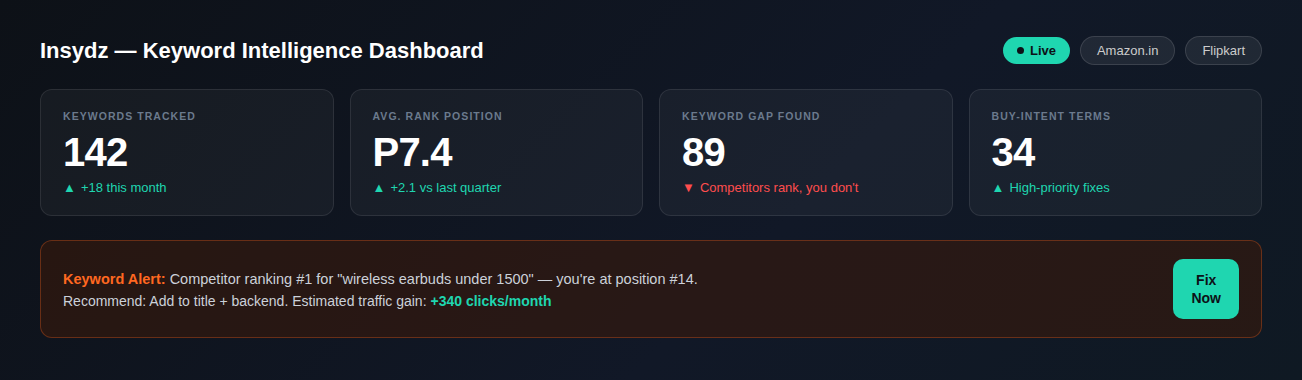
Keyword gap analysis view each gap sorted by estimated monthly traffic loss, with backend field recommendations per ASIN
Best Practices for Indian Sellers: Weekly Execution Model
The most successful Indian sellers don't do keyword research in one-time sprints they run a structured weekly rhythm that keeps their listings consistently competitive without manual effort. Daily automated digests, weekly 30-minute reviews, and monthly strategic audits keep your keyword strategy compounding without requiring a full-time SEO analyst.
- ✓Morning WhatsApp digest: top 5 rank changes across tracked ASINs
- ✓Act on Critical Rank Drop alerts any position loss of 5+ spots on buy-intent keywords
- ✓Competitor new keyword entry alert know when a rival starts ranking for a new term in your category
- ✓Buy Box status for top 10 SKUs rank and visibility combined
- ✓Full keyword gap report identify top 10 gaps between your rank and competitor rank
- ✓Update backend fields on 2–3 ASINs using AI-generated recommendations
- ✓Check new buy-intent terms emerging in your category this week
- ✓Identify out-of-stock competitors their keyword positions are temporarily vulnerable
- ✓Adjust 1–2 listing titles using AI recommendations from rank movement data
- ✓Keyword coverage audit before festive season are all seasonal terms in your backend fields?
- ✓New product gap analysis report which keyword clusters have high volume and low competition right now?
- ✓Revenue impact review compare organic traffic and conversion before vs after last month's keyword updates
- ✓Competitor new product keyword sets what terms are rivals' new launches targeting?
Key Metrics to Track Monthly
Find Your Keyword Gaps in Under 30 Minutes Free
Connect Amazon.in & Flipkart. Get your first keyword gap report today. WhatsApp rank alerts included.
Best Tools for Amazon Keyword Research in India (2026)
Why Global Tools Fall Short for Indian Sellers
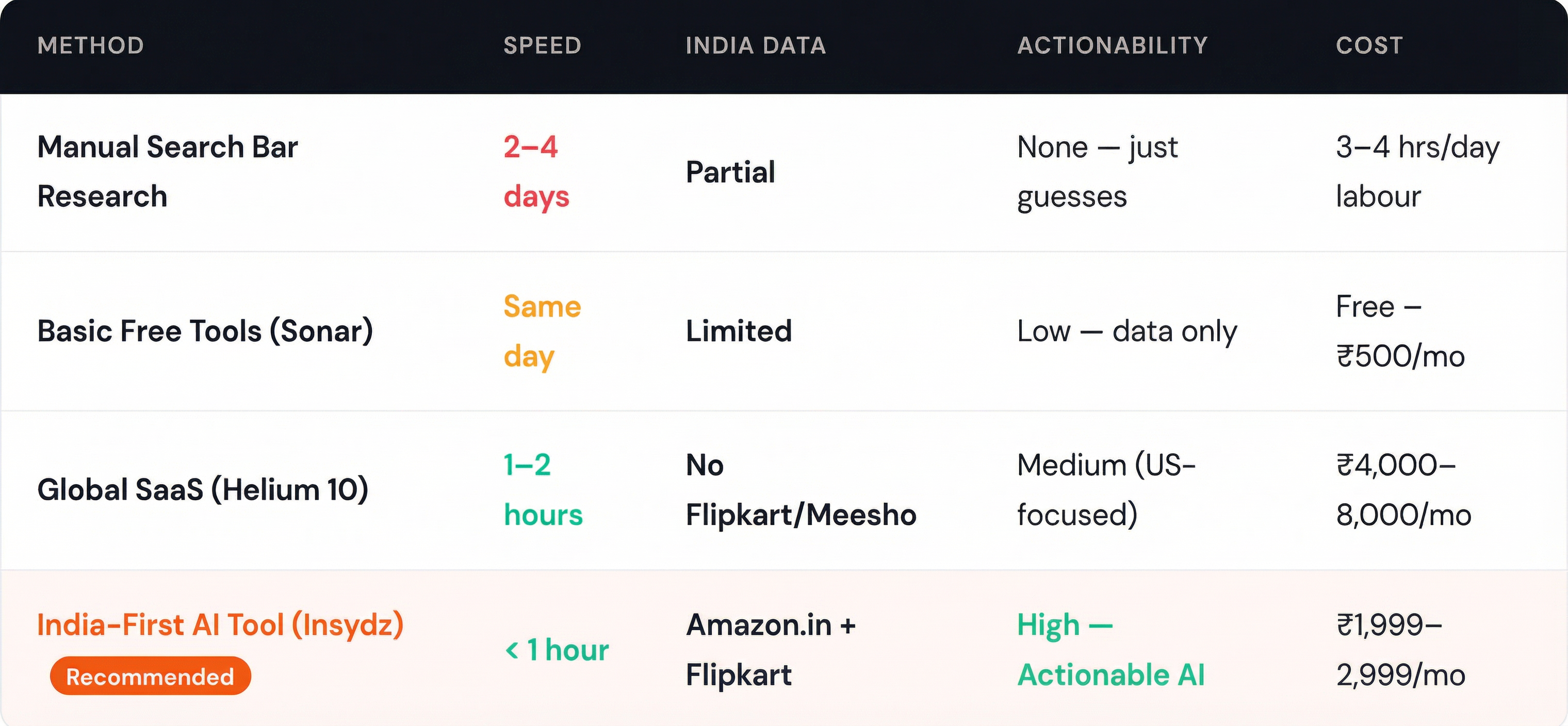
Not all tools are built equally and for Indian sellers, the platform choice is critical. Global tools like Helium 10 and Jungle Scout are built for Amazon.com. Their keyword databases, search volume data, and intent models are calibrated for US buyers. Adapting them for India means working with the wrong baseline US search volumes for Indian ASINs, no Flipkart coverage, and no understanding of Hindi or price-bracket search patterns that define Indian buyer behaviour.
| Tool | Amazon.in | Flipkart | WhatsApp Alerts | Buy Intent Data | Price (INR/mo) | |
|---|---|---|---|---|---|---|
| Helium 10 | Partial | No | No | No | US Only | ₹4,000–8,000/mo |
| Jungle Scout | Partial | No | No | No | US Only | ₹4,500–7,000/mo |
| Sonar (Free) | Yes | No | No | No | Basic | Free |
| Insydz ✦ | Yes | Yes | Yes | Yes | AI-Powered | ₹1,999/mo + Free |
Full Capability Comparison India Market
| Capability | Manual Research | Global Tools (US-first) | Insydz India-First |
|---|---|---|---|
| Amazon.in Keyword Data | Manual only | Partial — US-primary | Native Amazon.in |
| Flipkart Keyword Tracking | Manual only | Not supported | Full coverage |
| Competitor Keyword Gap Analysis | 2–4 days/ASIN | Amazon.com focused | Automated, <1 hour |
| Buy Intent & Price Bracket Terms | No systematic detection | US intent data | India-calibrated AI |
| Regional Language Keywords | No | English only | Hindi + Hinglish |
| Backend Field Recommendations | Manual guesswork | Basic | AI-generated, per ASIN |
| WhatsApp Rank Drop Alerts | Not available | Email only | Within 60 min |
| Festive Keyword Intelligence | Not available | Not available | BBD, GIF, Diwali data |
| Rank Tracking Frequency | Manual — whenever you check | Daily/weekly | Real-time + daily digest |
| Pricing | Your time (3–5 hrs/day) | ₹4,000–8,000/month | Free – ₹1,999/month |
Rank positions tracked natively on both platforms not estimated from Amazon.com data. Flipkart keyword coverage is unique to India-first tools.
Regional language search terms, transliterated Hindi queries, and Hinglish product descriptors are surfaced and scored by conversion intent not filtered out.
'Under 999', 'below 2000', 'best budget' modifiers are detected and scored for India-specific purchase intent the highest-conversion keyword category most sellers miss.
Any rank drop of 3+ positions on a tracked buy-intent keyword triggers a WhatsApp alert with the affected ASIN, term, and a recommended backend field fix.
For each keyword gap identified, the platform generates the exact text to add to your Amazon.in backend search terms field no guesswork, no duplication.
Pre-festive keyword audits surface seasonal search terms specific to Big Billion Days, Great Indian Festival, Diwali, and Republic Day Sale 3 weeks before the revenue window opens.
If you're an Indian seller on Amazon.in or Flipkart and you're not doing structured keyword research, you're optimising based on guesswork. The question isn't whether you need a tool it's which one is built for your market and budget. For most Indian SMB sellers, that answer is clearly an India-first platform.
Frequently Asked Questions
For Indian sellers on Amazon.in and Flipkart, the best tool is one built specifically for Indian marketplace data not adapted from a US tool. Insydz is the only platform that provides simultaneous keyword rank tracking across Amazon.in, Flipkart with WhatsApp alert delivery covering the full Indian e-commerce landscape, not just the Amazon.com data global tools are built on.