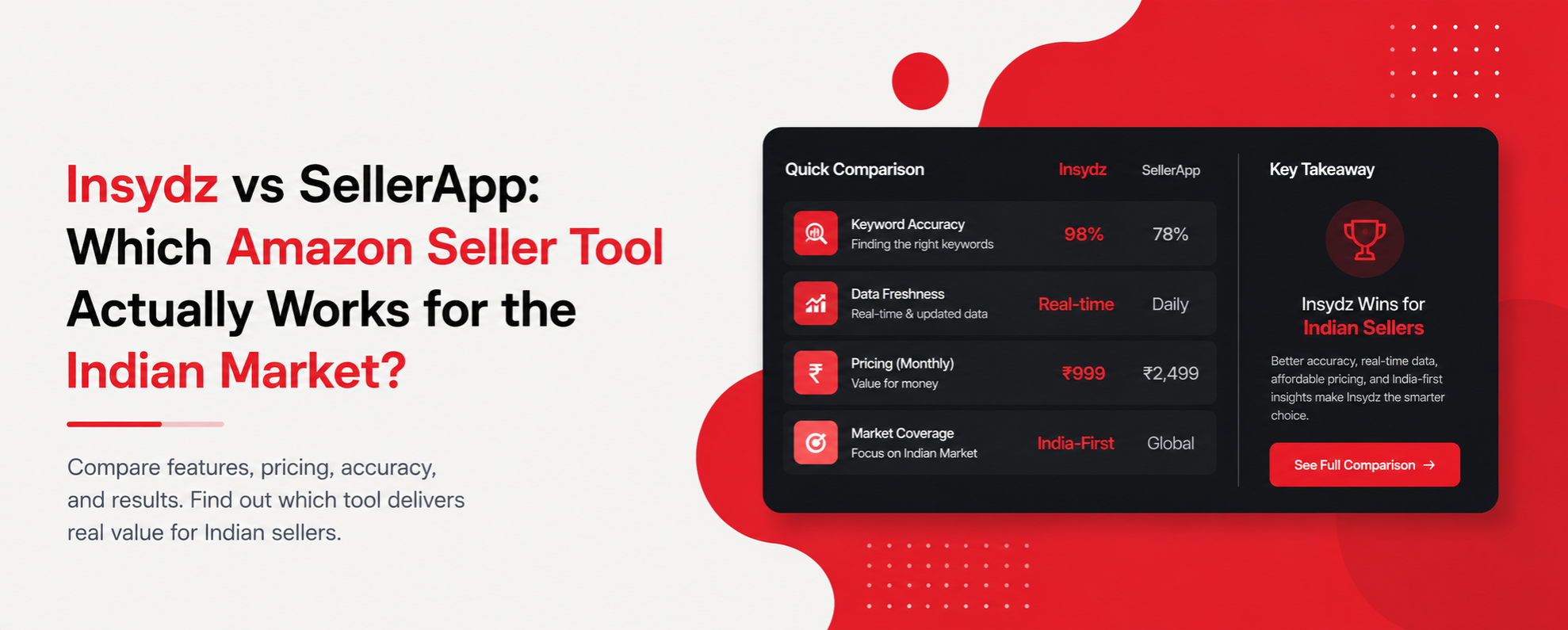
For Indian sellers active on both Amazon.in and Flipkart, Insydz is the better SellerApp alternative — it costs roughly 75% less, supports Flipkart natively, sends WhatsApp rank-drop alerts within 60 minutes, and is calibrated on Indian marketplace data. SellerApp remains a strong choice for India-based sellers focused exclusively on Amazon.com or other global marketplaces.
Why Are Indian Sellers Searching for a SellerApp Alternative?
SellerApp is a competent platform — there's no need to oversell the criticism. The reason Indian sellers keep typing "sellerapp alternative india" into Google is rarely about feature gaps. It's about three structural mismatches that show up the moment you actually try to run an Indian D2C business on the platform.
1. Pricing is in USD — Your Revenue is in INR
SellerApp's paid plans start at $99/month and scale to $199+/month for the Pro tier most growth sellers need. At current FX, that's roughly ₹8,300–₹16,500/month — a real number when your monthly Amazon.in revenue is ₹5L and PPC eats another ₹40K. Worse, USD billing means your tool cost moves every month with the rupee. Most Indian SMB sellers also can't claim GST input credit cleanly on USD invoices issued from a foreign entity.
Insydz prices in rupees, issues GST-compliant invoices from an Indian entity, and starts at ₹1,999/month with a forever-free tier for sellers under 1,000 reviews tracked. For a ₹15L/month seller, that's roughly ₹78,000 saved per year on tooling alone.
2. Flipkart is the Missing Marketplace
SellerApp supports 16 marketplaces — almost all Amazon. Flipkart is not among them. For an Indian seller, that means roughly 30–45% of your marketplace data simply isn't visible in the platform you're paying for. You can't track Flipkart keyword ranks, you can't see Flipkart competitor pricing, you can't run unified review analysis across both marketplaces. Most Indian sellers end up running SellerApp for Amazon and a separate manual process for Flipkart — paying for half a tool.
Insydz tracks Amazon.in and Flipkart natively in the same dashboard. Same competitor lists, same keyword universe, unified PPC and rank reporting.
3. The Feature Set Is Calibrated on US Buyer Behaviour
SellerApp's keyword research, listing optimization, and review intelligence are tuned on Amazon.com data and English-language buyer signals. That means Hinglish reviews ("bahut bekaar product hai bhai") get classified as neutral, Hindi-transliterated search queries don't surface in keyword reports, and the festive window logic that drives 40–60% of Indian category revenue in 4–7 days doesn't exist. You're paying for a global platform and adapting it to India — every week.
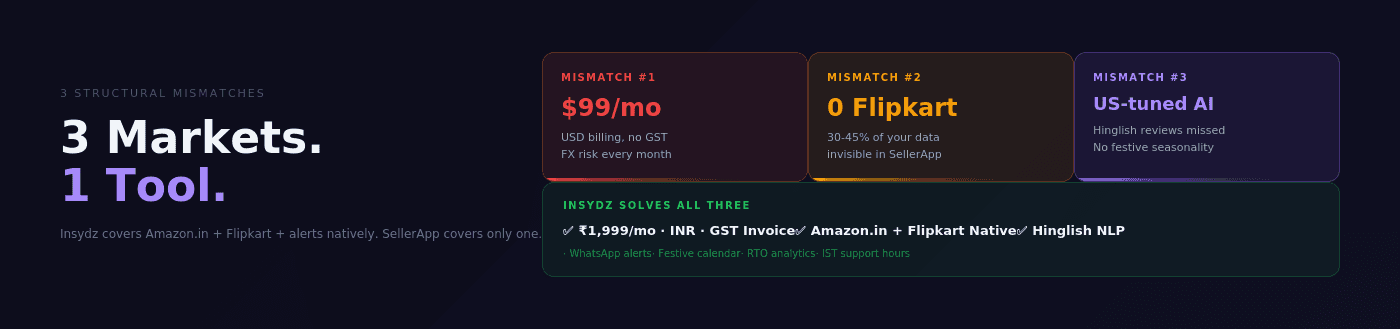
Three structural gaps that make global tools fail Indian D2C sellers — and how Insydz closes each one.
A Bengaluru-based home goods seller running ₹22L/month on Amazon.in summed it up: "SellerApp's PPC dashboard is genuinely better than what most Indian tools offer. But I was paying ₹14,000/month for something that ignored my Flipkart business completely and couldn't tell me when a Hindi-language competitor stole my festive rank. I wasn't getting 70% of my own data back."
Insydz vs SellerApp: Side-by-Side Comparison
Here is the comparison most Indian growth sellers actually need to make before signing a 12-month contract.
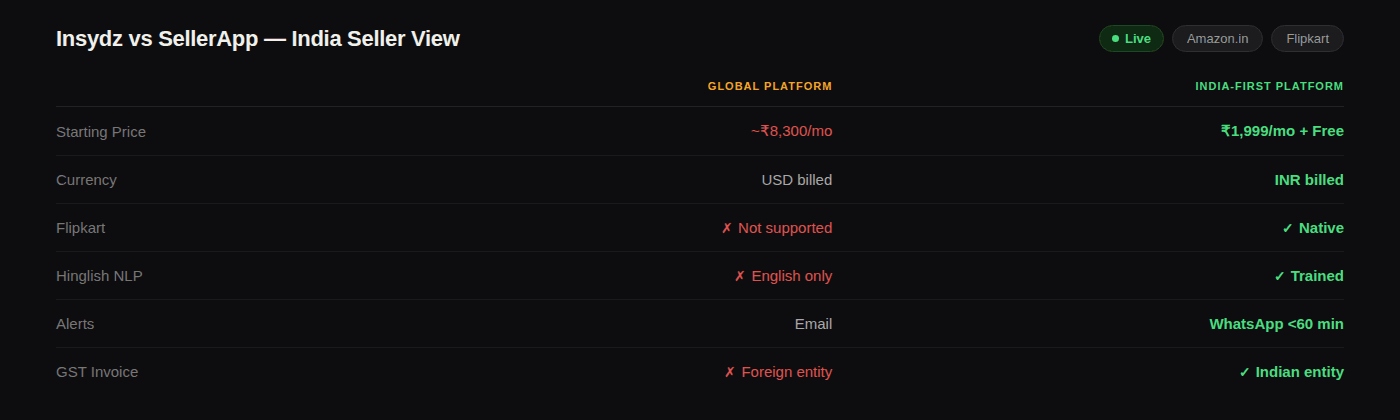
SellerApp vs Insydz — what changes when the platform is actually built for the Indian seller workflow.
Full Capability Matrix
| CAPABILITY | SELLERAPP | INSYDZ (INDIA-FIRST) |
|---|---|---|
| Pricing (Starting) | ~₹8,300/mo (USD) | ₹1,999/mo + Free Plan |
| Billing Currency | USD — FX volatility | INR — predictable |
| GST Invoice / Input Credit | No — foreign entity | Yes — Indian entity |
| Amazon.in Native Data | Partial — global engine | Native — India-first |
| Flipkart Rank & Reviews | Not supported | Full coverage |
| Meesho Visibility | Not supported | Roadmap (Q3 2026) |
| Hindi / Hinglish NLP | English only | Native + transliteration |
| Festive Calendar Logic (BBD, GIF, Diwali) | Generic seasonality | India calendar tuned |
| Rank Drop Alerts | Email — daily digest | WhatsApp — < 60 min |
| PPC Automation Depth | Mature, multi-marketplace | India-Amazon focused |
| Profit Dashboard | Strong — multi-currency | India fee + GST aware |
| RTO / COD Returns Intelligence | Not built for it | India-calibrated |
| Customer Support Channel | Email + chat (US/SG hours) | WhatsApp (IST hours) |
| Best For VERDICT | Sellers on Amazon.com / global SKUs | Indian SMB on Amazon.in + Flipkart |
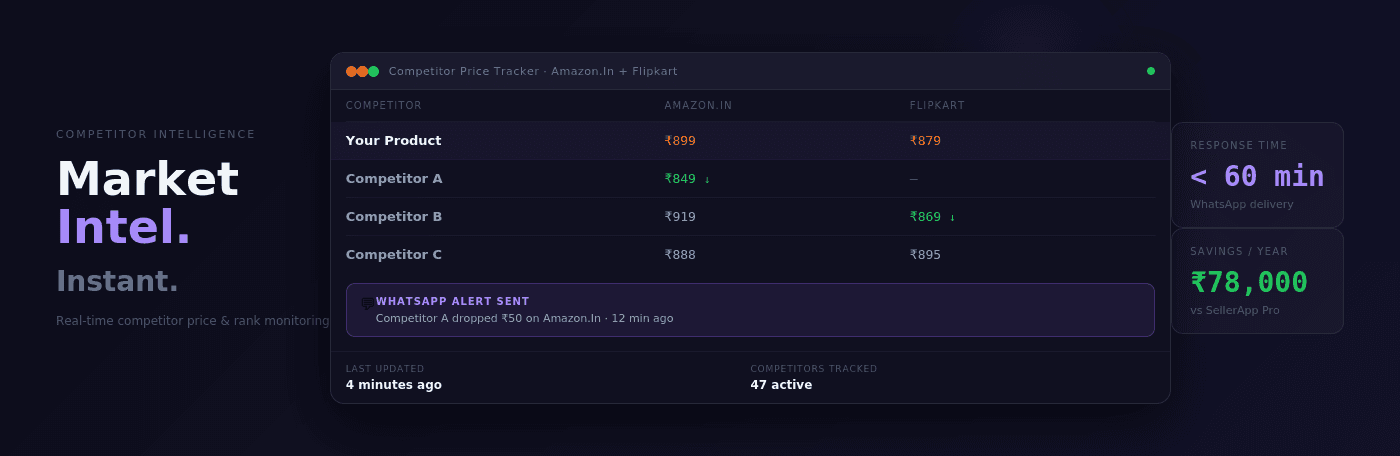
Insydz surfaces real-time competitor price moves across Amazon.in and Flipkart in one unified view — with WhatsApp alerts under 60 minutes.
Where Does Each Tool Genuinely Win?
This isn't a hit piece — both tools have strengths. Knowing which fits your seller profile prevents a 12-month regret.
You sell primarily on Amazon.com (or UAE / UK / DE marketplaces), USD billing isn't a problem, you don't need Flipkart visibility, and you need mature multi-marketplace PPC automation. SellerApp's keyword tools, profit dashboard, and ad automation are genuinely strong for a global Amazon-only operation. If your Amazon.in revenue is under ₹2L/month and your bigger play is US export, SellerApp's depth justifies the price.
You run Amazon.in and Flipkart together (most Indian SMB sellers), your monthly tool budget is in rupees and matters, you want WhatsApp alerts at 11pm during Big Billion Days, and your reviews and search queries include Hinglish or regional language. Insydz is built specifically for the ₹5L–50L/month Indian D2C operator who needs an integrated marketplace view, GST-compliant invoicing, and India-calibrated AI — without a US-priced contract.
The Honest Trade-Off
SellerApp's PPC automation depth on global Amazon is more mature than what any India-first tool, including Insydz, currently offers — that's a fair admission. The question is whether you'll actually use that depth on Amazon.in, where your ₹35K/month ad budget needs sharper INR-priced tooling and Flipkart visibility more than it needs multi-marketplace bid stacking.
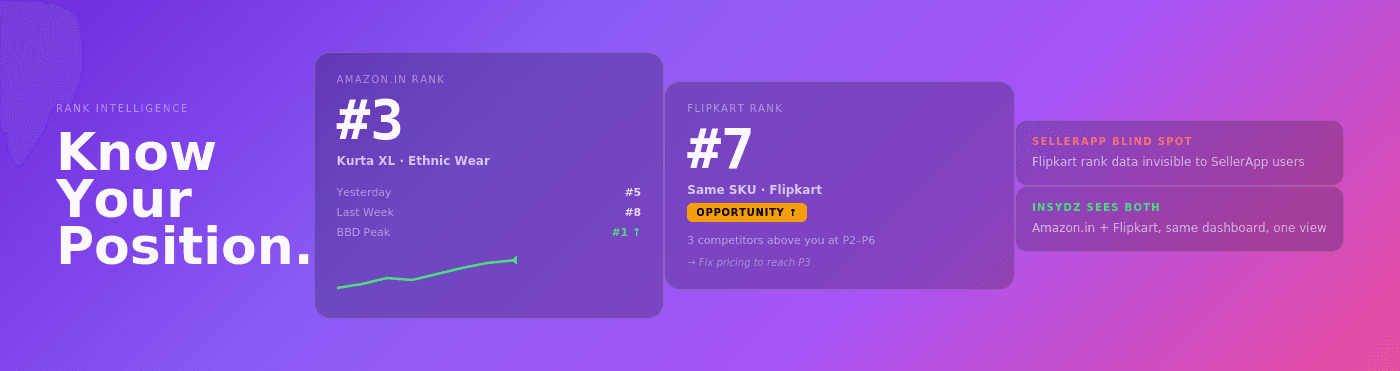
Insydz tracks rank positions across Amazon.in and Flipkart in real time — so Indian sellers never lose their position during festive windows.
How Do You Switch From SellerApp to Insydz in 30 Days?
If you've decided to test the alternative, here's the sequence Indian sellers we've onboarded actually follow. No big-bang migration, no data loss, no mid-month subscription overlap drama.
Activate the Insydz free plan. Connect your Amazon.in and Flipkart seller accounts. Don't cancel SellerApp yet. For the first week, do nothing except let both tools track the same ASINs side-by-side — you'll instantly see the Flipkart data SellerApp was missing.
Export your tracked keyword list, competitor ASINs, and PPC negatives from SellerApp as CSV. Insydz import handles all three in one upload. Your historical PPC learnings come with you — you don't restart from zero.
Configure WhatsApp rank-drop alerts (the single biggest behavioural change you'll feel — no more email dashboards at 9am after a 2am festive event). Tag your top 10 ASINs to the BBD/GIF/Diwali festive calendar so the AI primes 21 days before each window.
By Week 4 you'll have a parallel data set across both tools. Cancel SellerApp at next renewal — no early-cancellation drama, no contract cliff. Re-route your ₹8,300+/month savings into PPC budget or product photography. Most sellers see ROI inside the first 60 days from the freed-up budget alone.
The biggest switching mistake isn't picking the wrong tool — it's running them sequentially instead of in parallel for two weeks. Parallel tracking gives you actual Insydz vs SellerApp data on your own ASINs, not marketing-page screenshots.
5 Mistakes Indian Sellers Make When Comparing Tools
Most tool-comparison decisions go wrong before the trial even starts. These are the patterns we see across hundreds of Indian seller switch conversations.
SellerApp lists 30+ features. Insydz lists fewer. That's irrelevant if the features you'll actually use weekly are the same six — keyword research, rank tracking, review mining, PPC alerts, competitor pricing, profit dashboard. Map your weekly workflow first, then compare.
A $99/month plan was ₹7,200 in 2022, ₹8,000 in 2024, ₹8,300+ in 2026. That's a 15% silent price increase no one asked you to approve. Tool cost should be predictable — INR billing makes it so.
SellerApp's G2 page is dominated by US sellers raving about ACoS reduction on Amazon.com. That's a different product context than yours. Filter reviews by India-based sellers, or — better — find sellers in your category on r/IndianEcommerce and ask directly.
Sunk-cost thinking is the most expensive bias in SaaS. You're paying SellerApp ₹14,000 this month whether or not you trial Insydz. The cost of running both for 14 days is ₹0 — and the cost of staying on the wrong tool for 12 months is ₹1.6L+.
Big Billion Days runs through October. If your tool's support is in PT or SGT timezone, your 11pm IST rank drop on Day 2 of BBD waits till morning. Ask the support timezone question before signing anything. WhatsApp-based IST support is the difference between catching a ₹4L revenue dip and not.
Real Switch Story: Surat Apparel Brand
A Surat-based apparel D2C brand selling kurtas across Amazon.in and Flipkart was running SellerApp for 14 months before switching to Insydz in late 2025. Same SKUs, same team, same ad budget. Here's what changed.
USD billing, no Flipkart data, missed 3 of 5 BBD rank drops because email alerts arrived next morning. Flipkart managed manually in spreadsheets.
Parallel run for 2 weeks, exported keywords + PPC negatives, set up WhatsApp festive alerts on top 12 ASINs, cancelled SellerApp at renewal.
Tool cost down to ₹1,999/mo (-86%), Flipkart revenue up 31% from previously invisible keyword gaps, festive rank recovery time cut from 18 hours to 90 minutes.
The Flipkart upside surprised everyone — including the Insydz team. The brand had 22 SKUs on Flipkart that were ranking P3–P8 for buy-intent terms, but no one was watching them because SellerApp simply didn't show that data. Surfacing it took 11 days. Acting on it added ₹4.6L in monthly Flipkart revenue inside one quarter.
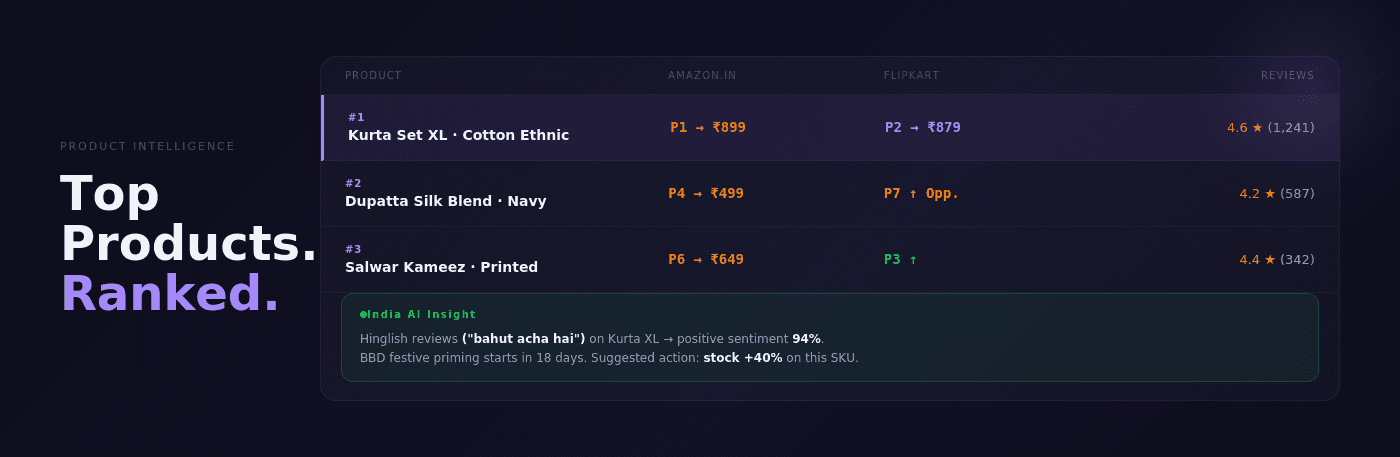
Insydz's India-calibrated AI ranks your products by opportunity across Amazon.in and Flipkart — with Hinglish sentiment and festive priming built in.
Run Insydz and SellerApp in Parallel — Free for 14 Days
No card, no contract. See your Amazon.in + Flipkart data side-by-side. If Insydz isn't sharper for the Indian market, keep SellerApp.
Why Indian SMB Sellers Pick Insydz Specifically
Predictable monthly cost in rupees, GST input credit available, no FX surprises mid-quarter. Built and billed from an Indian entity.
Same competitor lists, same keyword universe, unified review and rank tracking — no spreadsheet juggling between two tools.
Rank drops, competitor moves, festive sentiment spikes — delivered to where Indian sellers already work, not buried in email at 6am.
BBD, Great Indian Festival, Diwali, Republic Day Sale — keyword priming starts 21 days before each window. Generic seasonality models miss this entirely.
Reviews and search queries in Hindi, Hinglish, and transliterated Tamil/Telugu are clustered correctly — not flagged as low-confidence and dropped.
Returns, COD refusal patterns, and pin-code-level RTO signals are part of the standard view — because in India, that's where margin actually leaks.
SellerApp is genuinely good at what it does. It's just not designed for the Indian SMB seller's actual workflow — and paying USD prices for a tool that can't see your Flipkart revenue is a math problem, not a brand argument. If you're already on SellerApp and your Amazon.in business is the larger half of your revenue, run Insydz alongside for 14 days. The data will tell you which one to keep.