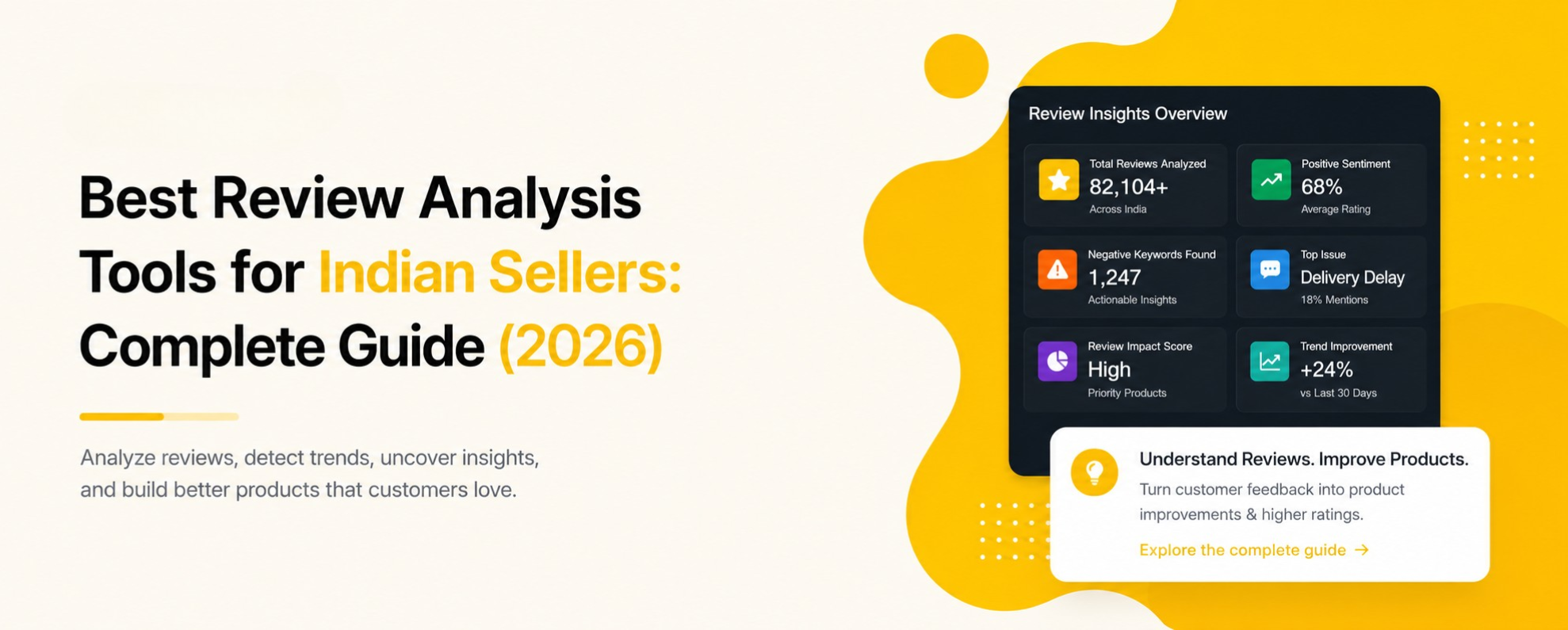
An AI review mining software for India is software that automatically reads, clusters, and scores every customer review across Amazon.in, Flipkart then surfaces the exact product defects, listing gaps, and competitor weaknesses hiding in plain sight. It turns your amazon sentiment analysis tool data into 5 specific decisions you can act on this week.
What is a Review Analysis Tool for Indian Sellers?
A review analysis tool for India is software that automatically reads, clusters, and scores every customer review across Amazon.in, Flipkart providing flipkart review insights that surface the exact product and listing issues driving 1-star reviews before they compound into a rating drop that impacts your organic ranking and conversion rate.
Unlike generic social listening tools built for brand mentions on Twitter or Instagram, India-focused review analysis tools are designed for marketplace product reviews the structured, purchase-verified feedback that directly influences your category ranking, buy box eligibility, and conversion rate on India's top e-commerce platforms.
Indian D2C brands on Amazon.in receive an average of 80–400 new reviews per month per ASIN. At that volume, manual review reading captures less than 10% of the signal. AI review intelligence dashboards surface the exact product and listing issues driving 1-star reviews before they compound into a rating drop that is expensive and slow to reverse.
Why Review Analysis is Critical for Indian D2C Brands
India's E-commerce Buyers Are the Most Review-Reliant in the World
A 2026 study found that 91% of Indian online buyers read product reviews before purchasing — higher than the US (88%) and significantly higher than global averages. This makes your review score not a vanity metric, but a direct conversion rate driver and a primary trust signal for first-time buyers in a market where brand familiarity is still being established.
Rating Damage is Silent and Algorithmic
Amazon's A10 algorithm and Flipkart's ranking engine both use review velocity and star rating as direct input signals. When your rating drops below 4.0, you don't just lose buyer trust you lose organic rank, which reduces visibility, which reduces new sales, which reduces new reviews, which makes the rating harder to recover. A single unresolved complaint cluster can depress your organic ranking for 3 to 6 months before you even notice the connection.
A Mumbai-based D2C brand selling decorative lighting on Amazon.in and Flipkart was at 3.9 stars with 22% of their negative reviews citing 'bulb not included in box' a listing clarity issue, not a product defect. After AI review analysis surfaced this cluster, they updated their listing title, added a packaging insert, and updated the main image to show the bulb separately. Within 45 days, their rating recovered to 4.3 stars. The fix cost ₹0 in product changes and 2 hours of listing work.
The revenue impact: conversion rate improved 14%, driving ₹68,000/month in incremental sales from the same organic traffic.
Competitor Review Mining is an Untapped Product Strategy
The most sophisticated D2C brands in India aren't just analysing their own reviews — they're mining competitor reviews to find the exact product gaps and pain points their category's buyers wish were solved. If your top competitor has 400 reviews at 3.8 stars and 31% of negative reviews mention 'remote stops working after 2 months', that's not just their problem that's your positioning opportunity. Combining this with data from an Amazon competitor price tracking tool allows you to outmaneuver them on both quality and value. Put 'remote with 12-month replacement guarantee' in your listing title and see what happens to your conversion rate.
The Festive Season Amplifies Every Unresolved Review Cluster
During Big Billion Days and Great Indian Festival, review volume spikes 4–6× for most categories. An unresolved complaint cluster that generates 10 negative reviews per month generates 50–60 during the festive surge. Brands that enter the festive season with known complaint clusters unresolved don't just lose the sale — they lose the rating permanently, because the festive review damage is harder to dilute with positive reviews in the slower post-festive months.
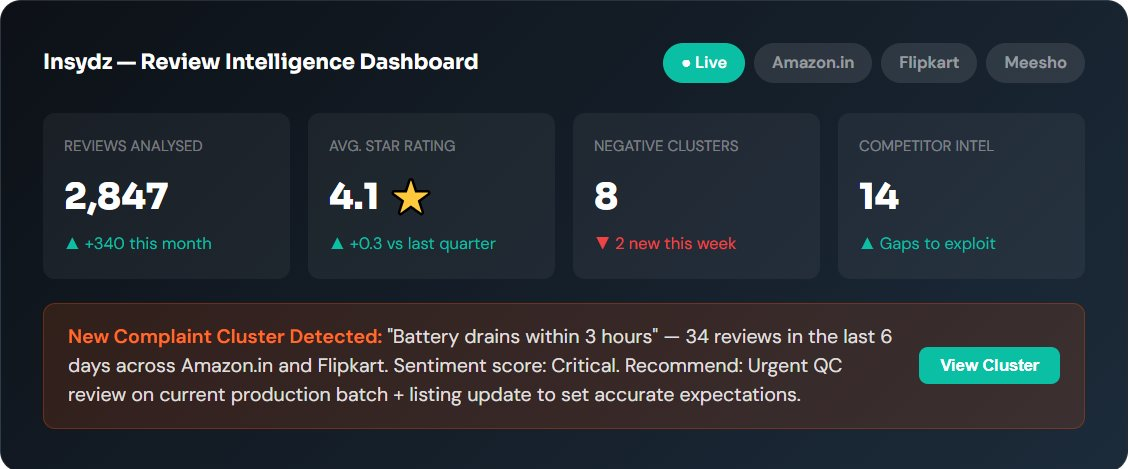
India-first review intelligence covers all three major marketplaces Amazon.in, Flipkart with native Hindi and Hinglish NLP processing
How Does AI Review Analysis Work?
Modern tools have replaced the manual spreadsheet workflow with a 5-step automated intelligence loop:
Link your Amazon.in, Flipkart product pages. The tool begins ingesting all historical reviews and sets up real-time monitoring for new reviews yours and your competitor ASINs.
The AI engine reads every review and uses sentiment analysis in natural language processing to identify recurring themes grouping semantically similar complaints and compliments into clusters like 'packaging damage', 'size inaccuracy', 'feature gap', and 'delivery issue'.
Each cluster is scored by sentiment polarity and weighted by frequency and recency. The tool builds a real-time rating breakdown showing exactly which complaint clusters are responsible for what percentage of your 1-star and 2-star reviews.
The moment a new negative theme appears in more than 3 reviews within a 48-hour window, you receive a WhatsApp alert with the complaint summary, affected ASINs, and a recommended action. For Indian sellers, WhatsApp delivery means action happens not email digests that get read 3 days later.
The platform delivers specific decisions: 'Update listing bullet point 2 and add packaging insert estimated rating improvement 0.3 stars in 60 days.' Not just data. Specific actions with projected outcomes.
Reading reviews tells you what one buyer said. AI cluster analysis tells you that 31% of your negative reviews share the same root cause and that fixing it will measurably improve your rating within 45 days. The difference is the difference between customer service and product strategy.
Types of Review Intelligence Indian Brands Must Track
Not all review insights are equal. Here's how AI clustering breaks down the signal from the noise across your Amazon.in and Flipkart product reviews:
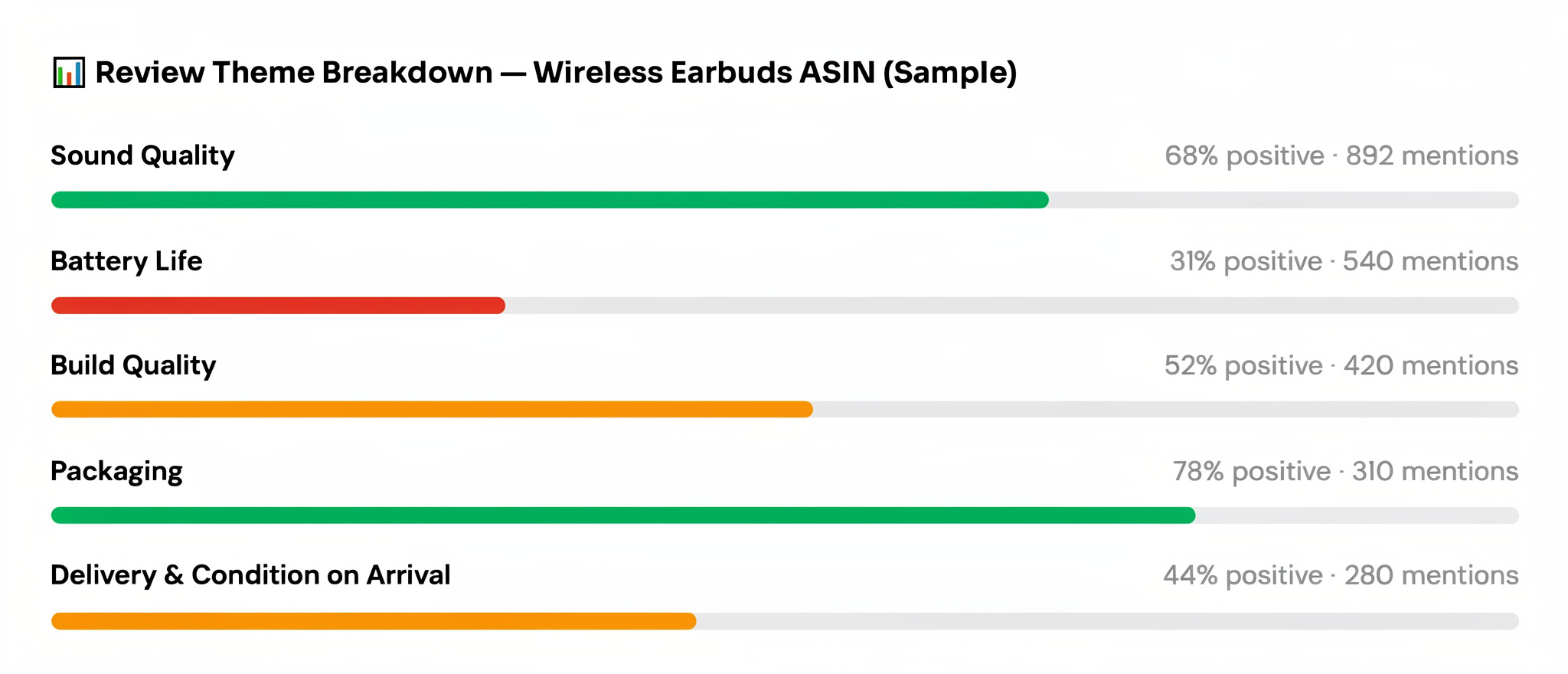
Seven categories of review intelligence automatically detected by AI each mapped to a specific product or listing action
| Review Intelligence Type | What the AI Detects | Action for Indian Sellers | Revenue Impact |
|---|---|---|---|
| Product Defect Reviews | Complaints about physical quality, breakage, missing parts, wrong specifications | Trigger supplier escalation; update listing title with defect-addressing copy | Fixes return rate |
| Packaging & Delivery Reviews | Damaged in transit, poor packing material, missing protective layers | Flag to logistics; upgrade packaging; add fragile sticker protocol | Protects star rating |
| Size & Fit Reviews | 'Smaller than expected', 'doesn't fit Indian sizing', measurement inaccuracies | Add size chart; update dimensions in listing; add comparison image | Cuts 20–30% of negatives |
| Feature Gap Reviews | Buyers wishing for a feature your competitor already offers | Product roadmap input or listing copy update to highlight existing features | Conversion uplift 5–12% |
| Competitor Gap Reviews | Your rivals' reviews revealing what their customers consistently hate | Counter-message those pain points directly in your listing bullets and title | Market share gain |
| Positive Theme Clusters | Recurring phrases in 5-star reviews — what buyers love most in their exact language | Mirror that vocabulary in title, bullets, A+ content, and sponsored ad copy | CTR + CVR lift |
| Review Velocity Signals | Sudden drop in new review rate — may indicate suppression or listing quality issue | Trigger review request campaign; audit listing health score | Ranking protection |
India-first tools provide full marketplace review intelligence across Amazon.in, Flipkart global tools see only social media mentions, leaving the most purchase-verified, actionable customer intelligence completely invisible.
5 Common Mistakes Indian D2C Brands Make with Review Analysis
Each of these mistakes silently costs Indian D2C brands rating points and therefore conversion rate and revenue — every week they go uncorrected.
A 4.1-star average is not a health signal. The real signal is the complaint cluster percentage and its trend direction. A product at 4.1 stars with 28% of negative reviews mentioning one fixable defect is a product with a solvable problem. A product at 4.1 stars with complaints spread across 12 unrelated issues needs a fundamentally different intervention but you can't tell the difference from the number alone.
Your competitors' reviews are free product research that most Indian D2C brands are leaving entirely untapped. The reviews your rivals' buyers leave are telling the entire category exactly what problems the current product standard doesn't solve. Sellers who read those reviews systematically consistently find 2–3 differentiation angles their competitors haven't addressed and put those angles directly in their listing title.
A single 1-star review saying 'charging cable too short' is noise. Twenty reviews in 60 days all citing 'cable length issue' is a product specification problem with a sourcing solution. Sellers who react to individual reviews spend energy on customer service responses. Sellers who detect clusters spend energy on root-cause fixes that eliminate the source of the negative reviews entirely.
The exact words buyers use in 5-star reviews are the exact search terms their buying-intent peers will type into the Amazon search bar. Mining positive review language and putting it directly into your listing title, bullets, and A+ content is the highest-conversion listing optimisation available and it's sitting in your own review section, unused.
Competitor listings change. New sellers enter with different defect patterns. Seasonal usage creates new complaint clusters: monsoon-related corrosion in electronics, AC compatibility issues in appliances, gifting suitability during Diwali season. A one-time audit gives you a snapshot. Continuous monitoring gives you a competitive radar that updates every 48 hours.
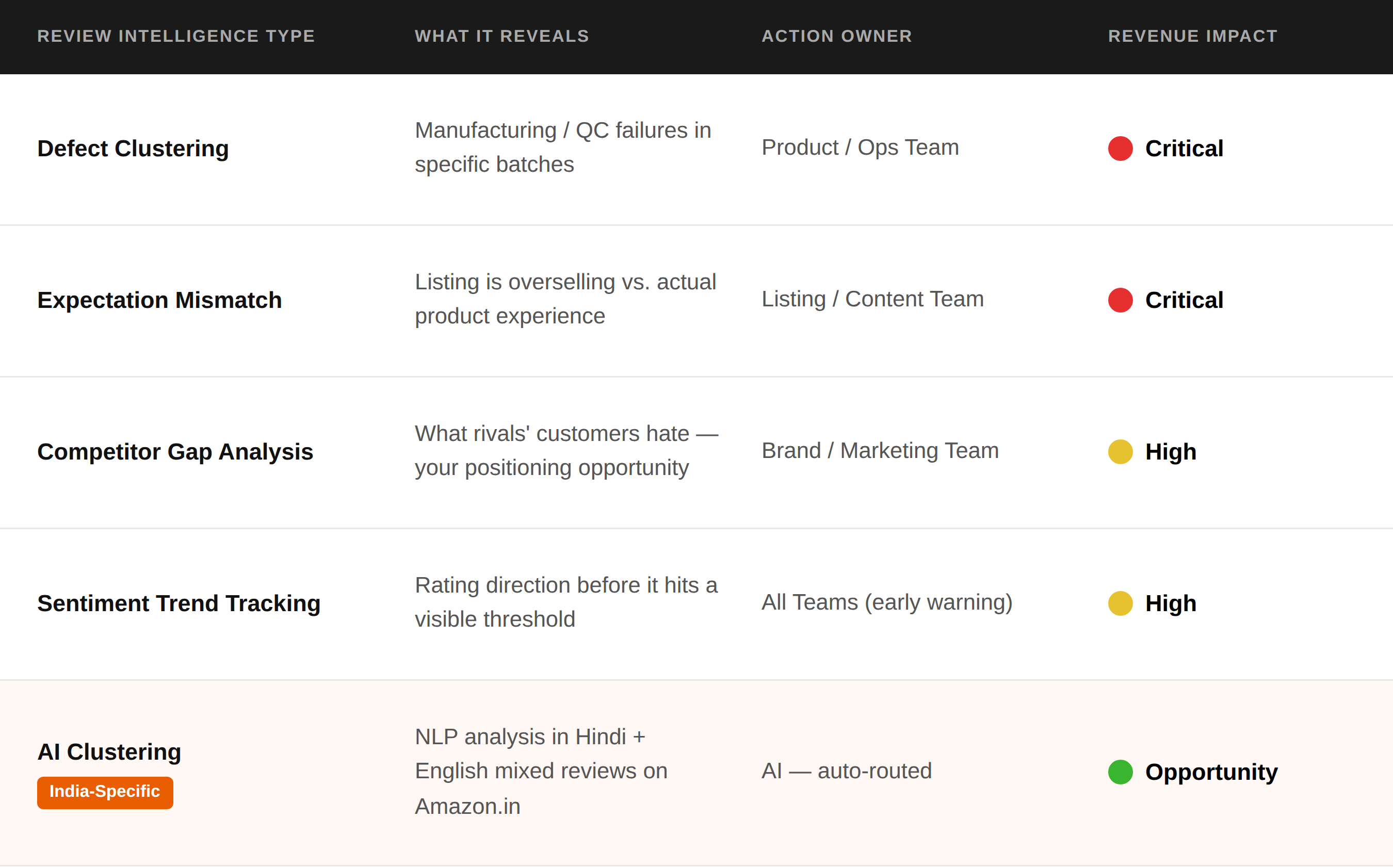
Complaint cluster breakdown by percentage showing which issues are growing vs shrinking and their projected impact on star rating trajectory
Best Practices for Indian D2C Brands: Weekly Execution Model
The most successful Indian D2C brands on Amazon.in and Flipkart don't react to review damage they run a structured weekly rhythm that catches complaint clusters before they reach critical mass. Daily automated alerts, weekly 30-minute reviews, and monthly strategic audits keep your review intelligence compounding without requiring a full-time analyst.
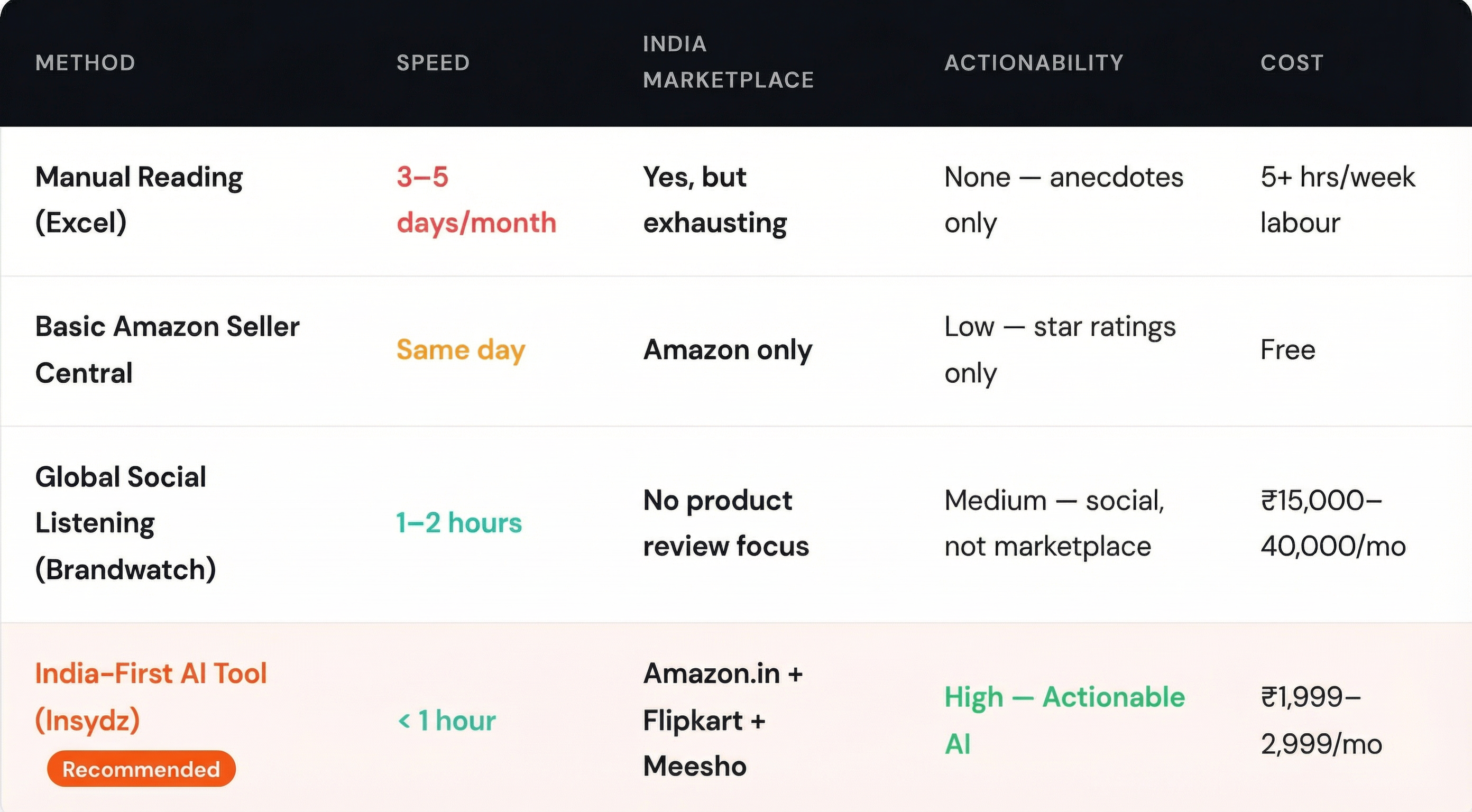
The three-tier review intelligence cadence daily alerts, weekly review, monthly strategic audit
- ✓New 1-star and 2-star reviews flagged via WhatsApp within 60 minutes of posting
- ✓New complaint clusters detected when 3+ reviews cite the same issue within 48 hours
- ✓Competitor review velocity alerts if a rival accumulates reviews unusually fast, you know within 24 hours
- ✓Listing health score updates based on new review language vs your current listing copy alignment
- ✓Review your weekly sentiment digest: which complaint category increased by more than 3 percentage points?
- ✓Check competitor review mining updates: have their top complaint clusters shifted?
- ✓Identify the one listing copy update that would address your highest-frequency complaint cluster
- ✓Update listing bullets with new positive review vocabulary that emerged this week
- ✓Flag any supply chain issues to your sourcing team based on durability or quality complaint trends
- ✓Full competitor review landscape audit: which rivals have improved their complaint profiles? Which have new vulnerabilities?
- ✓Map your top 3 complaint clusters to specific product improvement briefs for your supplier
- ✓Reconcile your listing copy against your current positive review language update wherever buyer vocabulary has drifted
- ✓Plan festive season listing updates: what did your category's reviews say after the last Diwali or Big Billion Days surge?
- ✓Set review velocity benchmarks for the next month based on historical category data
Key Metrics to Track Monthly
Start Your Review Intelligence in 30 Minutes Free
Connect Amazon.in, Flipkart &. Get your first complaint cluster report today. WhatsApp alerts included.
Best Tools for Amazon Review Analysis in India (2026)
Why Global Tools Fall Short for Indian Sellers
Several established platforms offer review analysis as part of their broader e-commerce intelligence suites Helium 10's Review Insights, Jungle Scout's Review Automation, and social listening platforms like Brandwatch and Sprinklr. For Indian D2C sellers, an honest assessment: none of them were built for the Indian marketplace. Their primary data infrastructure is Amazon.com, and their sentiment models are trained on English-language reviews. For sellers whose buyers write in Hindi, Hinglish, and English and who need Flipkart coverage these tools are fundamentally blind to a large portion of the most relevant market signal.
| Tool | Review Analysis | India Platform Coverage | Hinglish NLP | WhatsApp Alerts | Price (INR/mo) |
|---|---|---|---|---|---|
| Amazon Seller Central (built-in) | Basic star filter only | Amazon.in only | No | No | Free |
| Brandwatch | Social mentions only | Twitter, Instagram only | No | No | ₹15,000–40,000 |
| Helium 10 (Review Insights) | Amazon.com reviews only | Amazon.com only | No | No | ₹3,300–8,300 |
| Jungle Scout | Limited review data | Amazon only | No | No | ₹3,800–8,000 |
| Insydz | Full AI review intelligence | Amazon.in + Flipkart | Yes | Yes | Free – ₹1,999 |
Full Capability Comparison India Market
| Capability | Manual Reading | Global Tools (US-first) | Insydz India-First |
|---|---|---|---|
| Amazon.in Review Coverage | Manual only | Zero — US Amazon only | Full Amazon.in coverage |
| Flipkart Review Analysis | Manual only | Not supported | Native integration |
| Hindi & Hinglish Processing | No | English only | Native NLP for both |
| Competitor Review Mining | 1–3 hrs/product | US ASINs only | Automated, all 3 platforms |
| AI Complaint Clustering | No | Basic topic detection | Full issue taxonomy |
| WhatsApp Alerts | Not available | Email only | Within 60 min of new review |
| Listing Copy Recommendations | Not available | Not available | Bullet rewrites from reviews |
| Festive Trend Intelligence | Not available | Not available | Diwali, BBD, GIF patterns |
| Pricing | Your time (5+ hrs/wk) | ₹15,000–40,000/month | Free – ₹1,999/month |
Sentiment is scored in the language the review was written not after force-translation. 'Bilkul bekaar hai' is classified as strongly negative with the same accuracy as 'completely useless'.
Platform-specific complaint patterns are tracked and surfaced separately. Flipkart buyers disproportionately flag delivery issues;. You see the full picture.
Add any competitor's ASIN and Insydz clusters their reviews with the same taxonomy as yours. You see their top complaint categories, positive themes, and feature gaps in real time.
New complaint clusters and critical individual reviews reach you via WhatsApp within 60 minutes. For Indian SMB operators who check WhatsApp 50× a day, this is the difference between acting and archiving.
Specific bullet point rewrites generated from your positive review clusters and your competitors' negative review language the highest-conversion listing optimisation available.
Pre-festive complaint pattern audits so you know exactly which issues to resolve before Big Billion Days and Great Indian Festival review volume spikes 4–6×.
A review analysis tool is only as useful as the reviews it can actually read. For Indian D2C brands, that means native Amazon.in data, Flipkart coverage, and Hinglish NLP. Tools that don't pass this test aren't giving you Indian market intelligence they're giving you a partial picture of a US market you're not competing in.
Frequently Asked Questions
For Indian D2C brands selling on Amazon.in, Flipkart, the best review analysis tool is one built specifically for Indian marketplace reviews not adapted from a US-first social listening platform. The key differentiators are: native support for Amazon.in and Flipkart review APIs, Hindi and Hinglish sentiment processing, competitor ASIN review mining, and WhatsApp alert delivery. Insydz is built from the ground up for this use case, with a free plan that covers entry-level review intelligence and paid plans starting at ₹1,999/month.