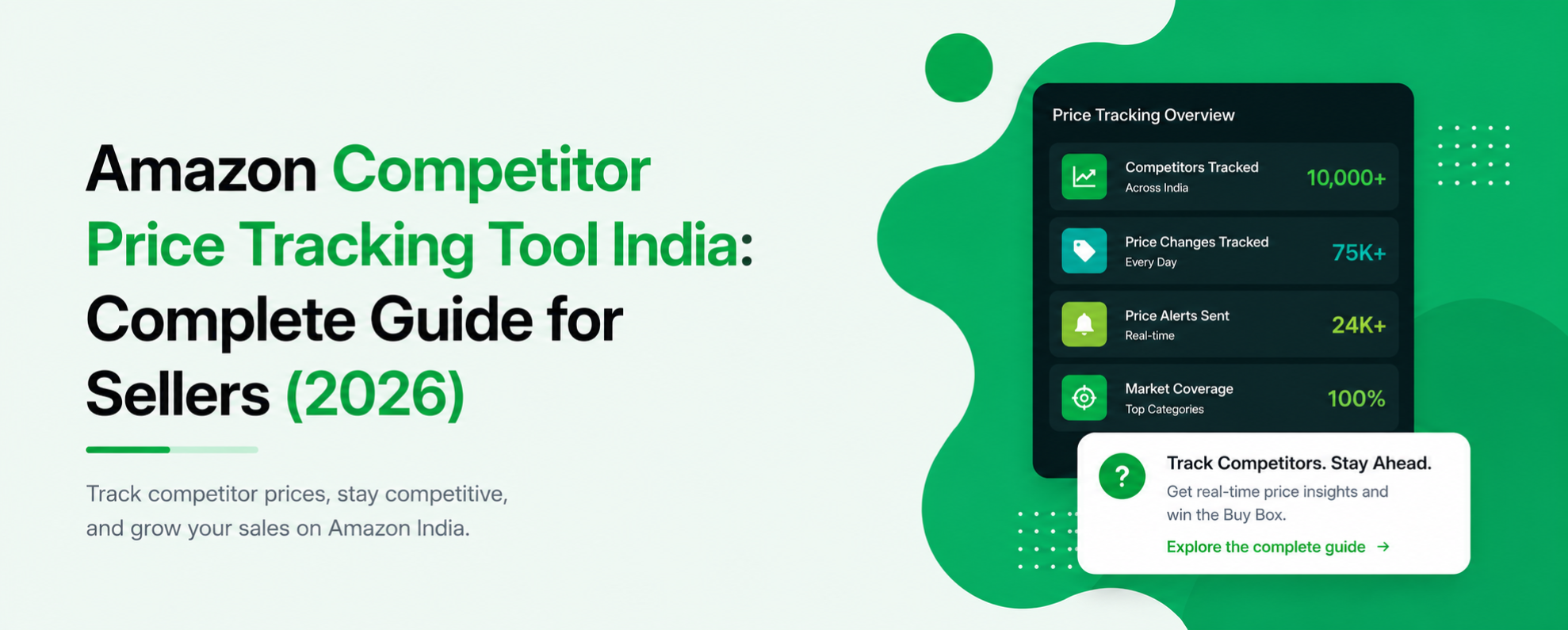
What is an Amazon Competitor Price Tracking Tool for India?
An amazon competitor price tracking tool India is software that automatically monitors your rivals' product prices, stock availability, and listing changes on Amazon.in, Flipkart in real time, without any manual effort. Unlike generic global tools built for US or European marketplaces, India-focused platforms account for the pricing dynamics, seller behaviour, and platform nuances unique to Indian e-commerce.
Here's the scale of the problem: Indian sellers on Amazon.in collectively lose an estimated — rather than proactive pricing decisions cost sellers 15–30% of potential monthly profit.
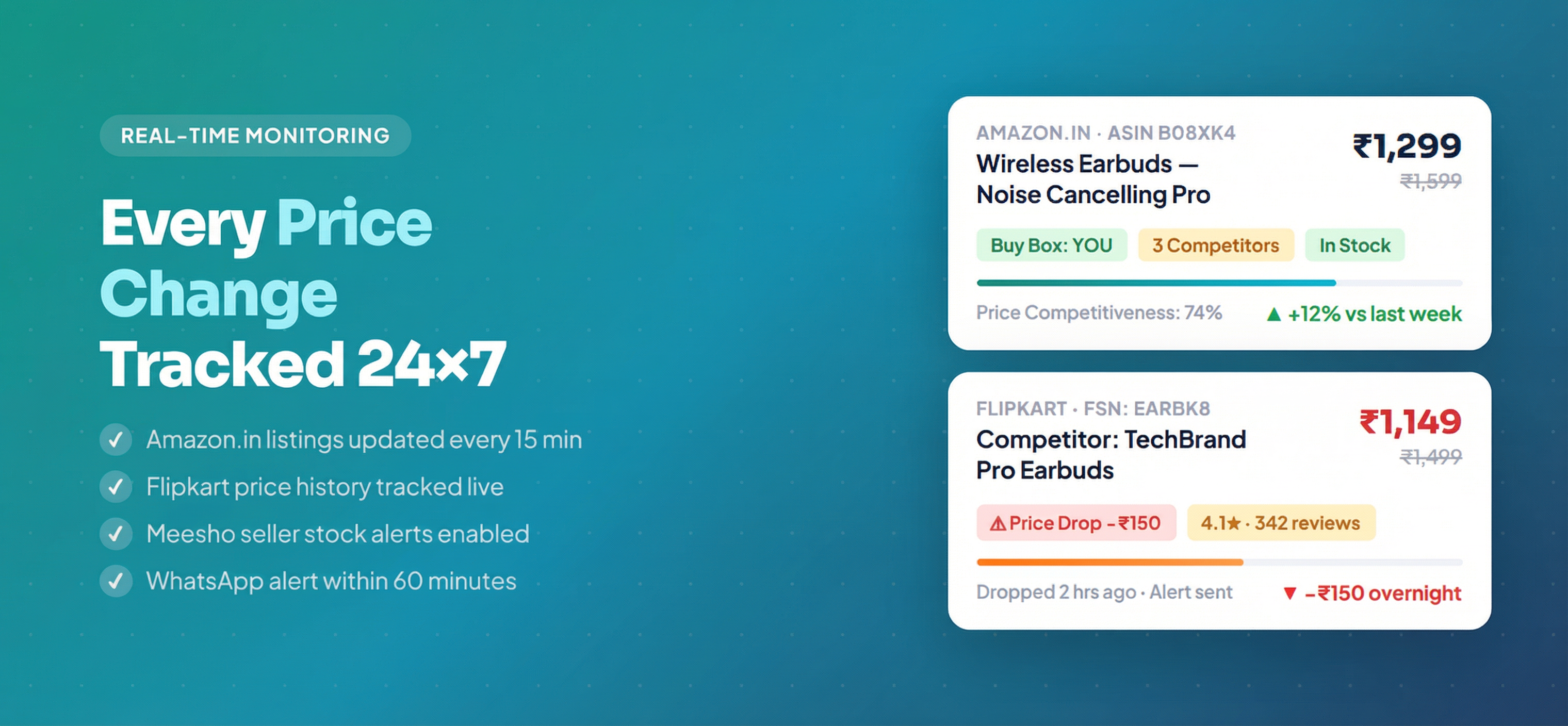
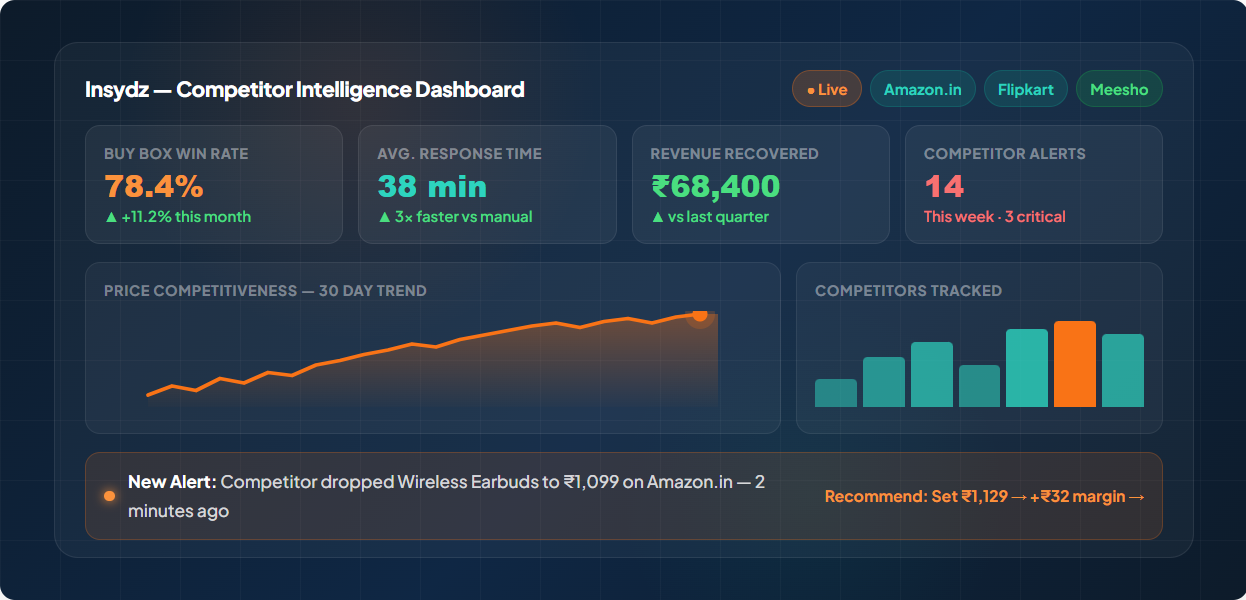
AI-powered price tracking dashboards convert raw competitor data into actionable decisions — showing you exactly what price to set, and why, for each ASIN.
Why is Competitor Price Tracking Critical for Indian Sellers?
Indian e-commerce is one of the most price-sensitive markets in the world. Shoppers compare prices across 3–5 sellers before purchasing. Implementing dynamic pricing on Amazon India is a necessity for survival — a ₹50 difference on a ₹500 product can shift the Buy Box — and with it, 70–80% of the category's sales volume.
Revenue Leakage is Silent and Compounding
Most Indian sellers price once and forget. Using automated price tracking tools improve accuracy and efficiency, allowing you to stay ahead. When a competitor dropped their price by ₹100 overnight, your product slides off the first page of Amazon search results. You don't even know it happened. Three weeks later, you've lost ₹45,000 in revenue you never even tracked.
Amazon & Flipkart Algorithm Penalises Stale Pricing
Both Amazon and Flipkart factor in price competitiveness when deciding which products to feature in search results and 'Recommended' carousels. A product that's ₹200 more expensive than the category median gets suppressed — even if your reviews are better.
The Festive Season Window is Unforgiving
During Big Billion Days and Great Indian Festival, 40–60% of annual e-commerce revenue concentrates into 4–7 days. A seller who loses the Buy Box on Day 1 of a festive event often can't recover the algorithm has already reallocated visibility to competitors.
How Does Amazon Competitor Price Tracking Work?
Modern tools have replaced the manual spreadsheet workflow with a 5-step automated intelligence loop:
Connect Your Seller Account
Link your Amazon/Flipkart seller account and add your top 5–10 competitor ASINs to start monitoring immediately.
Automated Live Data Crawling
The amazon price tracker crawler or API pulls live price data from product listings at frequent intervals every 15–60 minutes for AI-powered tools like Insydz.
AI Engine Analysis
The competitor monitoring tool AI engine compares your price against the category benchmark and competitor prices, factoring in ratings, delivery speed, and stock levels.
WhatsApp / Email Alert Triggered
You receive a WhatsApp or email alert the moment a competitor changes price by more than your defined threshold (e.g., ±5%).
Actionable AI Recommendation
The platform gives a decision, not just data: "Competitor A dropped to ₹899. Recommend adjusting to ₹919 to stay competitive while protecting ₹42 more margin."
Types of Amazon Price Tracking Approaches (Comparison)
| Method | Speed | Accuracy | Actionability | Cost |
|---|---|---|---|---|
| Manual Excel Tracking | 24–48 hours | Low (human error) | None | 3–5 hrs/day labour |
| Basic Free Alert Tools | 2–6 hours | Medium | Low (alerts only) | Free – ₹200/mo |
| Global SaaS (Helium 10) | 1–2 hours | High | Medium (US-focused) | ₹4,000–8,000/mo |
| India-First AI Platform (Insydz) | < 1 hour | High | High — Actionable AI | ₹1,999–2,999/mo |
Start Tracking Competitor Prices Free
WhatsApp alerts. No credit card. No dashboards to learn. Set up in 5 minutes.
5 Common Mistakes Indian Sellers Make with Price Tracking
If you're opening 10 competitor tabs every morning and copying prices into a spreadsheet you're already 24 hours behind. The competitor changed their price at 11 PM last night. You found out at 9 AM today. You lost the Buy Box for 10 hours.
Most Indian SMB sellers check email 2–3 times a day at most. They check WhatsApp 50+ times. A price alert sent to an email that's opened 4 hours later is not an alert it's a history lesson.
When sellers notice a competitor undercutting, the instinct is to slash prices immediately. This starts price wars that destroy margins across the entire category. Smart sellers use AI to find the minimum adjustment needed to stay competitive — not the maximum cut.
Price is one signal. But a competitor with 500 reviews and 4.6 stars can charge ₹150 more than you and still win. Sellers who only track price miss the full picture. Review Analytics — review velocity and sentiment tracking should run alongside price tracking.
Seasonal demand on Flipkart for electronics, apparel, and home goods swings 40–60% during festive periods. A seller who doesn't adjust pricing dynamically for Diwali, Republic Day Sale, or Big Billion Days leaves significant profit on the table.
Best Practices for Indian Sellers: Weekly Execution Model
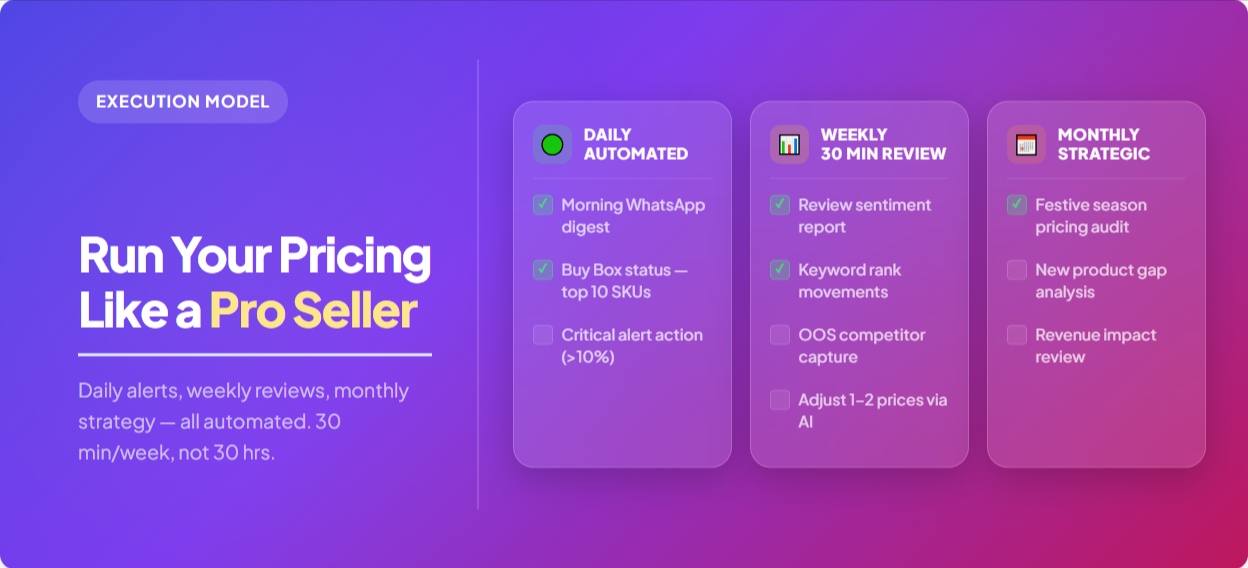
The most successful Indian sellers don't react to pricing changes they run a structured weekly rhythm that keeps them consistently competitive without manual effort.
- Morning WhatsApp digest: top 3 competitor price movements overnight
- Review Buy Box status for your top 10 SKUs
- Act on any 'Critical Alert' (competitor dropped >10%)
- Review competitor review sentiment recurring pain points?
- Check keyword rank movements for top 5 keywords
- Identify competitors that went out of stock (opportunity)
- Adjust 1–2 product prices based on AI recommendations
- Audit pricing for upcoming festive season or sale events
- Identify 1 new product from AI gap analysis report
- Review revenue impact of pricing changes (before vs. after)
During Big Billion Days and Great Indian Festival, 40–60% of annual e-commerce revenue concentrates into 4–7 days. Real-time price tracking is your only defence against losing the Buy Box during these windows.
Key Metrics to Track
The weekly rhythm also means you regularly perform real-time competitor price monitoring and review Keyword Rank Tracking movements to understand the full competitive picture not just price.
Best Tools for Amazon Competitor Price Tracking in India
Not all tools are built equally and for Indian sellers, the platform choice is critical. Finding the best competitor price tracking tools in India is the first step — here's an honest, side-by-side comparison.
| Tool | Amazon.in | Flipkart | Price | ||
|---|---|---|---|---|---|
| Helium 10 | Yes | No | No | No | ₹4,000–8,000/mo |
| Jungle Scout | Yes | No | No | No | ₹4,500–7,000/mo |
| Insydz | Yes | Yes | Yes | Yes | ₹1,999/mo + Free plan |
Global Tools: Powerful but Mismatched for India
Helium 10 and Jungle Scout are industry standards for Amazon sellers in the US and Europe. They offer deep keyword research, product research, and price tracking capabilities. However, for Indian sellers, they come with significant limitations.
Industry standard globally — but significant gaps for Indian sellers:
- ₹4,000–8,000/month — too expensive for most SMB sellers
- No Flipkart coverage
- English-only dashboards
- Email alerts only
Built ground-up for how Indian sellers actually work:
- Real-time WhatsApp alerts
- AI price recommendations
- Amazon + Flipkart coverage
- ₹1,999–2,999/month pricing
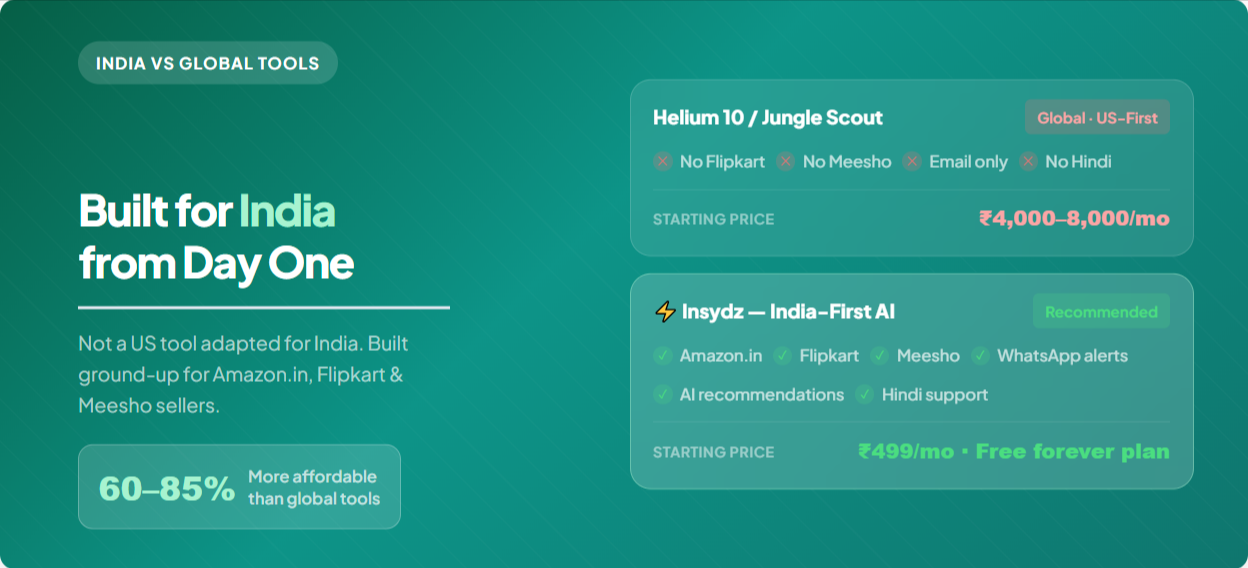
India-first tools like Insydz cover Amazon.in, Flipkart simultaneously — closing the multi-platform gap that global tools leave open for Indian sellers.
Frequently Asked Questions
Final Thoughts
Winning on Amazon India and Flipkart in 2026 isn't about having the best product it's about having the best intelligence. Competitor price tracking is the foundation of that intelligence layer.
Sellers who implement real-time AI-powered price monitoring stop reacting to the market and start leading it. They know when a rival goes out of stock before buyers do. They know when a competitor undercuts them within 45 minutes, not 45 hours. And they recover their Buy Box with a precise price adjustment enabled by a complete competitive picture — not a panicked discount.
The data is clear: every hour without price tracking is an hour of revenue being silently redirected to a competitor who does.