What Exactly Is Private Label, and Why Is It the Right Model for Amazon India in 2026?
Private label means sourcing from a manufacturer, applying your own brand and packaging, and selling it as your own. You specify it, brand it, and own the customer relationship.
Unlike reselling, private label builds equity. Your brand, your listing, your reviews — none of it can be taken away by another seller.
India's e-commerce penetration is still low in tier-2 and tier-3 cities — Jaipur, Surat, Coimbatore, Ludhiana. Buyers in these markets are moving online for the first time and have no established brand loyalty.
A private label product with 30 reviews and good images beats a generic listing with zero brand identity every time. The window to build a brand before category saturation is still open in 2026.
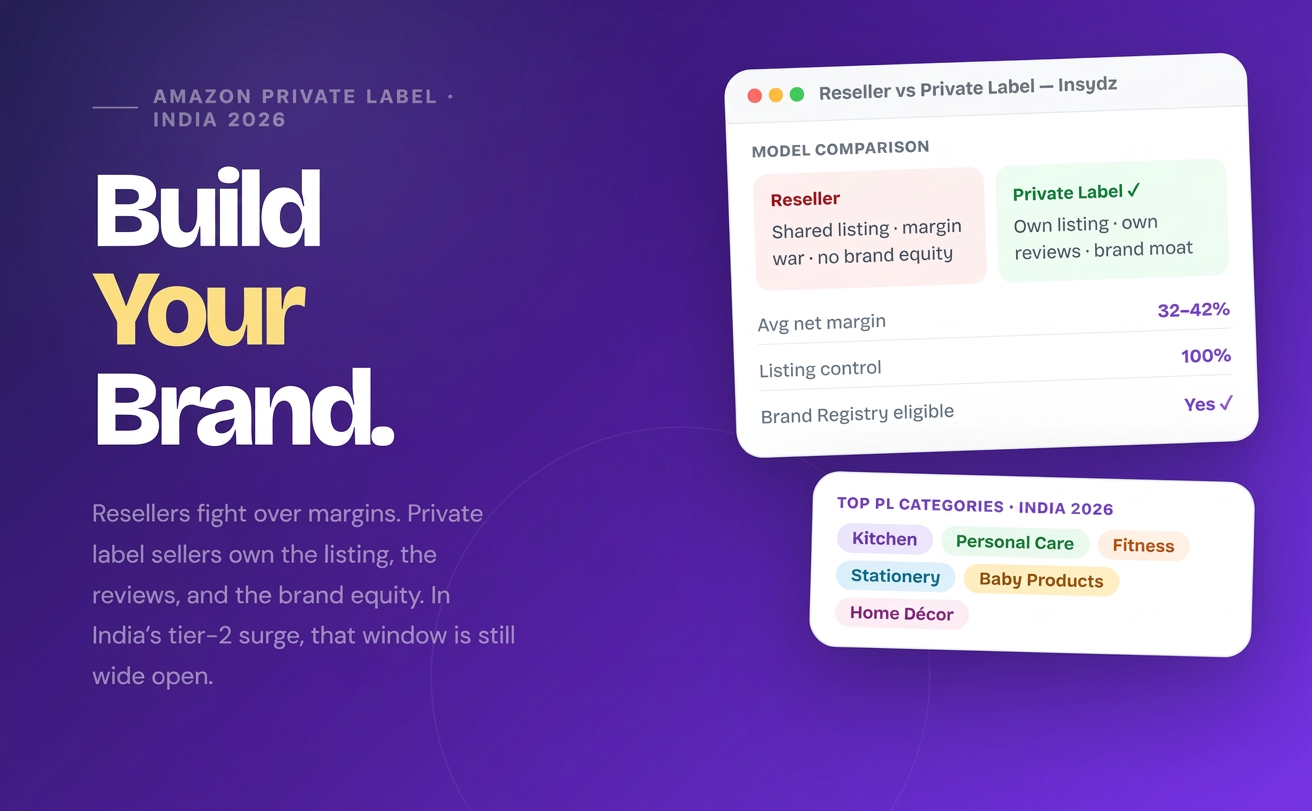
Private label vs reselling on Amazon India — model comparison and top performing categories for new brand builders in 2026.
How Do You Find the Right Product for Private Label on Amazon India?
Product selection determines whether your private label succeeds or fails. The framework Indian sellers use in 2026 combines demand validation with review gap analysis.
Start with Amazon Best Sellers in categories where Indian manufacturers exist. Look for ASINs selling 200–800 units per month, priced ₹399–₹1,499, with under 200 reviews.
Then read the 2-star and 3-star reviews. If 40% of the category leader's reviews mention "flimsy packaging" or "no Hindi instructions", those are the specs your product needs to beat.
Paste any ASIN into Insydz and you see the top complaint clusters for that product, ranked by frequency. Those complaints become your product differentiation brief before you brief your manufacturer.
- •Category leaders have 1,000+ reviews with 4.4+ average — too established to displace without a breakthrough product
- •Products that require a CE mark, BIS certification, or FSSAI licence — regulatory compliance adds 4–8 weeks and ₹30,000–₹80,000 in costs
- •Products where the top seller is a Flipkart or Amazon private label brand — fighting the platform itself is not a winnable strategy
Categories to consider: kitchen organisers, water bottles, stainless steel containers, personal care kits, and stationery sets. Avoid electronics — established brands dominate with warranties private label cannot match.
Where Do You Source Private Label Products in India, and How Do You Vet Suppliers?
Indian private label sellers have a structural advantage over Amazon.com sellers: your manufacturer is domestic. No import duties, no 12-week shipping delays, no minimum order quantities designed for Western importers.
Where to Find Manufacturers
IndiaMart and TradeIndia are the two primary directories. Search your category plus "OEM" or "white label" and filter for verified suppliers with GST registration.
For kitchen and home try Rajkot or Surat; for fitness accessories, Pune; for textiles, Tiruppur.
If you are within driving distance of the manufacturing cluster, visit the factory in person before committing to a production order.
- •Verify GSTIN on the GST portal before any payment
- •Order samples from at least 3 suppliers — never choose on price alone
- •Request a WhatsApp video walk-through of the production floor
- •Ask for a proforma invoice confirming unit price and lead time before committing
Negotiate MOQs to 100–200 units for your first run — do not commit to 500+ units until your listing proves a conversion rate above 5%.
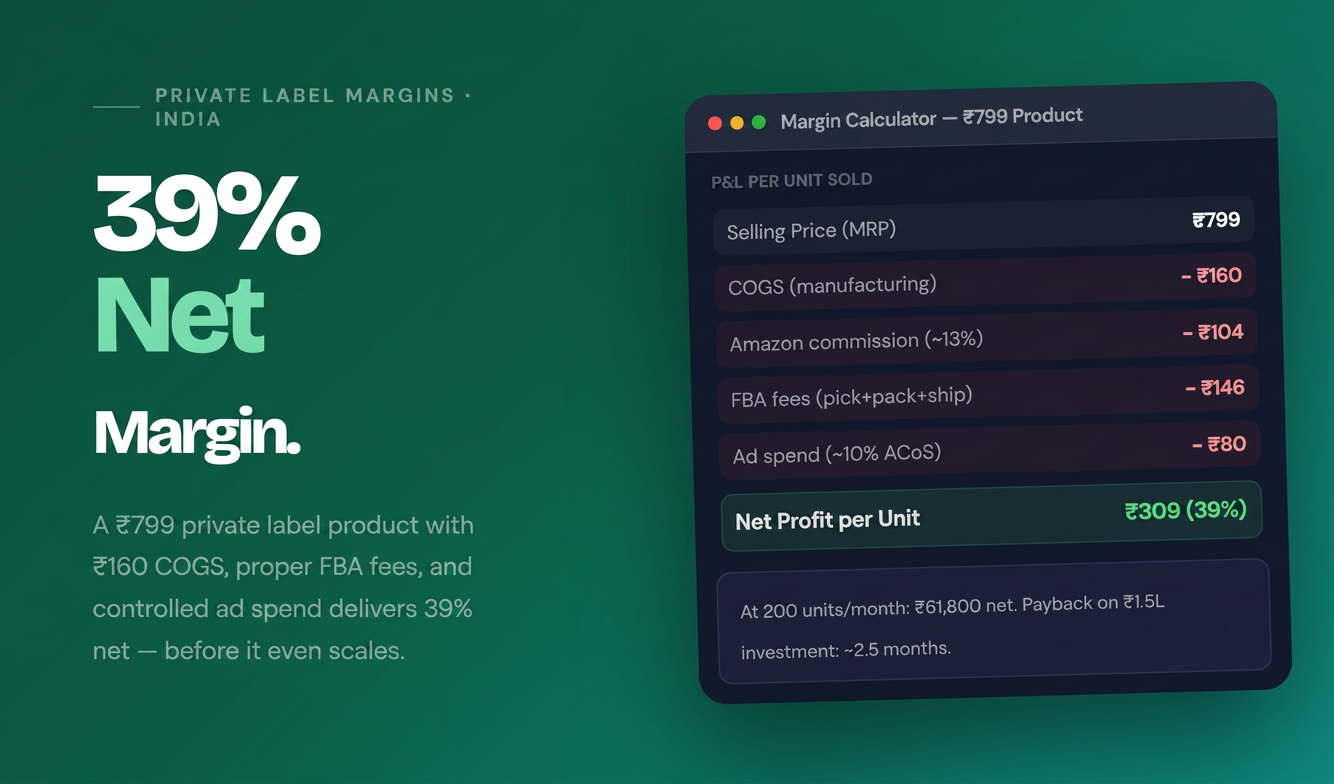
Private label margin model for a ₹799 Amazon India product — COGS, FBA fees, commission, and ad spend calculated to a 39% net margin per unit sold.
How Do You Register Your Brand and Get Amazon Brand Registry in India?
Brand Registry is the most important unlock in your private label journey — A+ Content (lifts conversion 3–10%), Amazon Vine access, and protection from listing hijackers.
Pick a Brand Name — Check IP India First
Search ipindia.gov.in to confirm your chosen name is available. Short, pronounceable names in both Hindi and English perform better with Indian buyers.
File Trademark in the Correct Class
File on IP India in the class matching your product (Class 21 for kitchenware, Class 3 for personal care, etc). Cost: ₹4,500 for individuals. Application number issued immediately.
Apply on brandregistry.amazon.in
Submit your brand name, trademark application number, and packaging photos showing the brand name. Amazon approves in 2–5 business days.
Unlock A+ Content, Vine, and Brand Analytics
Once approved, build your A+ Content module immediately — it increases conversion by 3–10% and is free to create. Enrol in Amazon Vine India for your first batch of verified reviews.
How Do You Create a Listing That Actually Converts for an Indian Buyer?
Indian buyers make 70%+ of purchase decisions on the primary image and star rating — before reading a word. A generic title and mediocre images will lose to a competitor with half your reviews but great visuals.
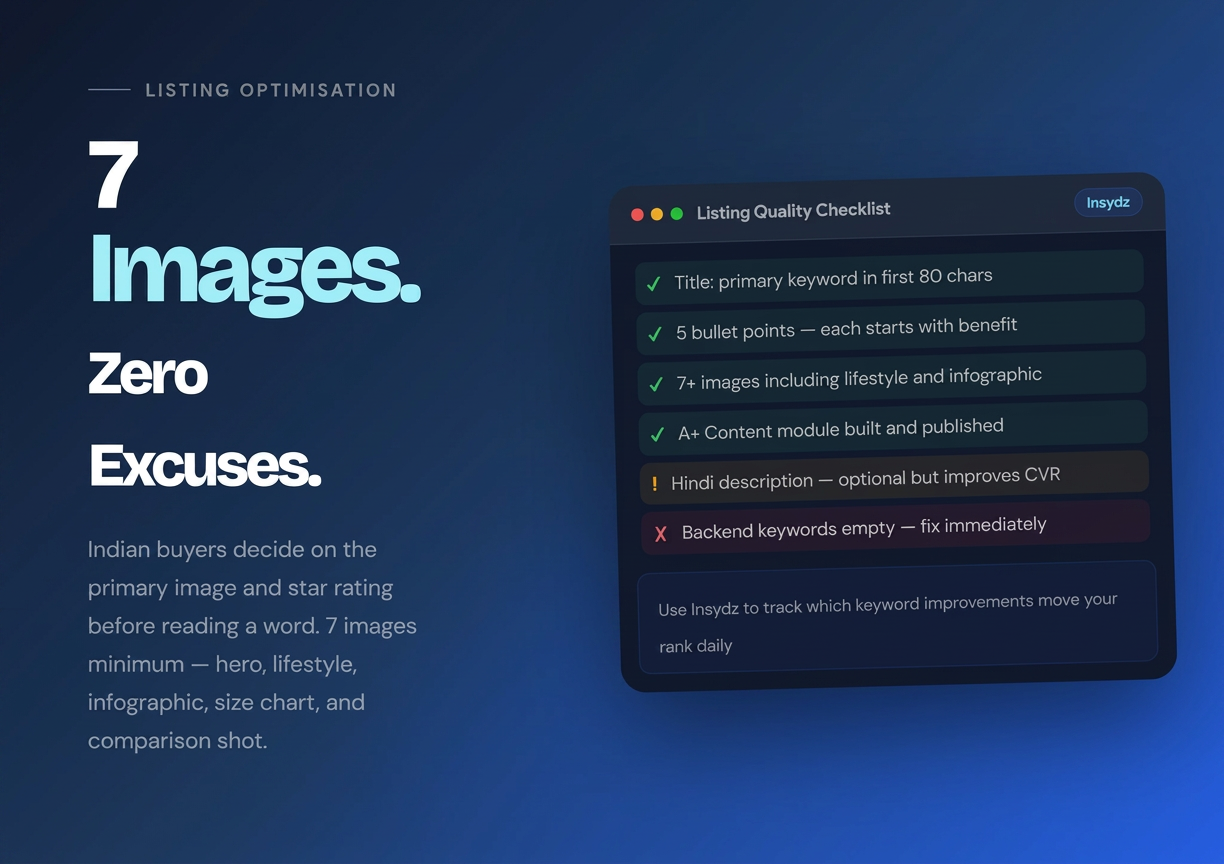
Listing quality checklist for Amazon India private label — title structure, image count, A+ Content, and keyword fields that directly impact conversion and rank.
What Is the Right Launch Strategy for a New Private Label on Amazon India?
Launching without a plan is the most common reason private label products fail. Most sellers list, wait for organic sales, get no reviews, and quit within 30 days. The 4-week launch window is the most critical period your product will ever have.
Enrol in Amazon Vine India on Day One
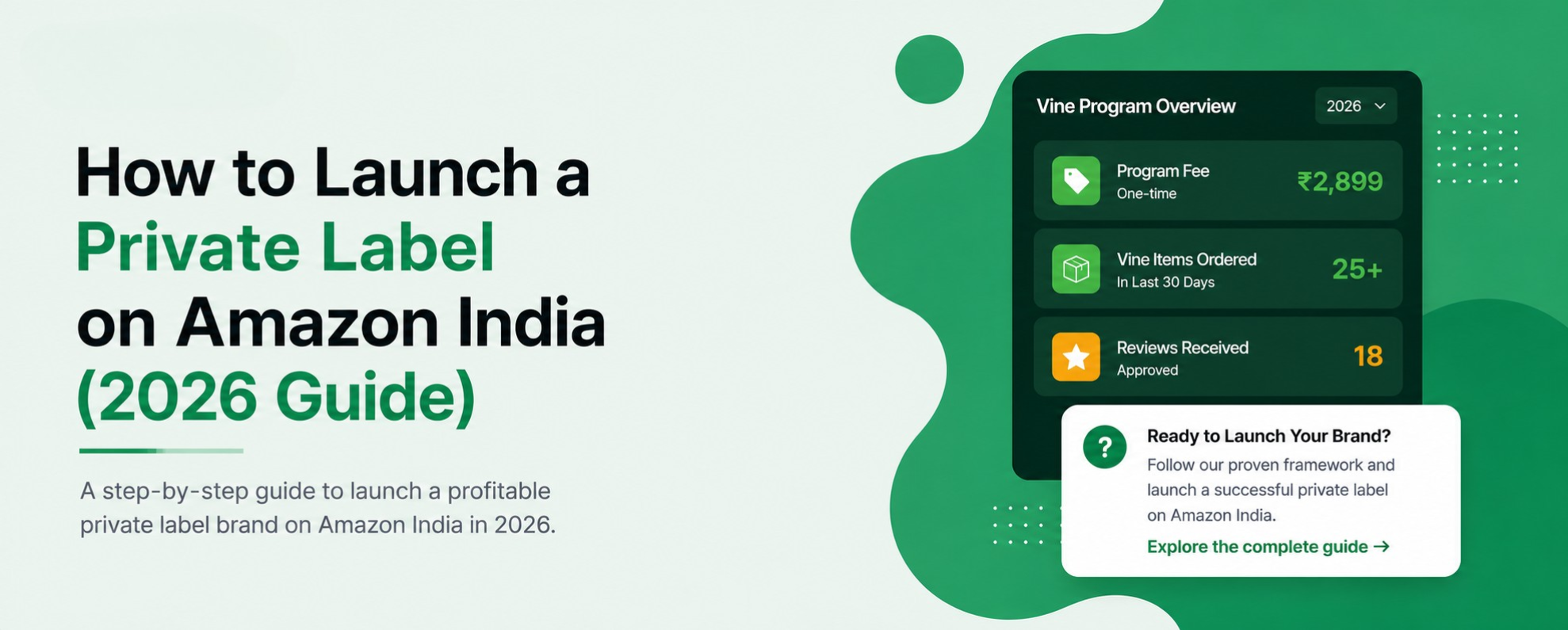
As soon as your listing is live with FBA inventory, enrol in Vine (₹19,200 for up to 30 reviews). This is non-negotiable for a private label launch. You need social proof before organic buyers arrive.
Run Sponsored Products at a Higher Bid for Weeks 1–4
Run an auto campaign and 2 manual exact-match campaigns on your top 5 keywords. Accept higher ACoS in weeks 1–4 to build rank, then optimise for profitability from week 5.
Share Your Listing on WhatsApp Before Going Live
Tell your network — customers, friends, colleagues — via WhatsApp that the product is live. Even 10–15 organic sales in week 1 signal relevance to Amazon's algorithm.
Track Keyword Rank Daily from Week 1
Use Insydz to track daily rank on your target keywords. Know when you cross threshold positions (#50, #30, #15) and which actions drove each jump.
Respond to Every Review in Weeks 1–8
Respond publicly to every 3-star or below review with a resolution offer. It shows future buyers you stand behind the product — and often prompts rating updates.
Track Your Private Label Rankings from Launch Day
See exactly which keywords move as your reviews and sales build — Insydz tracks daily on Amazon India and Flipkart.
Scaling: From 1 ASIN to a Full Brand
Once your first product is generating ₹2L in monthly profit, don't just sit on it. Reinvest that profit into your next product. A "brand" is a collection of complementary products that solve a specific customer problem.
What Are the Most Common Mistakes New Private Label Sellers Make on Amazon India?
These are the five mistakes that kill launches before they scale.
Which Tool Should You Use to Track and Grow Your Private Label on Amazon India?
Once live, the work shifts to rank tracking, review analysis, and competitor monitoring. Here is how tools compare for Indian private label sellers.
| Capability | Insydz | Helium 10 | Jungle Scout | Viral Launch |
|---|---|---|---|---|
| Amazon India keyword rank tracking | ✓ Native | Limited | US focus | US focus |
| Flipkart rank tracking | ✓ Yes | No | No | No |
| Competitor review analysis | ✓ AI-powered | Basic | Basic | Limited |
| Hindi review analysis | ✓ Yes | No | No | No |
| Pricing for Indian sellers | ₹0-₹4,999/mo | ₹7,000+/mo | ₹5,500+/mo | ₹5,000+/mo |
| India-first support | Email only | Email only | Email only |
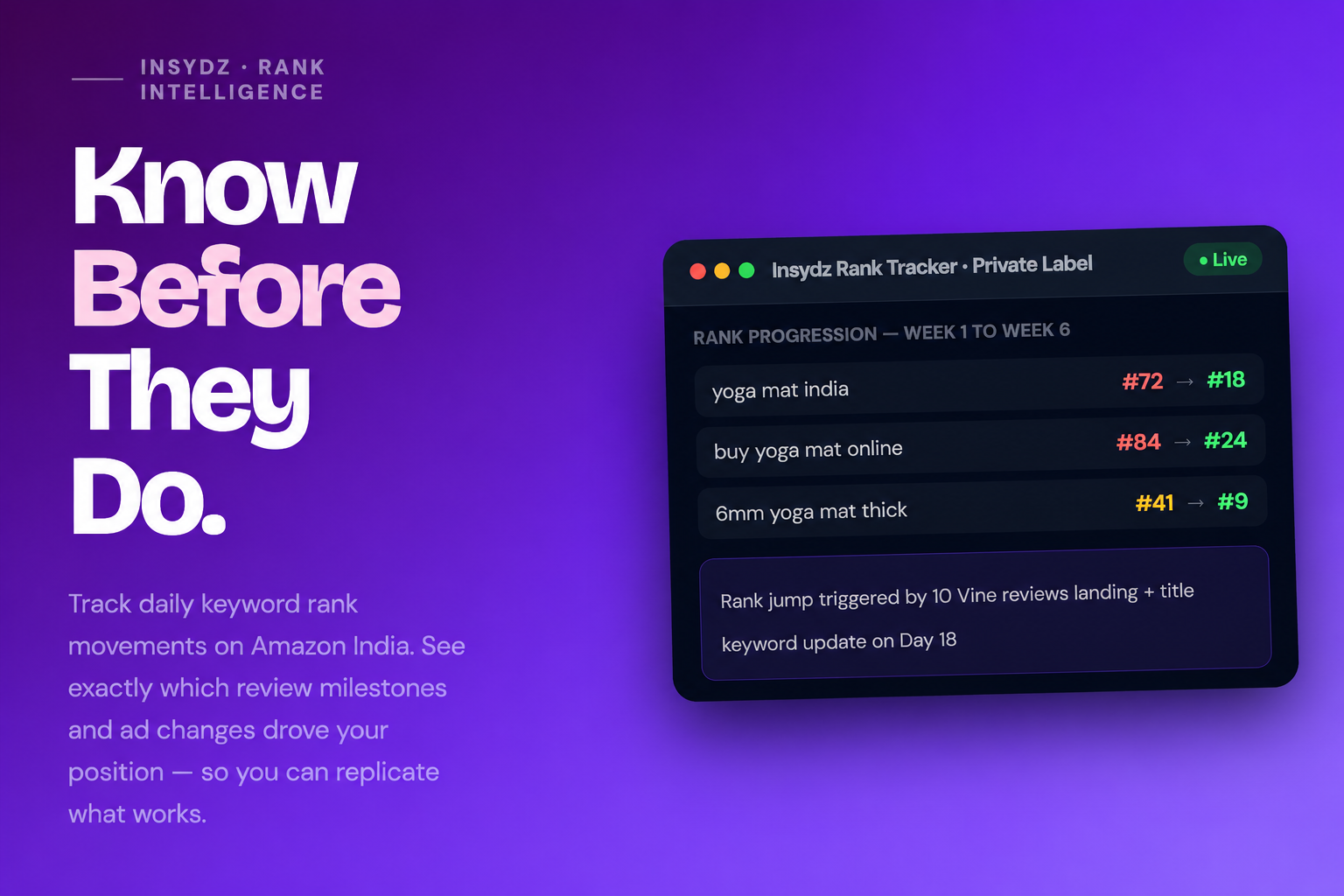
Insydz rank tracking for a private label yoga mat launch on Amazon India — from invisible (#72) to top-20 in 6 weeks, with rank jumps correlated to Vine reviews and listing changes.