Why Is Keyword Gap Analysis the Fastest Path to Organic Rank Gains?
Most Amazon India sellers optimise their listings in isolation, looking at their own title, bullets, and backend keywords and trying to improve what they already have. This has a ceiling: the words you have not thought of are not there to improve.
Keyword gap analysis flips the approach. Instead of starting with your own listing, you start with your competitor's ranking keywords and ask what you are missing. The gap is a ready made list of proven demand: someone is already searching, your competitor is already capturing it, and you are not.
One gap keyword discovery can move a listing from page 3 to page 1 for that specific term. This is not theoretical. It happens within 2 to 4 weeks of adding a high demand gap keyword to your backend search terms and generating a few sales on that term through Sponsored Products.
What Is Reverse ASIN Research and How Does It Work?
Reverse ASIN research means working backward from a product to its keywords. You start with your competitor's ASIN (their Amazon product ID) and ask: which search terms does this product currently appear for in Amazon search results?
The process works because Amazon's search index can be observed. When a buyer searches a term and a product appears, that product keyword relationship is recorded. Reverse ASIN tools check thousands of search terms one by one against a given ASIN and return the full list of terms where that ASIN ranks, along with its position for each term.
What You Get From a Reverse ASIN Lookup
- Keyword list: every search term the competitor's ASIN ranks for, usually 50 to 150 terms for a well optimised product
- Search frequency rank: how often that term is searched on Amazon India. Lower number means higher demand.
- Competitor's rank position: are they at position 3 or position 28? This tells you how hard they are to displace on each term.
- Your rank position: where you currently appear for the same term, or if you do not appear at all.
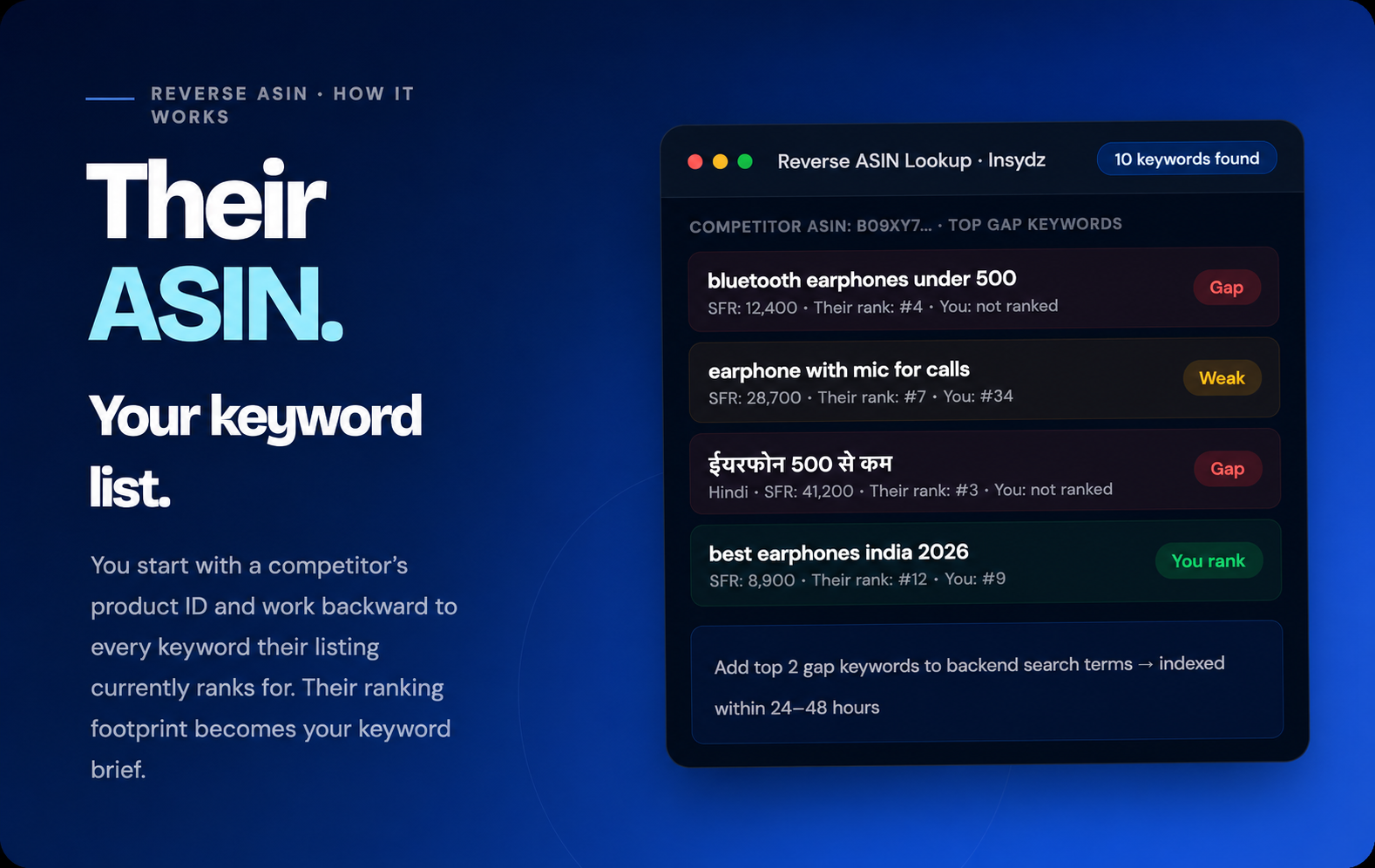
Insydz reverse ASIN lookup. Competitor keyword footprint revealed with search frequency rank, their position, and your current rank. Gap keywords (not ranked) and weak keywords (ranked below 20) are prioritised automatically.
What Does the Keyword Gap Actually Look Like in a Real Category?
Here is what a keyword gap analysis looks like in the earphones category on Amazon India, comparing a mid range seller to the category leader. The numbers are realistic for this category in 2026.
| KEYWORD | SEARCH FREQ. RANK | COMPETITOR RANK | YOUR RANK | GAP TYPE |
|---|---|---|---|---|
| bluetooth earphones under 500 | 12,400 | #4 | Not ranked | Hard gap |
| earphone with mic for calls | 28,700 | #7 | #34 | Weak rank |
| ईयरफोन 500 से कम (Hindi) | 41,200 | #3 | Not ranked | Hard gap |
| wired earphone with volume control | 67,800 | #6 | #28 | Weak rank |
| earphone for study music | 88,300 | #11 | Not ranked | Hard gap |
| tangle free earphone india | 112,400 | #5 | #41 | Weak rank |
| earphone 6 months warranty | 134,700 | #9 | Not ranked | Hard gap |
| best sound earphone 2026 | 8,900 | #12 | #9 | You rank |
The hard gap keywords (terms you do not rank for at all) are where the biggest ranking opportunity sits. Adding "bluetooth earphones under 500" and "ईयरफोन 500 से कम" to your backend search terms and running 3 to 5 days of exact match Sponsored Products on each term is typically enough to get Amazon to index your listing for those terms within 2 weeks.
How Do You Prioritise Which Gap Keywords to Target First?
Not all gap keywords are equal. A gap keyword with a search frequency rank of 12,000 deserves more immediate attention than one with a rank of 800,000. Here is a simple prioritisation framework.
Filter by search frequency rank under 50,000 first
On Amazon India, a search frequency rank under 50,000 represents a term searched frequently enough to drive meaningful traffic. Start your gap list here. Below 50,000 gives you 10 to 30 high priority targets for most categories.
Filter out broad head terms with low buying intent
A term like "earphones" has high search volume but low conversion because buyers are browsing, not buying. Prioritise gap keywords with buying signals: "buy earphones under 500", "earphones with warranty india". These convert at 2 to 3 times the rate of generic terms.
Check the competitor's rank on the gap keyword
If your competitor ranks #4 to #15 for a gap keyword, there is room to enter and compete. If they rank #1 to #3 on a high volume term, you may need Sponsored Products investment first before organic rank is realistic. Target the keywords where they rank #8 to #20 as your fastest wins.
Separate Hindi gap keywords for separate prioritisation
Hindi gap keywords compete in a different pool from English terms. Do not deprioritise them just because their search frequency rank appears lower. Competition for Hindi terms is typically 60 to 80 percent lower than for equivalent English terms, making them easier to rank for even from a standing start.
Pick 5 to 8 gap keywords to act on this week
More than 8 is too many to track meaningfully. Pick the 5 to 8 top gap keywords, add them to your listing, and run Sponsored Products on each for 7 days. Then check rank movement with Insydz and repeat with the next batch.
Insydz shows every keyword your competitor ranks for that you do not
Run a reverse ASIN lookup on your top competitor and see your keyword gap in under 60 seconds.
How Do You Add Gap Keywords to Your Listing Correctly?
Each part of your Amazon listing serves a different role in keyword indexing. Here is exactly where each type of gap keyword belongs.
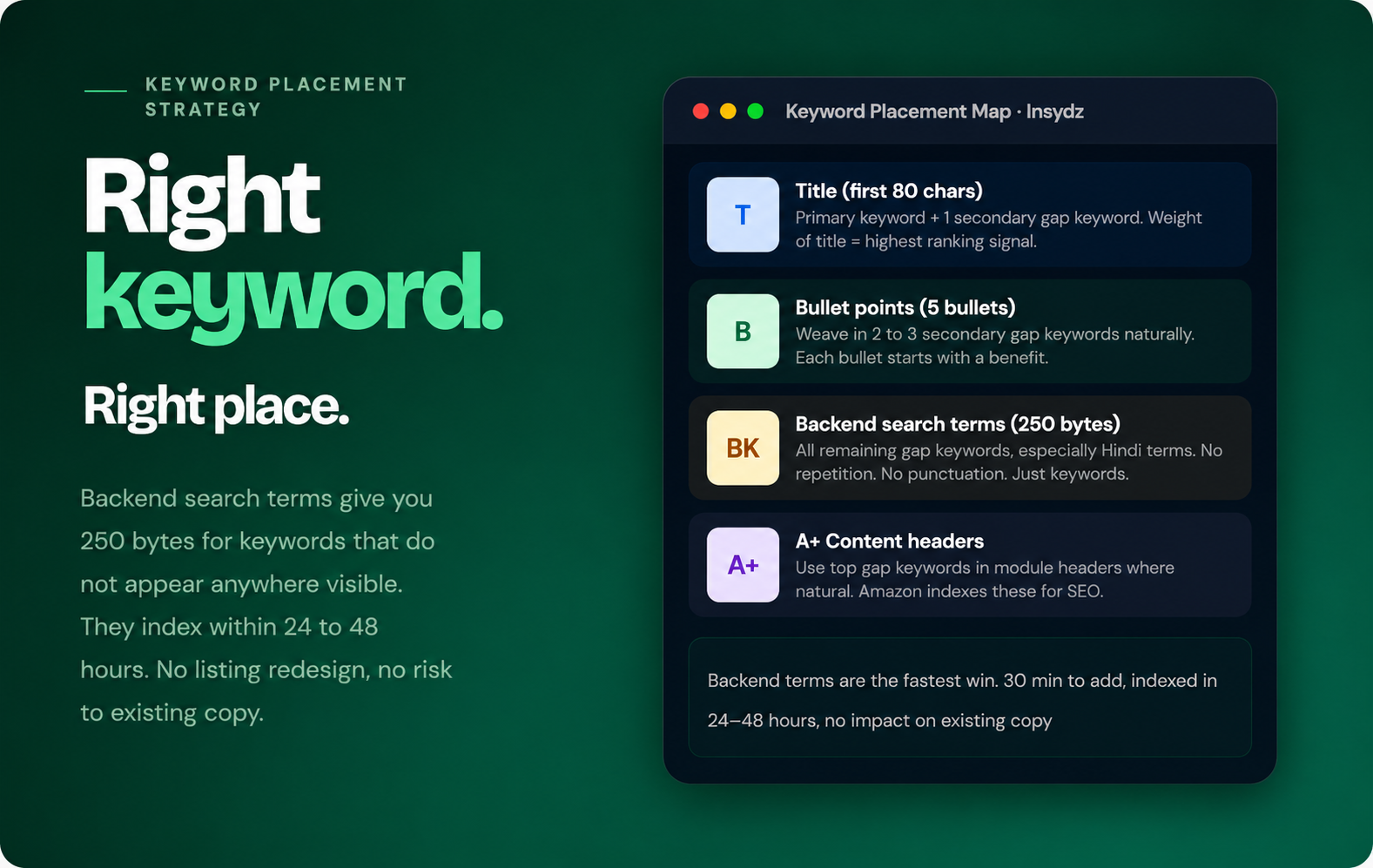
Keyword placement map showing where each type of gap keyword belongs in your Amazon India listing. Backend search terms are the fastest entry point: 250 bytes of invisible keyword real estate indexed within 48 hours.
| LISTING LOCATION | KEYWORD TYPE TO ADD | MAX CAPACITY | TIME TO INDEX |
|---|---|---|---|
| Title (first 80 chars) | Primary gap keyword only, must read naturally | 1–2 keywords max | Immediate |
| Bullet points | Secondary gap keywords woven into benefit statements | 3–5 additional keywords | 24 hours |
| Backend search terms | All remaining gap keywords incl. Hindi terms | 250 bytes (~40 keywords) | 24–48 hours |
| Product description | Long-tail gap keywords used in full sentences | 3–5 additional keywords | 2–5 days |
| A+ Content headers | Top gap keywords used as section titles | 2–4 additional keywords | 2–5 days |
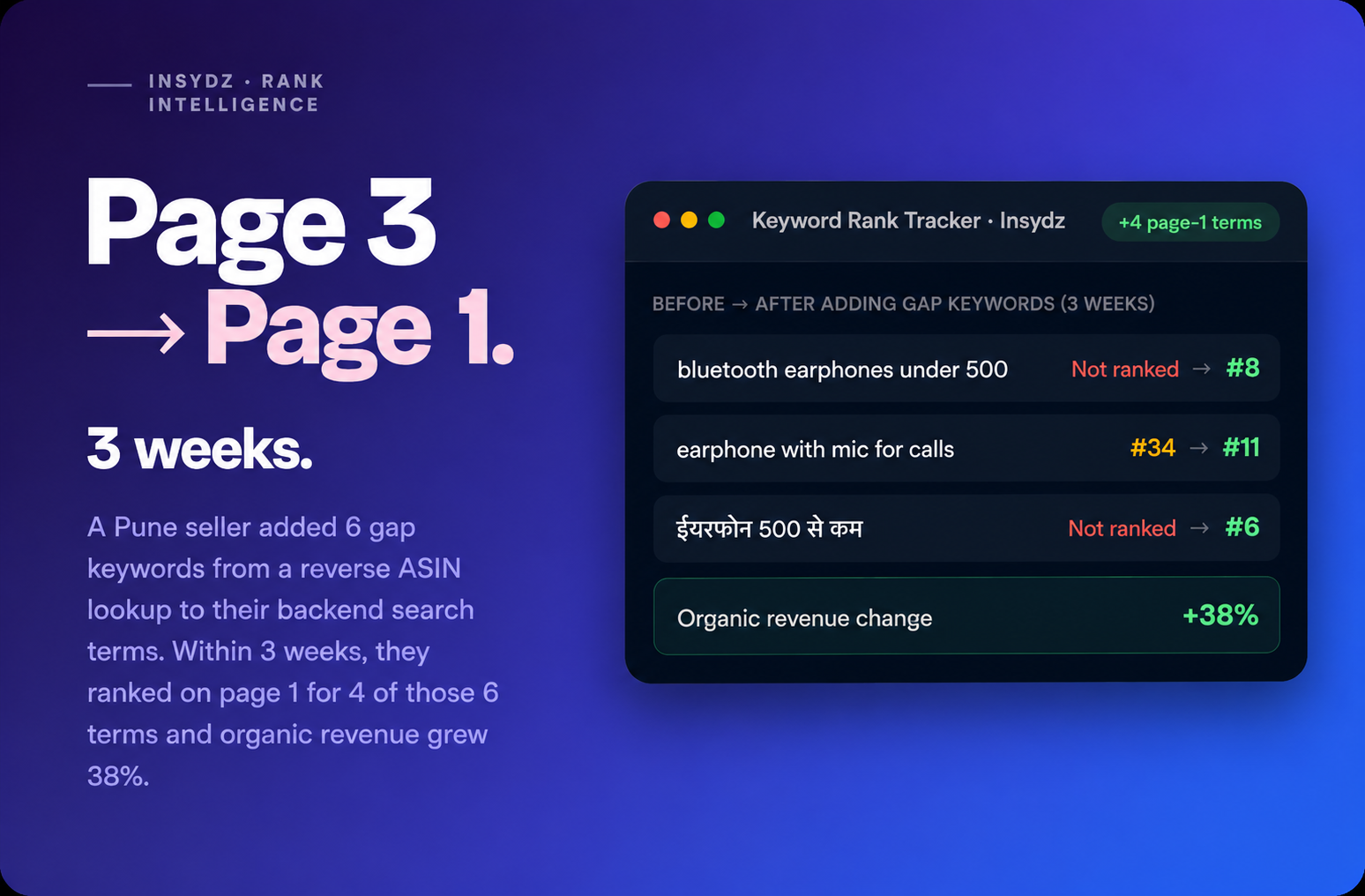
Insydz rank tracking. A Pune earphones seller added 6 gap keywords to backend search terms and moved from not ranked to top 10 for 3 of them within 3 weeks. Organic revenue up 38% on those terms alone.
How Do You Find Competitor Keywords Without a Paid Tool?
If you want to start today before setting up Insydz, here are the two free manual methods. They are slower and incomplete, but they work well enough to find the most obvious gaps.
Amazon Search Bar Method
Each suggestion is a real search term buyers use. Compare these to your current listing keywords. Any term not in your listing is a gap worth considering.
Seller Central Brand Analytics
Use this to validate the demand of gap keywords you have identified manually before adding them to your listing.
Insydz Reverse ASIN Lookup
The gap keywords are pre-filtered and sorted by priority.