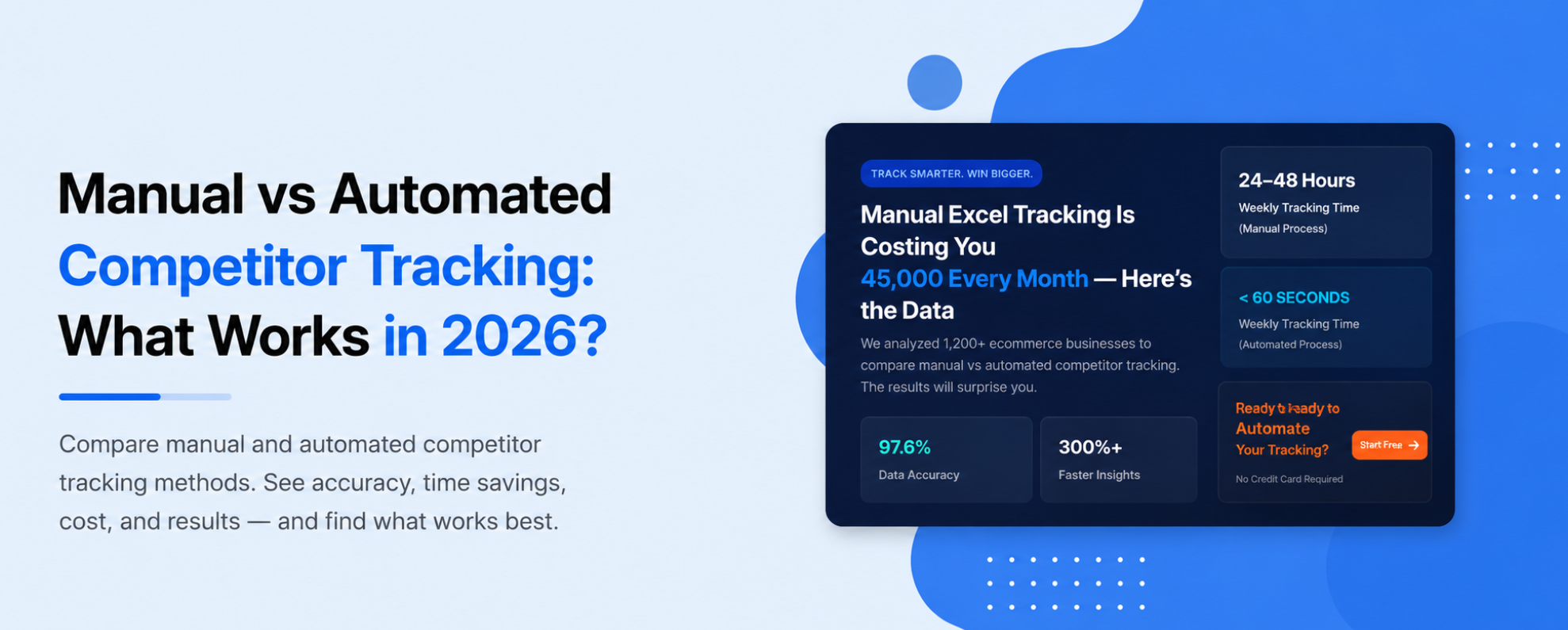
Manual tracking is like checking the weather by looking out the window every few hours. Automated competitor tracking is like having a real-time weather station that alerts you the moment conditions change and tells you exactly what to wear before you leave the house. Both tell you about the weather. Only one helps you actually respond to it in time.
Manual vs Automated Competitor Tracking: The Core Difference
At its simplest: manual price tracking gives you a snapshot of where prices were when you checked. Automated competitor tracking tells you where prices are right now and what to do about it.
For Indian ecommerce sellers on Amazon.in and Flipkart, that distinction is the difference between winning and losing the Buy Box on any given day. Dynamic pricing in e-commerce means India's market moves faster than any other — a ₹50 price change at 11 PM can shift the Buy Box overnight, and you won't know it happened until the next morning when you open your spreadsheet.
Manual Price Tracking
- ❌ Detection delay: 24–48 hours
- ❌ Data accuracy: 82–88% (human error)
- ❌ Requires 3–5 hrs daily effort
- ❌ Breaks down at 10+ SKUs
- ❌ No overnight coverage
- ✅ Zero tool cost
Automated Competitor Tracking
- ✅Detection: <60 min, 24/7
- ✅ Data accuracy: 99.9% (API crawl)
- ✅ Zero daily effort required
- ✅ Scales to unlimited SKUs
- ✅Overnight & weekend coverage
- ✅ AI margin-preserving recommendations
Manual vs Automated Full Breakdown
| Factor | Manual Excel | AI-Powered Automation | Winner |
|---|---|---|---|
| Detection Speed | 24–48 hours | < 60 minutes | AI Automation |
| Data Accuracy | 82–88% (human error) | 99.9% (API crawl) | AI Automation |
| Daily Labour | 3–5 hrs/day | Zero — fully automated | AI Automation |
| SKU Scalability | 8–12 SKUs practical | Unlimited | AI Automation |
| Alert Method | None — proactive check | WhatsApp in real time | AI Automation |
| Recommendation | Raw data only | AI decision + margin | AI Automation |
| Monthly Tool Cost | Free | ₹1,999–2,999/mo | Manual (barely) |
| True Monthly Cost | ₹96,000+ (all-in) | ₹1,999–2,999/mo | AI Automation |
Manual Price Tracking: The Full Picture
Manual price tracking — opening competitor listings on Amazon.in and Flipkart every morning, copying prices into a spreadsheet, and trying to spot patterns — is how the majority of Indian ecommerce sellers still manage competitor intelligence today.
It works. At very small scale. For sellers with 1–5 SKUs and a handful of competitors who are just starting out, a daily Excel check is a legitimate, zero-cost method of staying roughly informed. The problem isn't that manual tracking is wrong. The problem is that it stops working exactly when your business starts getting serious.
The Hidden Time Cost Most Sellers Never Calculate
A typical Indian Amazon seller managing 20 SKUs with 5 competitors each spends an average of 3.4 hours per day on manual price checks. At a conservative opportunity cost of ₹500/hour, that's ₹51,000/month in productive time spent on a task that AI can perform in seconds. Most sellers have never run this calculation.
A Delhi-based electronics accessories seller was doing ₹3.2 lakh/month on Amazon. A new competitor entered with a ₹30 lower price. Sales dropped to ₹1.8 lakh within 6 weeks. The seller found out via a customer message not a tool. Had they tracked prices in real time, they could have matched the competitor within an hour and retained the Buy Box.
Data Accuracy: The Problem Nobody Talks About
Manual data entry into Excel introduces errors at an average rate of 12–18% meaning roughly 1 in 6 price entries in your spreadsheet is wrong. You're making pricing decisions based on a data set that is both 24 hours stale AND 15% inaccurate. The combination of delay and inaccuracy is far more damaging to your competitive positioning than either problem alone.
Manual price tracking was the only viable option for Indian sellers before 2020. In 2026, AI-powered workflow automation has made it not just obsolete but actively harmful the hours spent on manual tracking are hours not spent on product development, listing optimisation, or customer acquisition. The opportunity cost of manual tracking now significantly exceeds the cost of automation.
Automated Competitor Tracking: The Full Picture
Automated competitor tracking in ecommerce tools crawl competitor prices on Amazon.in, Flipkart, and Meesho continuously — typically every 15–60 minutes — and surface changes the moment they happen, with AI-generated recommendations for exactly how to respond.
The key distinction between basic price alert tools and a genuine AI price tracking tool is the intelligence layer. A basic free tool tells you 'Competitor A changed their price.' An AI-powered platform tells you: 'Competitor A dropped to ₹899. You're currently at ₹949. Recommend: Adjust to ₹919 to recover the Buy Box while protecting ₹42 more margin than a direct price match.'
Automated Live Data Crawling
The tool's crawler or API pulls live price data from product listings at frequent intervals every 15–60 minutes for AI-powered tools like Insydz. No human checking, no delays, no errors.
AI Engine Analysis
The AI compares your price against the category benchmark and competitor prices, factoring in ratings, delivery speed, Buy Box eligibility criteria, and stock levels in real time.
WhatsApp Alert Not Email
You receive a WhatsApp alert the moment a competitor changes price beyond your defined threshold. Indian SMB sellers check WhatsApp 50+ times daily. Email is checked 2–3 times. The channel matters as much as the alert itself.
Actionable AI Recommendation
The platform gives a decision, not just data: 'Competitor A dropped to ₹899. Recommend adjusting to ₹919 to stay competitive while protecting ₹42 more margin.' Not a data dump — a decision engine.
One-Tap Price Update
For sellers using integrated platforms, the recommended price can be applied directly from the alert from competitor price drop to your updated listing in under 5 minutes, end to end.
Manual tracking gives you data points. AI-powered intelligence gives you decisions. That gap is the difference between reacting tomorrow and winning today. The sellers gaining market share in 2026 are not necessarily the ones with better products they're the ones with faster, more accurate competitive intelligence.
The Real Cost Comparison: Manual vs Automated
Most sellers evaluate manual tracking as 'free' because there's no tool invoice. This is the single most expensive misconception in Indian ecommerce. Manual tracking has three real costs that are rarely calculated together.
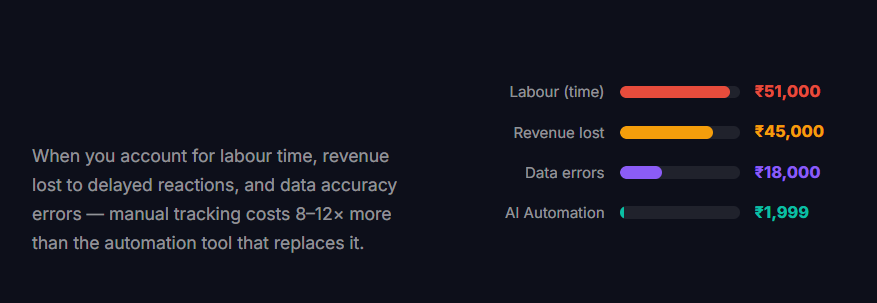
When labour time, delayed-reaction revenue loss, and data accuracy errors are combined manual tracking costs 8–12× more per month than the AI tool that replaces it entirely.
| Method | Speed | Accuracy | Actionability | True Cost/Month |
|---|---|---|---|---|
| Manual Excel Tracking | 24–48 hrs | Low (human error) | None — just data | ₹96,000+ (labour + revenue loss) |
| Basic Free Alert Tools | 2–6 hours | Medium | Low — alerts only | Free–₹500 + partial revenue loss |
| Global SaaS (Helium 10) | 1–2 hours | High | Medium (US-focused) | ₹4,000–8,000/mo (no Flipkart) |
| India-First AI (Insydz) ★ | < 1 hour | High | High — Actionable AI | ₹1,999–2,999/mo |
Replace Manual Tracking with AI Free
Real-time competitor price alerts on WhatsApp. Amazon.in, Flipkart & Meesho. Setup in under 30 minutes.
When Manual Tracking Still Makes Sense
This is an honest guide, not a sales pitch. There are specific scenarios where manual price tracking is a reasonable choice for Indian sellers in 2026:
If you're testing your first products, a daily manual check takes 20–30 minutes and is a reasonable starting point before committing to tools.
If your category has 2–3 competitors who rarely change pricing, automation ROI is lower. Quarterly manual checks may suffice.
Use manual tracking for 30–60 days to understand your competitive landscape before investing in tools.
Before committing to any paid tool, run a 2-week parallel test: manual tracking alongside a free trial to verify the tool's value.
The right question isn't 'manual or automated?' it's 'at what SKU count and revenue level does the ROI of automation exceed its cost?' For most Indian sellers, that threshold is 10+ SKUs generating ₹1 lakh/month. Below that threshold, the free Insydz plan bridges the gap.
5 Signs You've Already Waited Too Long to Automate
If buyers are telling you 'I bought from Competitor X because they were cheaper' the competitor changed their price days ago. By the time a customer tells you, you've already lost dozens of sales to that price gap. This is the most expensive early warning sign.
If your Buy Box percentage has fallen 10–20 points but your listing quality hasn't changed, a competitor almost certainly made a price move you didn't catch in time. Manual Excel monitoring doesn't track Buy Box win rate it only captures the price you remembered to check that morning.
Without real-time data and AI intelligence, most Indian sellers respond to perceived competitive pressure by cutting prices aggressively destroying margins unnecessarily. AI price tracking tools calculate the minimum adjustment needed to stay competitive, which is almost always less than the instinctive panic cut.
Manual tracking scales linearly with SKU count. At 20 SKUs, the daily price check becomes a 3–4 hour job. At 50 SKUs, it's a full-time role. Ecommerce automation in India means your price intelligence capacity should grow with your catalogue not require headcount.
Most price wars happen at 10 PM. Competitors make moves knowing you won't notice until 9 AM giving them a 10-hour window to capture your Buy Box while you sleep. Automated real-time alerts have no business hours.
Best Practices: Weekly Execution Model for Automated Tracking
The most successful Indian sellers don't react to pricing changes — they run a structured weekly rhythm that keeps them consistently competitive without manual effort. The foundation is real-time alerts and data accuracy — two capabilities that manual tracking simply cannot provide at scale. Daily automated digests, weekly 30-minute reviews, and monthly strategic audits keep your ecommerce automation strategy compounding.
For Flipkart sellers, our Flipkart keyword research and SEO optimization guide details the specific rank tracking workflow that complements automated price monitoring.
- Morning WhatsApp: top 3 competitor price movements overnight
- Review Buy Box status for top 10 SKUs
- Act on any 'Critical Alert' (competitor dropped >10%)
- Review competitor review sentiment recurring pain points?
- Check keyword rank movements for top 5 keywords
- Identify competitors that went OOS (opportunity)
- Adjust 1–2 product prices based on AI recommendations
- Audit pricing for upcoming festive season or sale events
- Identify 1 new product from AI gap analysis report
- Review revenue impact of pricing changes (before vs. after)
Key Metrics to Track
Buy Box Win Rate
Target: >70% for top SKUs. The single most important pricing health metric. Drops here signal a price or seller performance issue.
Price Competitiveness Index
Are you within 5% of the category median price at all times? Automated tracking makes this visible — manual tracking makes it invisible.
Revenue per SKU (Monthly Trend)
Track individual SKU revenue to catch silent revenue leakage early before a 20% drop becomes visible in monthly totals.
Competitor Stock-Out Capture
Did you gain sales when a rival went OOS? Often a 3–5× revenue opportunity. Only possible with automated tracking that monitors stock levels.
Best Tools for Automated Competitor Tracking in India (2026)
Not all tools are built equally and for Indian sellers, the platform choice is critical. Global tools like Helium 10 and Jungle Scout are built for Amazon.com. Their keyword databases, search volume data, and intent models are calibrated for US buyers making them fundamentally mismatched for Indian marketplace price dynamics. See our Insydz vs Helium 10 comparison for a detailed breakdown.
India-first platforms cover Amazon.in, Flipkart simultaneously with WhatsApp alerts and AI-powered buy intent data global tools cover none of these India-specific requirements.
| Tool | Amazon.in | Flipkart | WhatsApp Alerts | Buy Intent Data | Price (INR/mo) |
|---|---|---|---|---|---|
| Helium 10 | Partial | No | No | US Only | ₹4,000–8,000/mo |
| Jungle Scout | Partial | No | No | US Only | ₹4,500–7,000/mo |
| Sonar (Free) | Yes | No | No | Basic | Free |
| Insydz ✦ | Yes | Yes | Yes | AI-Powered | ₹1,999/mo + Free |
If you're an Indian seller on Amazon.in or Flipkart and you're not tracking competitor prices with AI, you're operating on guesswork. The question isn't whether you need a tool it's which one fits your budget and platforms. For most Indian SMB sellers, that answer is clearly an India-first platform. The free plan removes every barrier to starting.
The 2026 Verdict
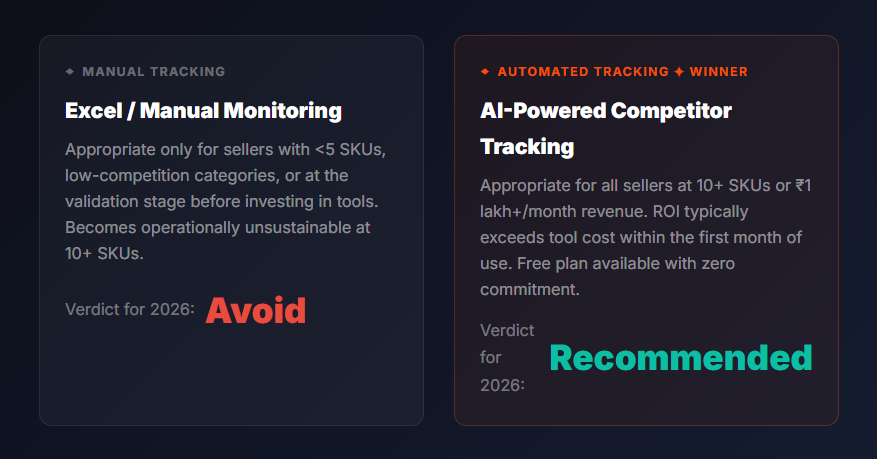
Excel / Manual Monitoring
Appropriate only for sellers with <5 SKUs, low-competition categories, or at the validation stage. Becomes operationally unsustainable at 10+ SKUs.
Verdict for 2026: AvoidAI-Powered Competitor Tracking
Appropriate for all sellers at 10+ SKUs or ₹1 lakh+/month revenue. ROI typically exceeds tool cost in the first month. Free plan available with zero commitment.
Verdict for 2026: RecommendedFrequently Asked Questions
Manual price tracking in Excel is still viable for sellers at the very early stage 1–5 SKUs, low-competition categories, or pre-revenue validation. For any seller beyond that threshold, the true cost of manual tracking (labour time + delayed reaction revenue loss + data errors) typically exceeds ₹50,000/month far more than the ₹1,999/month cost of AI-powered automation. The free tier on India-first platforms like Insydz removes the cost barrier entirely for small sellers.
Final Thoughts
The manual vs automated debate was genuinely close in 2020. In 2026, it isn't a debate anymore.
Manual price tracking made sense when the only alternative was expensive US-built software that didn't understand Indian marketplaces, didn't support Flipkart, and sent alerts by email that nobody read in time. That world no longer exists.
India-first AI platforms now offer real-time alerts on WhatsApp, AI-powered margin-preserving recommendations, and full Amazon.in + Flipkart coverage starting at ₹1,999/month or completely free. The cost of automation is now lower than the cost of one hour of manual tracking per day.
Every hour you spend manually checking competitor prices is an hour a competitor with automation is acting on intelligence you haven't seen yet.