Why Does Amazon Treat Your Reviews as a Ranking Signal, Not Just Reputation?
Most sellers think of reviews as reputation, a score that buyers glance at before deciding. That is half the picture. Amazon's search algorithm reads your reviews too, and it reads them as evidence of listing quality. A listing that keeps earning fresh positive reviews is, to the algorithm, a listing that satisfies buyers. A listing whose recent reviews skew negative is a listing the algorithm becomes cautious about ranking.
Two properties of your reviews feed this. The first is your average star rating, which influences both how often your listing is shown and how often shoppers click it. The second is review velocity, the rate at which fresh reviews arrive. A sudden run of negative reviews changes both at once, which is why a bad patch compounds faster than the raw number of reviews suggests.
This is why treating reviews emotionally is the costly mistake. The seller who reads three angry reviews, feels stung, and closes the tab has learned nothing actionable. The seller who counts the themes across all of them has a repair brief. The rest of this guide is about becoming the second seller.
What Does Dropping From 4.2 to 3.9 Stars Actually Do to Your Sales?
The number looks trivial. Three tenths of a star. In practice it crosses the most important psychological line on Amazon India: the gap between a listing that reads as four stars and one that reads as under four. Buyers scanning a results page read the rating before the title, before the price, before the image detail. A 4.0 reads as acceptable. A 3.9 reads as risky.
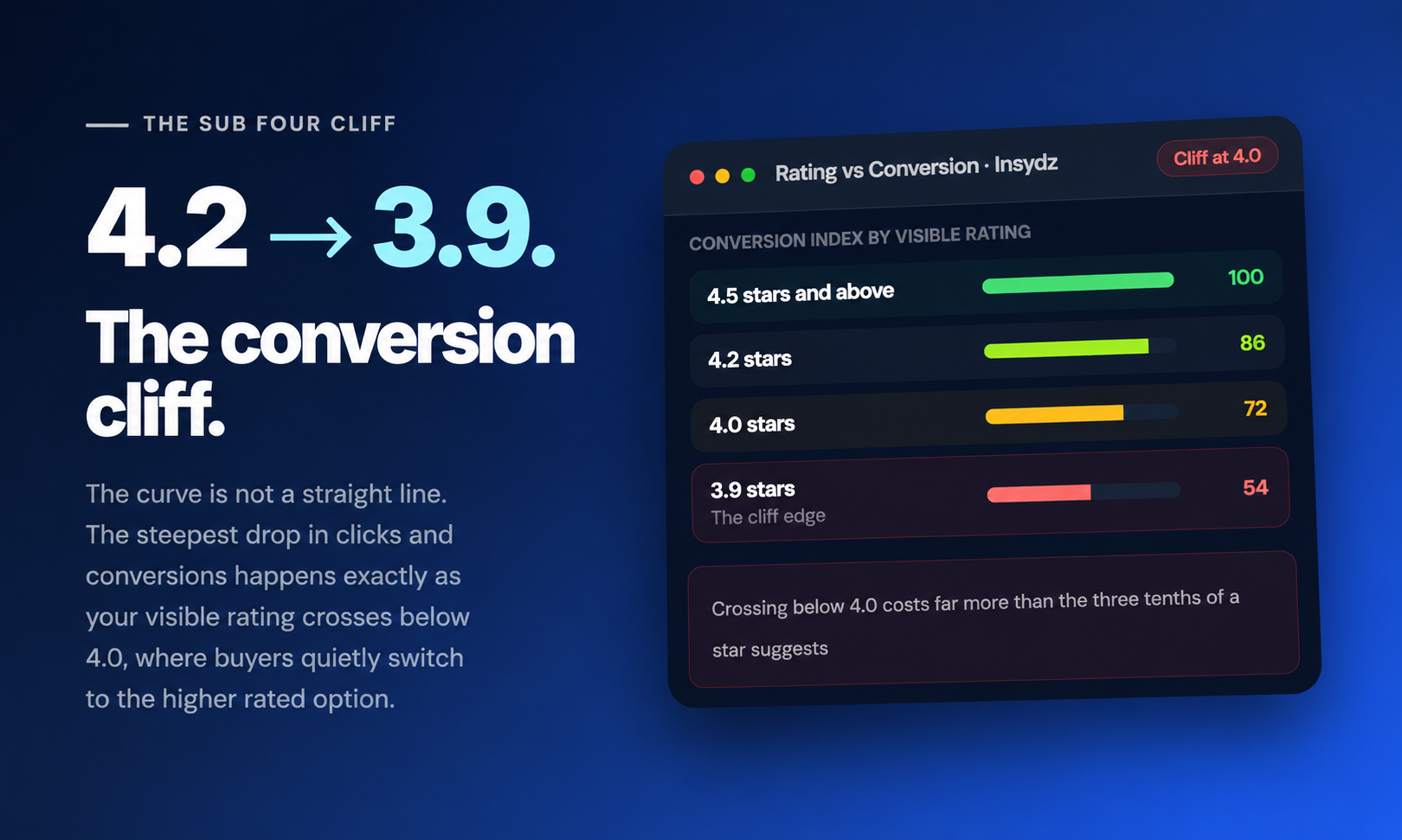
Conversion index by visible star rating on Amazon India. The decline is gentle from 4.5 to 4.2, then turns sharp as the rating crosses below 4.0, where hesitant buyers move to the higher rated competitor. The figures are illustrative of the pattern, not a single category measurement.
Two effects stack here. The first is click through from search: many buyers filter results mentally by the star badge and skip anything that reads under four. The second is conversion on the product page itself, where a sub four rating gives an already cautious buyer a reason to compare your listing against the next option. The buyer who would have bought at 4.2 hesitates at 3.9, and on Amazon hesitation almost always means they buy from someone else.
| VISIBLE RATING | HOW BUYERS READ IT | SEARCH CLICK IMPACT | CONVERSION IMPACT |
|---|---|---|---|
| 4.5 and above | Trusted, default choice | Baseline | Baseline |
| 4.2 to 4.4 | Still safe | Slight dip | Slight dip |
| 4.0 to 4.1 | Acceptable, with hesitation | Noticeable | Noticeable |
| 3.8 to 3.9 | Reads as risky | Sharp drop | Sharp drop |
| Below 3.8 | Avoided unless cheapest | Severe | Severe |
Why Is the Pattern in Your Reviews the Real Intelligence?
Here is the mistake almost every seller makes. They open their reviews, read the most recent few, react to whichever one is angriest, and close the page. They have now learned one buyer's bad day. They have not learned what is actually wrong with their product or listing.
One negative review is noise. A buyer received a unit with a genuine defect, or had unrealistic expectations, or simply had a bad week. You cannot run a business off a single data point. But ten negative reviews that all mention the same thing, the box arrived crushed, the size ran small, the cable frayed in a month, are no longer noise. They are a signal with a clear cause, and the cause is something you can fix.
This is the core shift this guide asks of you. Stop treating reviews as individual verdicts to react to and start treating them as a dataset to count. The moment you group them by theme, the loudest single review stops mattering and the most common complaint takes over. That common complaint is your repair brief.
How Do You Read Your Negative Reviews Analytically?
Analytical reading means sorting every review at 3 stars and below into a small set of themes, then counting. You are not trying to address each review. You are trying to find the one or two themes that explain most of your negatives. Almost every category's complaints fall into five buckets.
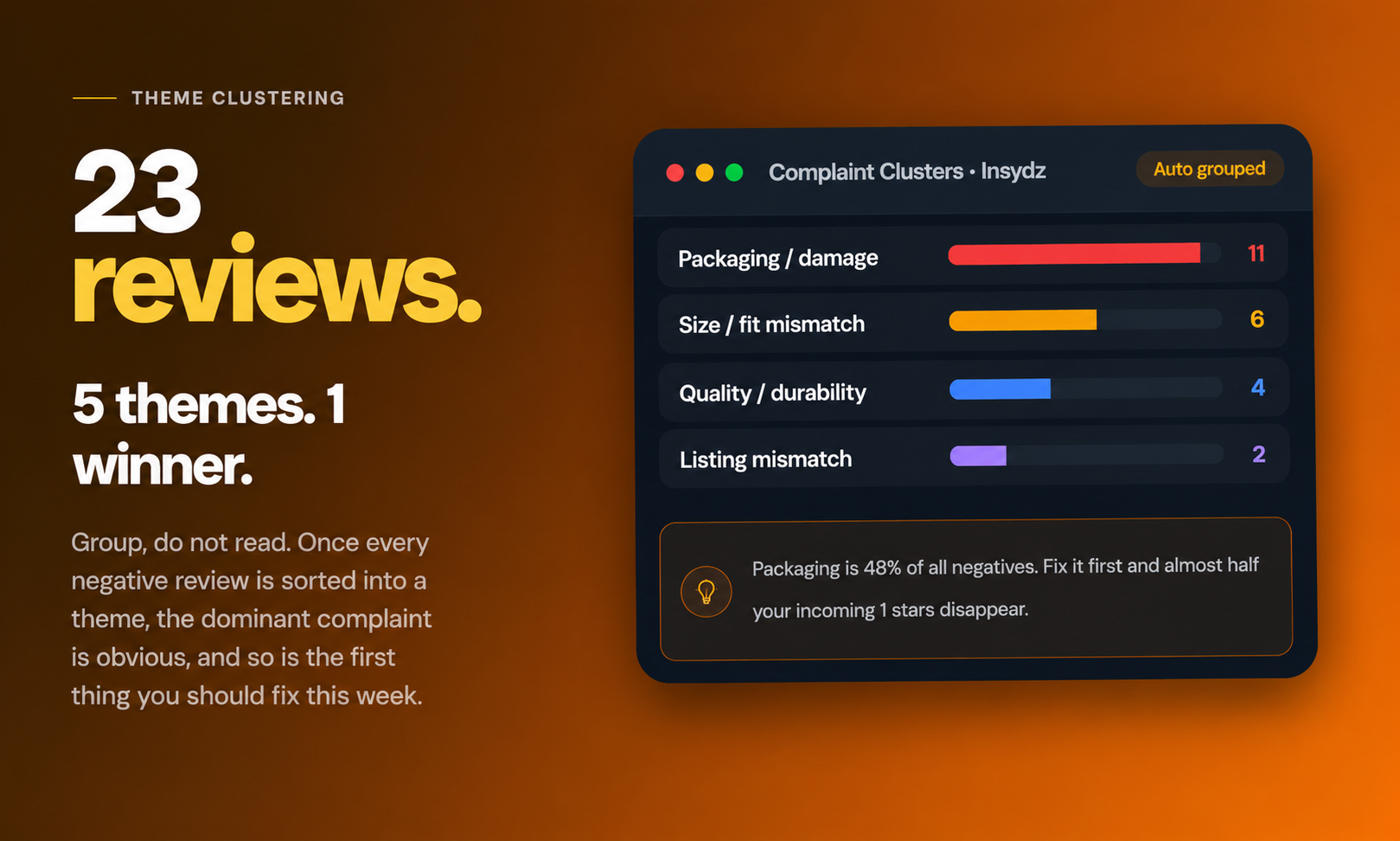
Complaint clustering. The same negative reviews sorted into five themes and counted. The packaging cluster is nearly half the total, which makes it the obvious first fix. No single review tells you this. Only the count does.
| WHAT THE REVIEW SAYS | WHAT IT USUALLY MEANS | WHERE TO FIX | FIX SPEED |
|---|---|---|---|
| Arrived damaged or broken | Packaging or transit handling | Fulfilment / packaging | Medium |
| Smaller or larger than expected | Size information set wrong expectation | Listing (size chart, images) | Fast |
| Stopped working after a few weeks | Genuine quality or durability fault | Product / supplier | Slow |
| Not as shown in the pictures | Misleading images or overclaimed copy | Listing | Fast |
| Delivered very late | Fulfilment method or stock location | Fulfilment (consider FBA) | Medium |
| Generic 1 star, no text, sudden cluster | Possible fake or competitor activity | Report to Amazon | Varies |
Insydz reads every review and surfaces the pattern automatically
Stop reading reviews one by one. See your complaint clusters, your sentiment trend, and your rating velocity in one view, in under 60 seconds.
What Should You Fix First: Listing, Product, or Fulfilment?
Once you know your dominant cluster, the next decision is sequencing. Not every fix takes the same time or money, so you fix in order of speed and impact. The rule is simple: fix the listing first because it is fastest, then chase product and fulfilment causes in parallel because they take longer.
Group your negatives by theme, not by date
Pull every review at 3 stars and below and sort them into the five buckets: packaging, sizing, quality, listing mismatch, and delivery. Count each. This single step replaces hours of emotional reading with a five line summary you can act on.
Identify the single largest cluster
The biggest count is your priority. If packaging is 11 of 23 negatives, packaging is the fix that removes the most future one star reviews. Resist the urge to fix the loudest review. Fix the most common complaint.
Classify the cluster as listing, product, or fulfilment
Listing problems mean you set the wrong expectation. Product problems mean the item underperforms in use. Fulfilment problems mean damage or delay in transit. The classification decides both what you change and how quickly you can change it.
Fix the listing issues first
Update the size chart, replace the misleading image, correct the specification, and rewrite any bullet that overpromises. These changes go live in minutes and stop new reviews of the same type almost immediately. Most sellers find a meaningful share of their negatives were listing problems all along.
Address product and fulfilment causes in parallel
Raise durability and quality faults with your supplier and switch fragile items to sturdier packaging or to FBA where handling is more consistent. These take weeks rather than minutes, so start them now while the listing fixes are already working.
Track rating velocity for the next 30 days
Watch the share of incoming reviews that are positive. As fixes land, fresh positive reviews start lifting your average, and because Amazon weights recent reviews heavily, the recovery shows up faster than the slow decline did. Insydz tracks this daily so you know the fix is working before your rating fully recovers.
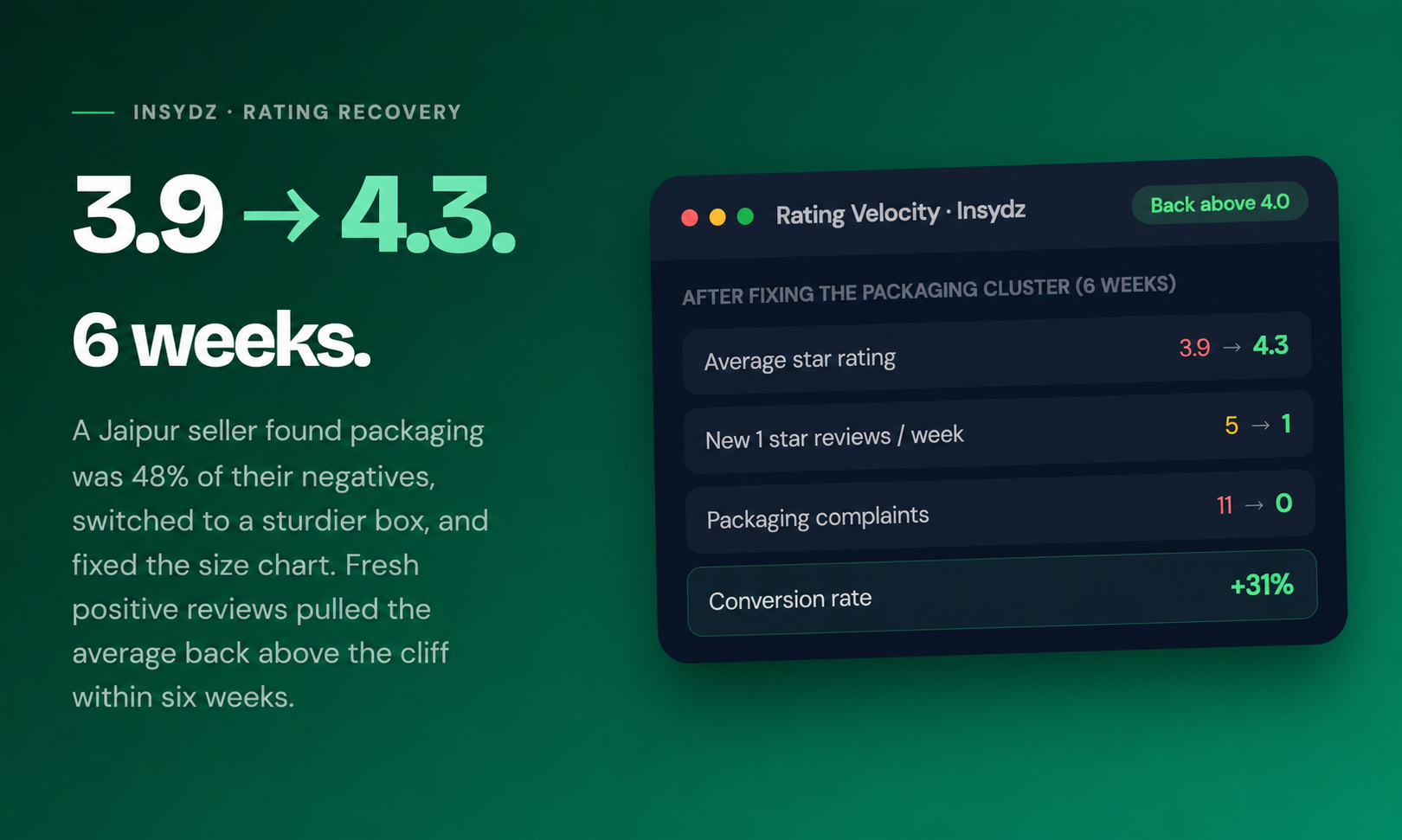
Insydz rating velocity view. After a Jaipur seller fixed the packaging cluster behind 48% of their negatives, new one star reviews fell, fresh positives lifted the average from 3.9 back to 4.3, and conversion recovered. The figures illustrate a typical recovery pattern.
How Do You Respond to Negative Reviews Properly on Amazon India?
First, an important correction to a common belief. You can no longer reply publicly to a product review. Amazon removed seller comments on reviews, so the old habit of posting a defensive reply underneath a one star review is no longer possible, and was rarely a good idea anyway. What you can still do, used well, often works better.
What You Can Actually Do
- Brand Registry Customer Reviews tool: If you are enrolled in Brand Registry, Seller Central lets you privately contact a buyer who left a critical review of your branded product. You can offer a courtesy refund or a support message. A buyer whose problem is genuinely solved will often update or remove the review on their own.
- Buyer Seller Messaging: For order related issues such as a damaged or late delivery, reach the buyer through the order to resolve the specific problem. This addresses the cause directly rather than arguing about the review.
- Report genuinely abusive or fake reviews: Reviews that break Amazon's policies, contain abusive language, or look like competitor planted content can be reported for removal. More on detecting these below.
The deeper point is that responding to reviews one at a time is damage control, not strategy. The seller who privately resolves ten packaging complaints has spent real effort and still has a packaging problem. The seller who fixes the packaging has removed the source. Responding well matters, but it is downstream of fixing the pattern.
Can Competitors Plant Fake Negative Reviews, and How Do You Detect Them?
It does happen, although Amazon's systems detect and remove a large share of it. If you have done the analytical work above and a portion of your negatives simply does not fit any real pattern, fake reviews are worth investigating. Here is how to spot them and what to do.