What Does Ranking on Page 1 of Amazon India Actually Mean?
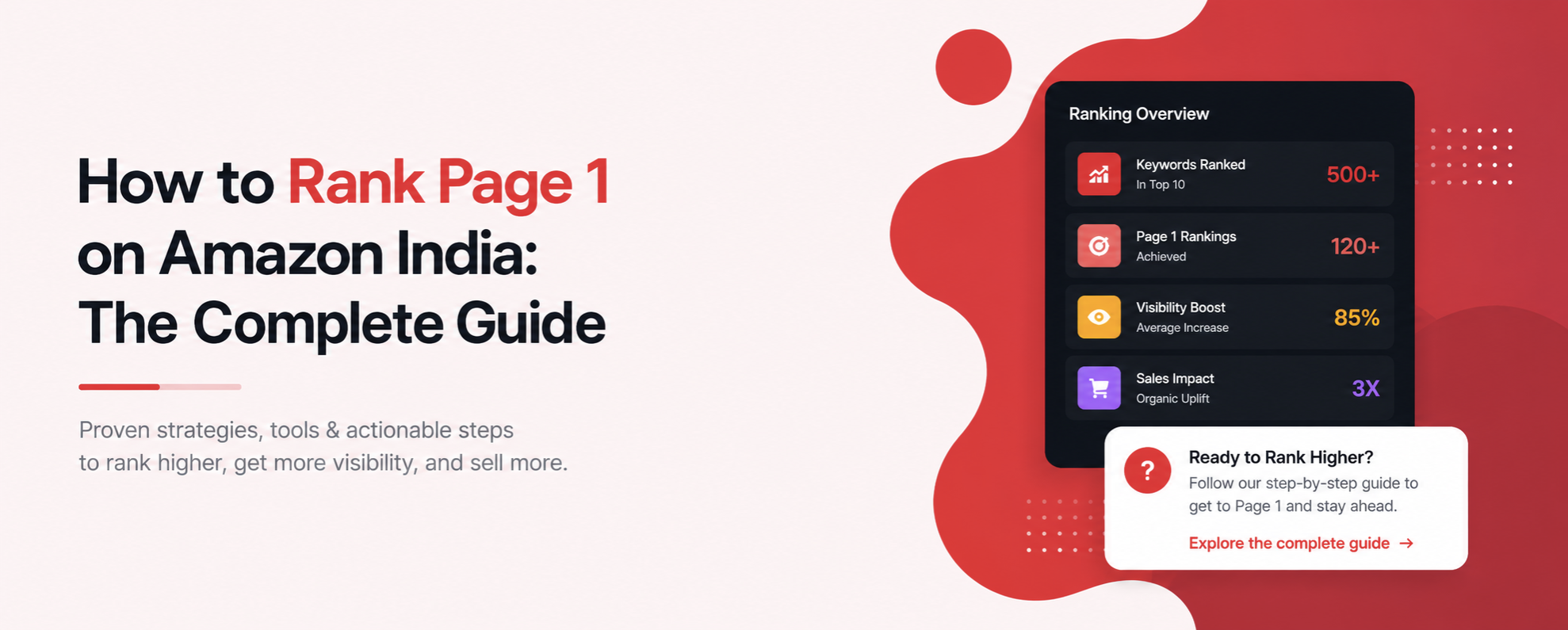
To rank on page 1 amazon india means getting your product to appear within the first 16–24 results when a buyer searches for your category on Amazon.in — the prime real estate where 70% of all clicks occur. Sellers who occupy this space capture the majority of organic demand without paying for every click. Sellers outside it are essentially invisible, regardless of product quality or price.
The scale of the opportunity is significant: the difference between ranking on page 1 vs. page 3 for the same keyword can mean a 10x gap in daily organic sales, with zero additional ad spend required once the ranking is established. This is compounding leverage — a well-optimised listing earns revenue around the clock, unlike a Sponsored Products campaign that stops the moment you pause it.
Why Ranking on Page 1 of Amazon India Matters More Than You Think
The Page 1 Revenue Cliff
Amazon.in buyer behaviour follows a steep drop-off after the first page. Research consistently shows that page 1 captures over 70% of all clicks for any given search query. Page 2 gets around 15%. Everything after page 2 shares the remaining crumbs. The implication for ad spend is equally stark: sellers who rank poorly organically compensate by running Sponsored Products campaigns continuously — paying ₹8–25 per click for visibility they could earn for free with better listing optimisation.
Indian Buyers Search at Scale and They Search Specifically
Amazon.in processes hundreds of millions of search queries every month across categories from electronics to kirana goods. Indian buyers have become increasingly specific in their searches: not just "water bottle" but "insulated water bottle for office 1 litre steel under 400". These long-tail queries have lower competition and higher purchase intent — and a page 1 ranking for even three or four of them can meaningfully move your monthly revenue.
Competition Is Intensifying Every Quarter
The number of active sellers on Amazon.in has grown 40% over the past three years. In most categories, the seller who ranked on page 1 two years ago with a basic listing is now being displaced by sellers who treat listing optimisation as a systematic, ongoing process rather than a one-time setup task. Complacency is the fastest route off page 1.
How Amazon India's A9 Algorithm Actually Works
The Amazon A9 algorithm has two jobs: find products relevant to what the buyer searched, then rank them by which ones are most likely to result in a purchase. Understanding this two-step logic is the key to ranking on page 1 of Amazon India — because the algorithm isn't just looking at your keywords, it's looking at your entire commercial track record.
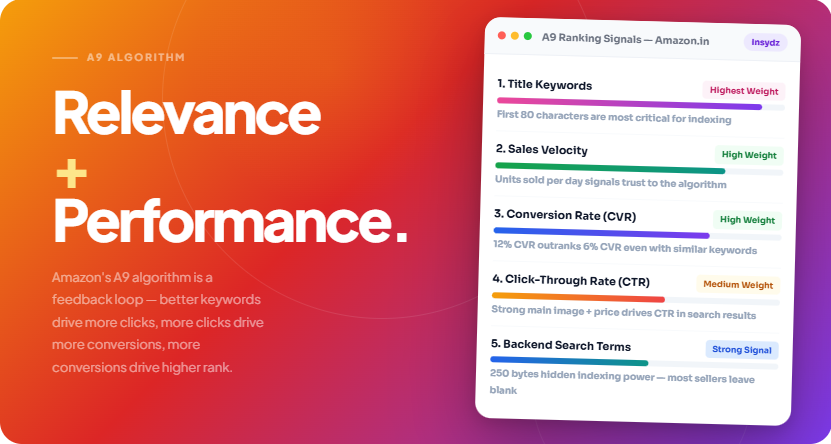
Amazon A9 algorithm ranking signals relative weights that determine your page 1 position on Amazon.in
Step 1 — Relevance: Can Amazon Find Your Product?
Keyword Indexing: Amazon scans your product title, bullet points, product description, and backend search terms to understand what your product is. If a keyword doesn't appear anywhere in your listing, Amazon will not rank you for it regardless of how relevant your product actually is. This is why keyword research must precede listing writing, not follow it.
Title Weight: Your product title carries the highest SEO weight in the A9 algorithm. The first 80 characters of your title are most critical — Amazon prioritises these for indexing and they're what buyers see in compressed mobile search results. Marketing language like "premium quality" or "best in class" wastes these characters without adding ranking value.
Backend Search Terms: Amazon gives you 250 bytes of hidden search terms in Seller Central. These are invisible to buyers but fully indexed by the algorithm. Most sellers either leave these blank or fill them with duplicate keywords already in their title — both are significant missed opportunities.
Step 2 — Performance: Will Your Product Convert?
Sales Velocity: Amazon tracks how many units you sell per day. Higher sales velocity signals a popular, trustworthy product and Amazon rewards it with better ranking.
Conversion Rate (CVR): Of all the buyers who view your listing, what percentage actually buy? A product with a 12% CVR will outrank a product with a 6% CVR for the same keyword even if they have identical titles and backend keywords. CVR is improved through better images, stronger bullet points, competitive pricing, and social proof from reviews.
The A9 algorithm is a feedback loop, not a one-time optimisation. Better keywords → more impressions → more clicks → more conversions → higher ranking → even more impressions. Breaking into this loop requires a well-optimised listing from day one, supported by targeted early-stage advertising to build CTR optimization and conversion signals over time.
The 6 Core Ranking Factors on Amazon.in Explained
Understanding the A9 algorithm in detail allows you to systematically improve each ranking factor. Here is how each factor works and what it means in practice for Indian sellers.
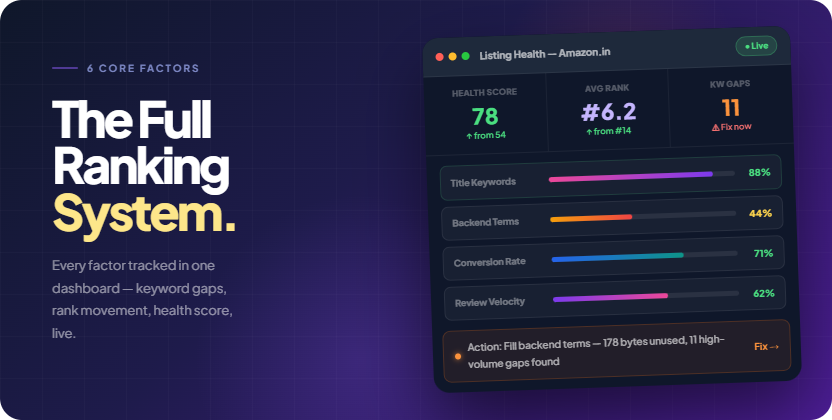
Insydz Listing Health Dashboard tracking all 6 A9 ranking factors with actionable improvement scores for Amazon.in sellers
| RANKING FACTOR | WHAT AMAZON MEASURES | HOW TO IMPROVE IT | IMPACT LEVEL |
|---|---|---|---|
| Product Title | Keyword relevance in first 80 characters | Lead with primary keyword; add 2–3 attributes | Critical |
| Sales Velocity | Units sold per day, trend direction | Early-stage ads + deals to build sales history | Critical |
| Conversion Rate | % of listing views that result in purchase | Better images, competitive price, strong reviews | Critical |
| Backend Keywords | Hidden search terms (250 bytes in Seller Central) | Fill with Hinglish variants, long-tail, synonyms | High |
| Click-Through Rate | % of impressions that result in listing visits | Stronger hero image; competitive pricing badge | High |
| Bullet Points | Secondary keyword presence + conversion copy | Lead with buyer benefit, include 1–2 keywords each | Medium |
5 Critical Mistakes That Keep Indian Sellers Off Page 1
These five mistakes are the most common reasons Indian sellers fail to break into page 1 and stay there. Each one is entirely preventable once you understand the mechanics behind it.
Writing Titles for Yourself, Not the Algorithm
A seller who titles their product "Premium Quality Handcrafted Copper Water Bottle Eco Friendly and Stylish" has written a marketing headline, not an SEO title. Amazon cannot rank you for "copper water bottle" if the exact phrase doesn't appear coherently in your title. The vocabulary buyers use to search and the vocabulary sellers use to describe are often entirely different — and the algorithm sides with buyers, not sellers.
Leaving Backend Search Terms Empty or Duplicated
In Seller Central, the "Search Terms" field gives you 250 bytes of hidden indexing power. A consistent pattern across Indian seller accounts shows 60–70% of sellers either leave this blank or fill it with duplicates already in their title. This is the equivalent of leaving a full-page ad slot blank. Filling it correctly with non-duplicate Hinglish variants, competitor brand names (where permitted), and long-tail phrases can unlock dozens of additional ranking positions with zero visible listing changes.
Launching Ads Before Fixing the Listing
Running Sponsored Products on an unoptimised listing is paying for traffic that won't convert. If your listing has poor images, thin bullet points, or no reviews — ads bring visitors who leave. Amazon's algorithm interprets this low conversion as a signal to reduce your organic ranking further. Fix the listing first, then amplify it with ads. This sequence is not negotiable.
Ignoring Long-Tail Keywords Where the Real Intent Lives
Most Indian sellers compete for 2–3 generic head keywords in their category ("water bottle", "yoga mat", "phone case") where competition is brutal and cost-per-click is high. The smarter play: rank for long-tail variations like "stainless steel water bottle 1 litre office use under ₹400" where buyer intent is specific, competition is low, and conversion rates are dramatically higher. Five page 1 long-tail rankings often deliver more revenue than one contested head keyword.
Treating SEO as a One-Time Task
Sellers who optimise a listing once and never revisit it lose rankings as competitors update their listings, new search trends emerge, and seasonal keywords shift. Category leaders review and update their listings quarterly at minimum and track keyword rankings weekly to catch drops before they compound into sustained revenue losses. Ranking is not a destination; it's a position you defend with data.
Find Your Keyword Gaps in Minutes
Insydz gives Indian sellers the exact keywords their top competitors rank for that they don't even have in their listing yet.
Best Practices: A Page 1 Ranking Execution Plan for Indian Sellers
The sellers who consistently hold page 1 positions on Amazon.in don't rely on guesswork — they follow a structured four-phase process. Here is the complete execution framework, from initial keyword research through ongoing tracking and iteration.
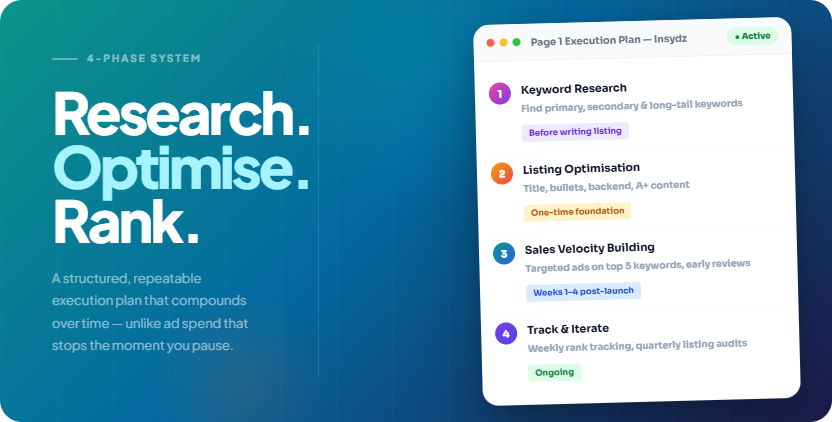
Insydz 4-phase page 1 execution plan a structured, data-driven workflow for sustained organic rank growth on Amazon.in
Phase 1: Keyword Research (Before Touching Your Listing)
Foundation cannot be skipped.
Step 1
Use a keyword research tool to find your primary keyword (highest volume, medium competition), 3–5 secondary keywords (related terms), and 10–15 long-tail keywords (specific, high-intent phrases).
Step 2
Run a competitor reverse ASIN lookup on your top 3 rivals to find keywords they rank for that you don't even have in your listing.
Step 3
Identify seasonal keywords relevant to your category (e.g., "Diwali gift ideas", "monsoon raincoat", "back to school stationery") and plan listing updates 4–6 weeks before the season.
Step 4
Map keywords to their intended placement: primary keyword in title, secondary keywords in bullets, long-tail and Hinglish variants in backend search terms.
Phase 2: Listing Optimisation (One-Time Foundation)
Title, bullets, backend, images, A+ content.
Title
Brand + Primary Keyword + 2–3 Key Attributes + Size or Variant. Keep under 200 characters. Put the most important keyword in the first 80 characters.
Bullet Points
Address the top 5 buyer questions or objections. Lead each bullet with a benefit, not a feature. Include 1–2 secondary keywords per bullet naturally.
Backend Search Terms
Fill all 250 bytes with non-duplicate, relevant keywords, common misspellings, and Hinglish variations. Do not repeat keywords already in your title.
Images
Minimum 6 images. Main image on white background, product fills 85% of frame. Secondary images: lifestyle, dimensions, feature callouts, use-case scenarios.
A+ Content
If brand-registered, use A+ Content. Include keywords naturally in the narrative text — this is indexed by Amazon and improves CTR with visual storytelling.
Phase 3: Sales Velocity Building
Weeks 1–4 post-optimisation.
Step 1
Run a targeted Sponsored Products campaign on your top 5 keywords for the first 2–4 weeks post-optimisation — not to profit, but to signal sales velocity to the A9 algorithm.
Step 2
Use Amazon's "Request a Review" button for every order — consistent review velocity helps ranking more than a burst of reviews followed by silence.
Step 3
Consider a launch-period deal or coupon (5–10% off) to boost CTR in search results during the initial ranking push.
Step 4
Monitor your conversion rate daily during this phase — if CVR drops below 8%, revisit bullet points and main image before scaling ad spend.
Phase 4: Tracking and Iteration (Ongoing)
Weekly tracking, quarterly audits.
Step 1
Track your keyword rankings weekly — not just overall BSR. BSR is category-level; keyword rank tells you exactly where you stand for each target term.
Step 2
Monitor CTR and CVR in Seller Central's Brand Analytics — if CTR is low, test a new main image; if CVR is low, revisit bullet points and pricing.
Step 3
Quarterly: full listing audit against your top competitor's listing — where are they stronger? What keywords are they using that you aren't?
Step 4
Set up rank drop alerts (WhatsApp or email) so you know within 24 hours if a key ranking position shifts — early intervention prevents weeks-long ranking recovery.
Key Metrics to Track Weekly
Best Tools for Amazon India Ranking in 2026
Global Tools: Strong Capabilities, Indian Market Gaps
Jungle Scout, Helium 10's Cerebro and Magnet, and DataHawk are well-regarded for keyword research and rank tracking on Amazon. For Indian sellers evaluating these tools, three material gaps affect their usefulness:
Jungle Scout
Excellent keyword research and rank tracking but database is US-centric. Amazon.in search volumes and Hinglish keyword patterns are significantly underrepresented. Plans start at approximately ₹3,800/month.
Helium 10
Comprehensive suite including Cerebro (reverse ASIN), Magnet (keyword discovery), and Keyword Tracker. Same India data limitations. Plans range from ₹3,300–8,300/month.
Platform gap
Neither tool covers Flipkart keyword intelligence — a significant limitation for Indian sellers running multi-platform businesses.
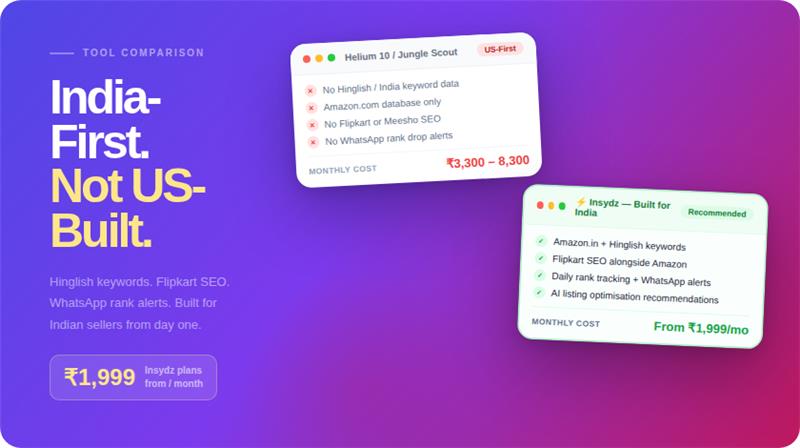
Insydz vs. global tools India-specific keyword intelligence, Flipkart SEO, and WhatsApp rank alerts built for Amazon.in sellers
Insydz: Page 1 Ranking Intelligence Built for Amazon.in
Insydz takes a connected approach to Amazon ranking rather than treating SEO as a standalone function — it ties keyword intelligence to competitor pricing, review sentiment, and market trends in one dashboard. For sellers focused specifically on ranking on page 1 of Amazon India, the tool provides:
📋 What Insydz Provides
Keyword research powered by Amazon.in-specific data, including Hinglish variants and India-specific buying intent patterns that global tools miss entirely.
Competitor reverse ASIN analysis — see exactly which keywords your rivals are ranking for, and which gaps you can target first to gain ground.
Daily keyword rank tracking with WhatsApp alerts when you drop positions, so you catch ranking losses within hours, not weeks.
Listing optimisation recommendations in plain language — not just a score, but actionable next steps like "Add this keyword to your title because it has 18,000 monthly searches and your top 3 competitors all use it."
Flipkart keyword intelligence alongside Amazon.in — one tool for both platforms.
Pricing from ₹1999/month with a forever-free plan for sellers starting out.