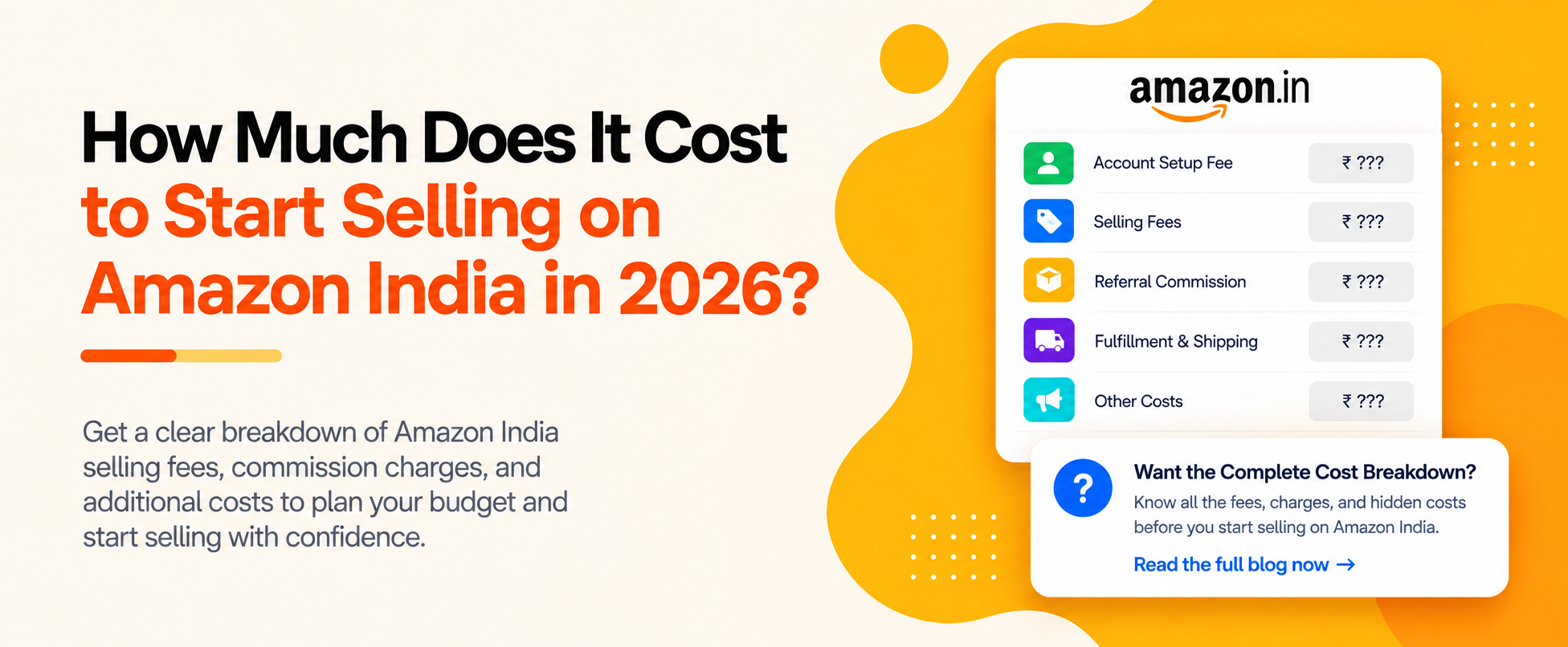
Search how much does it cost to sell on Amazon India and most answers stop at a list of fees. A new seller needs something more useful: a total for the first month, and a way to check whether a product still earns money after fees. This guide gives both, in rupees, with the September 2026 changes included.
How Much Money Do You Need to Start Selling on Amazon India?
The account costs nothing, so the money goes into stock, packaging, photos, and ads. Published seller guides put a small start at roughly ₹10,000 to ₹1 lakh, and a properly funded FBA launch at ₹50,000 to ₹1.5 lakh.
| COST ITEM | PLANNING RANGE | WHAT TO KNOW |
|---|---|---|
| Seller account registration | ₹0 | No joining fee |
| GST registration | ₹0 | No government fee. A consultant is optional |
| First inventory batch | ₹30,000 to ₹80,000 | Depends on unit cost and order size |
| Launch advertising | ₹10,000 to ₹20,000 | Needed to gather first keyword data |
| Small start, total | ₹10,000 to ₹1 lakh or more | Lean products, one SKU |
| FBA launch, total | ₹50,000 to ₹1.5 lakh | Includes photos, fees, and ads |
These are planning ranges from third party seller guides, not Amazon figures. Your category and product cost decide where you land. A safe method is to fix your first inventory order, then add an ad budget and a buffer for the first payout.
Amazon pays sellers 7 days after delivery on the standard level, so your cash returns quickly once orders flow.
What Does It Cost to Register as an Amazon India Seller?
Creating the account is free. You need a PAN, a GSTIN unless you sell only exempt goods, a bank account, an email ID, a mobile number, and a pickup address that matches your GST state.
GST registration is mandatory for most sellers of taxable goods, and the government portal charges nothing. Sellers who deal only in GST exempt goods, such as printed books, can register with PAN details instead.
What Fees Does Amazon Charge on Every Order?
Every sale carries up to five cost lines. The first three apply to almost all orders, and the last two depend on how you ship.
Referral fee
A percentage of the selling price, set by category. It starts at 0%. Mobile phones are 5%, laptops 6%, and fashion jewellery above ₹1,000 is 22.5%.
Closing fee
A fixed fee per item, based on price band and fulfilment channel. It starts at ₹2 and rose from September 7, 2026.
Weight handling fee (shipping)
Starts at ₹37 per item shipped and varies by weight, distance, and volume. Amazon uses the higher of actual and volumetric weight, with a 500 g minimum for standard items. Self Ship sellers pay their own courier instead.
FBA extras
Pick and pack is ₹17 per unit up to 1 kg, and storage is ₹50 per cubic foot per month. Removing stock costs ₹10 per unit for standard shipping and ₹30 for expedited.
GST on fees
Amazon adds 18% GST on every fee above. If you are GST registered, you can usually claim it back as input tax credit.
Is the Referral Fee Really Zero for Products Under ₹1,000?
For many categories, yes. Amazon highlights zero referral fees on over 12.5 crore products, and third party reports say the limit rose to ₹1,000 across more than 1,800 categories from March 16, 2026.
It does not apply everywhere. Amazon's own fee table shows flat rates for mobile phones, laptops, and televisions, and slab rates for books. Always check your exact fee category, not the aisle where the product appears.
What Changed in August and September 2026?
Two updates matter for anyone building a budget this month. Both raise the cost of small mistakes.
Closing fee increase from September 7
Closing fees rose by ₹1 on products priced up to ₹500 and by ₹3 above that. The change applies to the Fulfilment Centre, Easy Ship, and Seller Flex channels, and Amazon cited higher fuel and logistics costs.
Cancellation fee tied to order value from August 17
For Easy Ship and Self Ship orders, the fee is now a percentage of order value: 10% below ₹10,000, 8% from ₹10,001 to ₹50,000, 5% up to ₹1 lakh, and 2% above. GST of 18% is added.
The practical lesson is simple. Keep stock counts accurate and confirm shipments inside the 24 hour window, because a seller side cancellation now costs real money.
What Does a ₹999 Product Really Cost to Sell?
Take a pet food product priced at ₹999 and sold through FBA, weighing 500 g to 1 kg, shipped within the same region. The referral rate for this category above ₹300 is 6.5%.
Illustrative example. Fees total ₹195.81, or about 19.6% of the price, before product cost, packaging, ads, and returns.
| LINE ITEM | AMOUNT |
|---|---|
| Selling price | ₹999.00 |
| Referral fee at 6.5% | ₹64.94 |
| Closing fee, FBA, ₹501 to ₹1,000 | ₹30.00 |
| Weight handling, regional | ₹54.00 |
| Pick and pack | ₹17.00 |
| Subtotal before GST | ₹165.94 |
| GST at 18% | ₹29.87 |
| Total Amazon fees | ₹195.81 |
| Left before product cost | ₹803.19 |
If the same price belonged to a zero referral category, the referral line drops to ₹0 and the fees fall by about ₹76 including GST. The other lines stay. Confirm the closing fee and weight handling amounts for your product in Amazon's current fee table, because slabs differ by category and channel.
One more line appears in your payout. Amazon collects 1% TCS on net taxable sales, but that is a tax you claim back as credit, so it is not a fee.
Which Costs Do New Sellers Usually Miss?
The fee page shows Amazon's charges. It does not show what growth and mistakes cost you.
Advertising
Sponsored Products is pay per click and sits outside the fee schedule. For many sellers it becomes the largest cost after the product itself, and one calculator puts typical ACOS at 15% to 30% in competitive categories.
Returns and refunds
A refund fee exists, and ad spend is not returned when a sale is reversed. Amazon's STEP programme offers a refund fee waiver of up to ₹10 at the standard level, which shows the fee is real.
Packaging and inbound freight
Boxes, tape, labels, and transport to a fulfilment centre are yours to pay. Slim packaging also lowers volumetric weight, which cuts the shipping fee.
Long term storage and removals
Slow stock in a fulfilment centre attracts long term storage charges and removal fees. Order smaller batches until a product proves itself.
Cancellation fees
Missed ship confirmations and seller side cancellations now cost up to 10% of the order value on Easy Ship and Self Ship orders.
How Should You Plan Your Budget Based on Your Stage?
The cost of starting depends less on Amazon and more on how much stock and advertising you commit to first.
Just exploring
First product live
FBA launch
Selling on Amazon and Flipkart
How Can You Keep Amazon Selling Costs Low?
Use the zero referral band
Price inside the zero referral band where your margin allows, and confirm your fee category first.
Trim your packaging
Trim packaging to reduce volumetric weight and drop into a lower shipping slab.
Confirm shipments fast
Confirm every shipment within 24 hours to avoid cancellation fees.
Claim your credits
Claim input tax credit on Amazon's fees and reconcile TCS every month.
Test one product first
Test one product before scaling. Compare landed cost, fees, and ad cost before you commit to stock.
Not sure which tool to use for that comparison? See the Amazon seller tools guide.
Frequently Asked Questions
Summary: What It Costs to Start on Amazon India in 2026
Amazon India costs nothing to join, so your real starting cost is inventory, packaging, and ads. A small start can sit near ₹10,000 to ₹1 lakh, and an FBA launch near ₹50,000 to ₹1.5 lakh. On every sale, plan for a referral fee, closing fee, shipping or FBA charges, and 18% GST.
The 2026 changes reward careful sellers. Zero referral fees help products up to ₹1,000, while the higher closing fee and order value cancellation fee punish sloppy operations. Insydz gives you INR pricing, GST aware margins, and a free plan to test your numbers on your own ASINs before you spend on stock.
- What Are the Best Amazon Seller Tools for Indian Sellers in 2026?
- Insydz vs Helium 10: Which Tool Fits Indian Sellers Better?
- Amazon India Repricing Strategy 2026: Set Rules, Floors, and Hold Buy Box
- How to Find Every Keyword Your Amazon India Competitor Is Ranking For
- Best Flipkart Analytics Tool for Indian Sellers (2026)
Sources: Amazon.in Fees and Pricing page (checked September 29, 2026), Business Standard on the September 2026 fee changes, and 2026 seller guides from GoNukkad, RegisterKaro, IIDT Escala, and Blooprint for budget ranges and the worked example. Fees change often, so confirm current rates in Seller Central before pricing.