What Is an Amazon India Price War and Why Do They Start?
A price war is not a single undercut — every competitive category has those. A price war is a sustained cycle where one seller's price drop triggers a matching drop from competitors, which triggers another cut, and so on, until the category's average selling price has fallen far enough that margins become unsustainable for at least some of the participants.
On Amazon India, price wars typically start in one of three ways. First, a new seller enters a category with artificially low launch pricing and does not raise it. Second, a seller with a cost advantage (lower COGS, direct factory sourcing) deliberately prices below the category average to drive out competitors. Third, a seller with an automated repricing rule set without a price floor accidentally triggers a spiral that pulls every competitor with a similar rule into a race toward zero.
Automated repricing rules without price floors are the single most common cause of category-wide margin collapse on Amazon India in 2026. If you have repricing rules active, setting a calculated floor is non-negotiable. The guide on how to set a price floor and build repricing rules covers this in detail.
Why Matching Every Price Drop Is the Wrong Response
The instinct to match is understandable. Losing Buy Box share is visible and immediate. The margin cost of matching is abstract and shows up later. But the math of matching is brutal once you run it.
Consider a product priced at ₹799 with a 15% net margin — roughly ₹120 per unit. A competitor drops their price to ₹699, a ₹100 reduction. If you match, your margin drops from ₹120 to ₹20 — a 83% margin collapse from what looks like a 12.5% price reduction. If the competitor drops again to ₹649, you are below break-even.
| YOUR PRICE | COMPETITOR PRICE | MARGIN PER UNIT | MARGIN CHANGE |
|---|---|---|---|
| ₹799 (start) | ₹849 | ₹120 (15%) | Baseline |
| ₹699 (matched) | ₹699 | ₹20 (2.5%) | -83% |
| ₹649 (matched again) | ₹649 | -₹30 (loss) | Below floor |
Beyond the margin math, matching every cut teaches your competitor that cutting works. Each drop that triggers a response is confirmation that the strategy is effective. You are, in effect, funding the playbook being used against you.
Matching makes sense when: your product is genuinely commoditised with no meaningful differentiation, your competitor has equivalent reviews and listing quality, and the matched price is still above your calculated floor. Outside of those three conditions, matching is usually the wrong move. If you have not set a floor, do that first — the full formula is in the repricing strategy guide.
Strategy 1 — Differentiate Your Listing So Price Is Not the Only Signal
The reason price wars work is that buyers compare on price when they cannot compare on anything else. If your listing title, images, A-plus content, and review profile give buyers meaningful signals beyond price, a ₹50 to ₹100 premium becomes defensible.
This is not about cosmetic changes. It is about identifying the specific reasons buyers are choosing your product over competitors — or choosing competitors over you — and making those reasons visible in your listing.
Read your competitor's 1-star and 2-star reviews
Every complaint a buyer leaves on a competitor's listing is a reason to choose you — if your listing addresses it directly. A competitor's reviews full of complaints about poor packaging or fast wear become your opportunity to lead with durability and protective packaging in your own listing copy.
Put your review advantage in your listing, not just your rating
If you have 200 reviews at 4.4 stars and your competitor has 40 at 3.8, buyers can see that — but your listing should also make the quality gap tangible. A-plus content that shows specific use cases, addresses common objections, and demonstrates product quality converts at a higher rate than a listing that competes on specifications alone.
Check whether your images are doing competitive work
Category-leading images show the product being used, not just the product on a white background. A buyer comparing two identical-spec tiffin boxes at different prices will choose the one whose images show the product being opened, packed, and carried — because it reduces purchase uncertainty in a way that a spec list cannot.
Strategy 2 — Bundle and Reframe to Exit the Direct Comparison
A bundle is not just a way to add volume — it is a way to create a product that sits outside the direct price comparison. A standalone steel tiffin box at ₹799 competes directly against every other standalone steel tiffin box. A tiffin box bundled with a carry bag and a meal prep guide at ₹999 competes against nothing at that specific combination, because no competitor has that exact bundle.
Bundling works because it changes the buyer's comparison frame. Instead of "which tiffin box is cheapest," the buyer asks "which combination gives me the most for my money" — and that question favours the seller who defined the combination, not the one competing on the cheapest unit.
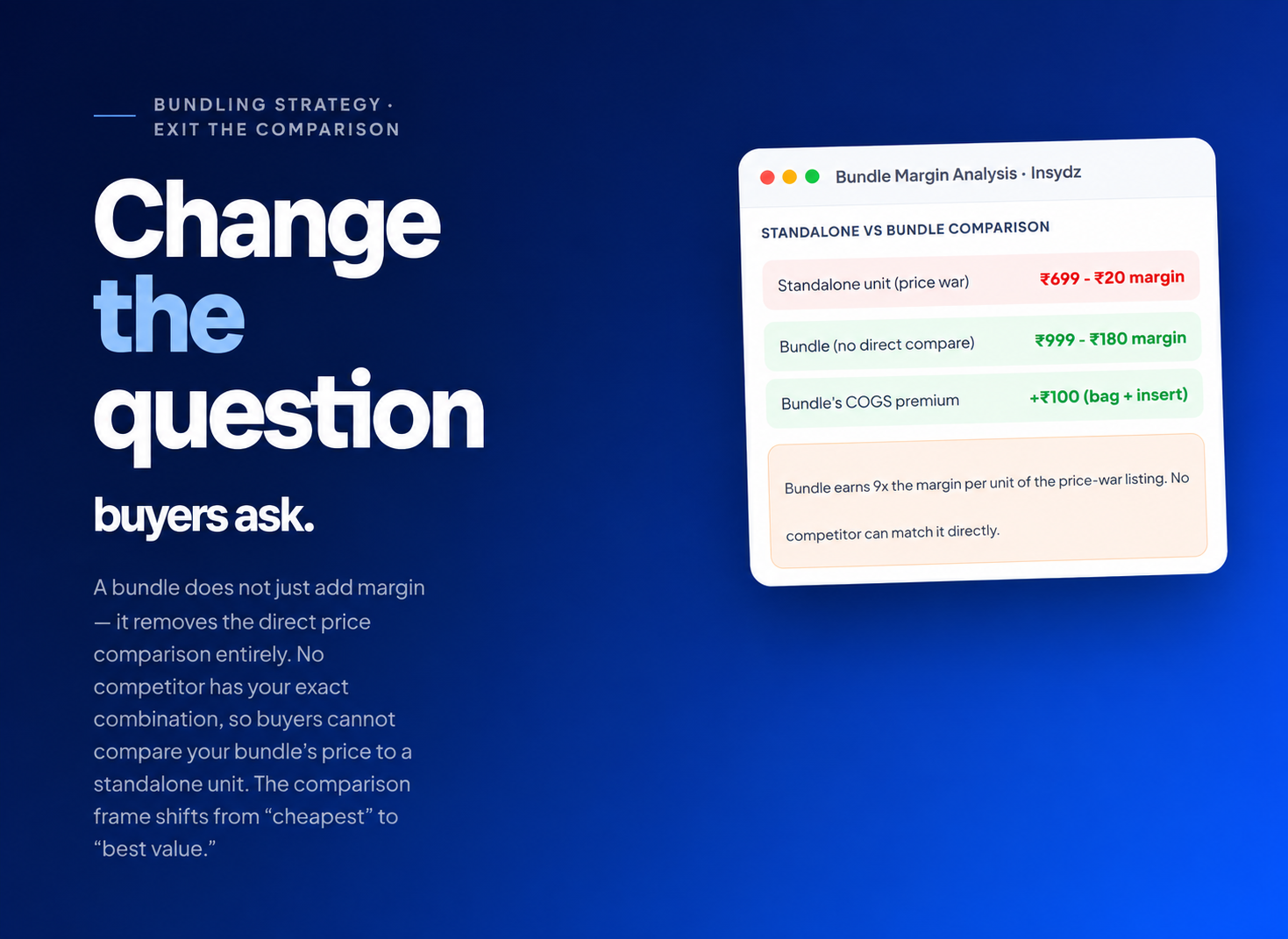
Insydz bundle margin analysis for a tiffin box seller. The standalone unit, priced at ₹699 to stay competitive in a price war, generates ₹20 margin per unit. The bundle — same base product plus a carry bag and meal prep insert — sells at ₹999 with ₹180 margin per unit and has no direct price competitor to undercut it.
The practical steps for building a bundle that exits the price comparison:
- Choose a complementary add-on with low COGS and high perceived value. A printed care guide, a storage bag, a second accessory item. The add-on should cost less than ₹80–100 to source but make the bundle worth ₹150–200 more than the standalone.
- Create a separate listing for the bundle. Do not adjust the standalone listing's price — run both. The standalone competes where it must; the bundle captures buyers shopping on value.
- Price the bundle so the per-unit math works even if no one buys the standalone. Bundle pricing should not depend on the standalone selling — it should stand alone as a viable margin position.
Strategy 3 — Own the Mid-Range Instead of Chasing the Floor
Most Amazon India price wars are fought at two ends: the floor (where sellers with unsustainable costs are racing) and the premium (where differentiated sellers with strong reviews sit). The mid-range — the band between the category floor and the established premium — is frequently under-served and represents a viable competitive position for sellers who cannot yet command a premium but are unwilling to fund a race to the floor.
Owning the mid-range means holding a price that is visibly above the floor, offering clearly better listing quality and reviews than the floor sellers, but positioned below the established category premium so buyers who have price sensitivity but want something better than the cheapest option land on you.
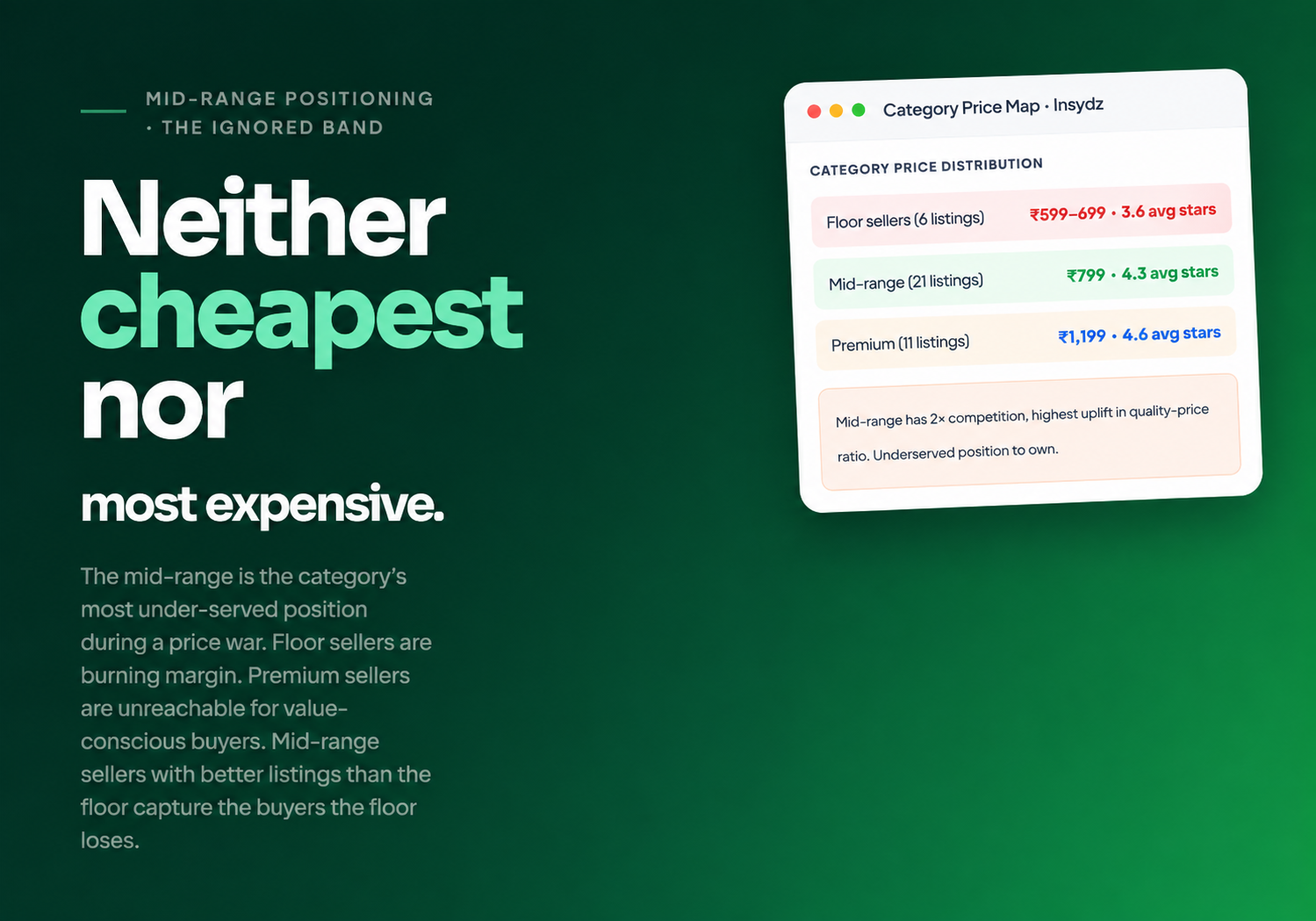
Insydz category price map for a tiffin box category mid-price war. Six sellers are fighting at ₹599–699 with an average 3.6-star rating. One premium seller sits at ₹1,199 and is unreachable for value-conscious buyers. The mid-range at ₹799 with 4.3 stars has only two competitors and the best quality-to-price ratio in the category — the most defensible position to hold.
How to Know When to Hold vs Match During a Price War
The decision to hold your price or match a competitor's drop should be based on data, not instinct. Four questions determine the right call.
- Is the competitor's listing quality lower than yours? If they have significantly fewer reviews, lower rating, weaker images, or missing A-plus content, buyers can see that alongside the price difference. A ₹50–100 premium is often survivable when your listing quality gap is visible.
- Is this drop sustained or a temporary test? A competitor who drops ₹100 and holds it for a week is signalling cost structure. One who drops and recovers within 48 hours is testing Buy Box response. Tracking competitor prices in real time is the only way to distinguish these without waiting to see which it is.
- Is their new price above or below your calculated floor? If they are pricing below what you can profitably match, matching is not an option regardless of what happens to your Buy Box share. The guide on how to set a price floor covers how to calculate this precisely.
- Are you still holding enough Buy Box share to matter? If you are retaining 55–65% Buy Box share at your current price, the premium is working. If Buy Box drops below 30%, a partial adjustment — not a full match — is worth testing.
Know whether a competitor's price drop is a real threat or a temporary test — before you respond
Insydz tracks competitor prices in real time and sends WhatsApp alerts the moment something changes. Free to start.
What Real-Time Competitor Intelligence Changes About Your Response
The practical problem with price war strategy is speed. A competitor drops their price at 7 AM. If you find out at 9 PM when you check your dashboard, you have already lost 14 hours of Buy Box during what is typically the highest-traffic part of a weekday. You have also lost the ability to distinguish a sustained drop from a test, because the data you have is a snapshot, not a trend.
Real-time competitor intelligence changes three things in a price war:
- Response time. A WhatsApp alert within minutes of a competitor repricing means you make the hold-vs-match decision in the same hour, not the next day.
- Pattern recognition. Seeing a competitor's price history across 72 hours tells you whether they are testing or committing. A single data point does not.
- Confidence in holding. Knowing that your competitor's review score is 3.8 stars while yours is 4.4 — and that they have cut to ₹699 — is the information that makes holding at ₹799 a deliberate strategy rather than a guess.
The habits of top Amazon India sellers consistently show the same pattern: the sellers who come out of price wars with the most market share are not the most aggressive pricers — they are the most informed ones. They know what competitors are doing and why before they respond, and that knowledge is what separates a price war strategy from a price war reaction.
Frequently Asked Questions: Amazon India Price War Strategy
- Competitor Undercutting Your Amazon India Price? How to Find Out and What to Do in 1 Hour
- How Negative Reviews Are Silently Killing Your Amazon India Sales — and How to Stop It
- How to Launch a Private Label on Amazon India in 2026: The Complete Seller's Playbook
- Amazon India Repricing Strategy 2026: How to Set Rules, Floors, and Hold Buy Box
- We Studied 100 Amazon India Seller Accounts: What the Top 10% Do Differently